// new script 07 sept "
Category: Blogs
From Understanding Agentic Loyalty to Deploying It: A Sequencing Guide for BFSI Leaders

Agentic Loyalty for BFSI: From Theory to Deployment
From Understanding Agentic Loyalty to Deploying It: A Sequencing Guide for BFSI Leaders

Praveen Vadla

Senior Digital Marketing Manager | Jul 17, 2026

From Understanding Agentic Loyalty to Deploying It: A Sequencing Guide for BFSI Leaders

Capgemini says 75% of banks plan to adopt AI agents in customer service within two to three years. Far fewer have deployed. That gap between intent and execution is where the next round of competitive advantage in banking loyalty will be won or lost.

IN BRIEF

  • Capgemini’s Banking Top Trends 2026 names AI-driven loyalty, agentic AI, and gamification as the three plays banks are using to win customer engagement. The direction is now an analyst consensus, not a vendor claim.
  • The market signal is strong but the deployment is not: 75% of banks plan to adopt AI agents in customer service, yet most loyalty programmes still run on human-designed, human-triggered campaign cycles.
  • Moving to agentic loyalty is a sequencing problem, not a switch. Teams that try to jump straight to autonomous decision-making without the data and guardrail foundations underneath it tend to stall in pilot.
  • A verified APAC banking deployment shows what behaviour-triggered loyalty delivers at scale before full autonomy even enters the picture: 32x ROI and 709,000 users activated with Jenius (SMBC Indonesia).

If you have read our guide to what agentic AI means in loyalty programmes, you already understand the architecture: the four-layer Agentic Loyalty Stack, the six autonomous revenue agents that sit at the top of it, and why a monthly campaign cadence can no longer keep pace with individual customer behaviour.

So this is not another explainer. The question that matters for a senior BFSI team is no longer what agentic loyalty is. It is how to get from where the programme runs today to where the analysts say it needs to be, in an order that survives a risk committee, a CFO, and a two-year IT roadmap. This piece is about sequencing.

The direction is no longer in dispute

For most of the last decade, the case for AI-led loyalty in banking was a vendor argument. That has changed. In its Banking Top Trends 2026 report, the Capgemini Research Institute for Financial Services names three plays banks are using to connect with customers, and all three sit inside the loyalty and engagement layer: implementing agentic AI in customer contact centres, using gamified mobile-first platforms, and leveraging AI-powered loyalty programmes to personalise offers and services.

Capgemini frames AI-driven personalisation as a growth driver in its own right, arguing that financial institutions should shift to differentiated loyalty programmes that personalise rewards rather than offering generic incentives on data they already hold. The supporting evidence is worth putting in front of a board.

Capgemini Banking Top Trends 2026 – the case for AI-driven loyalty

Signal What it tells a BFSI leader
38% Of customers who switched financial institutions in 2024 did so because they were not satisfied with service quality. The churn driver is experience, not price.
73% Of card customers are motivated by personalised offers and rewards, which makes generic incentives a measurable revenue leak.
75% Of banks plan to adopt AI agents in customer service functions within the next two to three years.

Source: Capgemini Research Institute for Financial Services, Banking Top Trends 2026. Figures drawn from the published report; confirm against the source before citing externally.

Read the third number again, because it is the one that should shape your planning. Three-quarters of banks plan to adopt AI agents. Planning is not deploying. The market has reached consensus on the direction and has not yet moved on the execution. That is precisely the position in which first-mover advantage is still available.

The consensus has formed around the destination. It has not formed around who arrives first.

Why most agentic loyalty efforts stall in pilot

The failure pattern is rarely a failure of ambition. It is a failure of order. Teams read that agentic AI can detect a spend decline on Tuesday and intervene on Wednesday, and they try to buy the Wednesday intervention without first building the thing that detects Tuesday. Autonomous decisioning sits at Layers 3 and 4 of the stack. It cannot run on a foundation that does not yet exist at Layers 1 and 2.

There are three foundations that have to be in place before an autonomous agent can act safely inside a regulated bank:

Signal density before autonomy

A retail loyalty programme might see a customer a few times a week. A bank sees them dozens of times a day across channels. That signal density is what makes an agentic intervention precise rather than generic, but only if the signals are unified. Fragmented data is the single most common reason an agent has nothing useful to act on.

Guardrails before action

An autonomous agent in BFSI does not get to override compliance. It optimises within defined limits, on incentive disclosure, communication frequency, and data usage. Those limits have to be designed and agreed before the agent is allowed to execute, not retrofitted after a pilot raises a flag.

A defined behavioural target before a reward

An agent with a vague objective produces vague outcomes. The objective has to be specific and measurable, reduce 90-day primary-account dormancy, lift credit-card reactivation, before the system has anything to optimise toward. A deployment without a measurable behavioural target is not an agentic deployment. It is automation with better marketing.

A sequencing model that survives a risk review

The progression below is deliberately ordered so that each phase produces a defensible result before the next one starts. The point is not speed for its own sake. It is to reach autonomous decisioning with the data, the guardrails, and the internal trust already in place.

PHASE 01 · FOUNDATION

Unify the behavioural signal

Bring the high-frequency signals a bank already generates into one behavioural layer. The deliverable is not a campaign. It is a single, real-time view of customer behaviour that later phases can act on. Most BFSI organisations sit here today.

PHASE 02 · PREDICTION

Add predictive intelligence and prove it quietly

Layer predictive models onto the unified signal, spend-decline detection, lapse probability, redemption likelihood, and validate their accuracy against real outcomes before anything acts on them. This phase builds the internal evidence the risk committee will ask for in Phase 3.

PHASE 03 · GUARDED AUTONOMY

Let one agent act inside tight guardrails

Move a single, well-bounded use case, often offer optimisation, from prediction to autonomous execution, within strict compliance limits and on a defined behavioural target. One agent, fully measured, builds the trust that funds the rest.

PHASE 04 · SCALE

Extend to the full agent set

With the foundation, the evidence, and the guardrails proven, extend autonomy across the remaining revenue agents. This is the Layer 3 to Layer 4 progression Capgemini’s two-to-three-year window is describing, reached on a footing that holds up under scrutiny.

PROOF POINT · APAC BANKING

What behaviour-triggered loyalty delivers before full autonomy

It is worth being precise about what is already proven versus what is still forward-looking. The deployment with Jenius (SMBC Indonesia) was behaviour-triggered, rules-based loyalty, behaviourally designed and measurable, not fully agentic AI. It is a marker of what the foundation phases can deliver at scale, and a sense of the headroom the agentic layers add on top.

32x
Return on investment
709K
Users activated

What this means for your next planning cycle

The honest read of the Capgemini data is that the industry has agreed on where loyalty is going and has not yet moved. For a BFSI team, that produces a narrow and valuable window. The work that creates advantage in the next twelve months is not buying an autonomous agent. It is building the foundation that an autonomous agent needs, in an order that earns internal trust at each step, so that when the rest of the market begins deploying in two to three years, your programme is already there.

That is the difference between a platform that drives revenue and one that merely reports on it. The destination is settled. Sequencing is the advantage.

FAQs:

What is the difference between agentic AI and the AI our loyalty platform already uses?

Most loyalty AI today is predictive or assistive: it tells a team that a customer is likely to churn, then waits for a human to decide and act. Agentic AI acts on the prediction autonomously, selecting an intervention from a defined toolkit, executing it through the right channel at the right time, and recording the outcome to improve future decisions, all within compliance guardrails. The defining difference is autonomous execution against a measurable objective.

Yes, when it is designed to. A well-built agent does not override compliance rules on incentive disclosure, communication frequency, or data usage. It optimises within those defined limits. The guardrails have to be agreed before the agent is allowed to execute, which is why guarded autonomy sits at Phase 3 of a sound sequencing model rather than at the start.

Because autonomous agents sit at the top of the stack and depend on foundations beneath them: unified behavioural signal, validated predictive models, and agreed guardrails. Skipping to execution without those in place is the most common reason agentic loyalty efforts stall in pilot. Sequencing exists to reach autonomy on a footing that survives a risk review.

Capgemini’s Banking Top Trends 2026 reports that 75% of banks plan to adopt AI agents in customer service functions within two to three years. That timeline is the planning window. Teams that build the foundation now are positioned to be live when the broader market is still beginning.

Praveen Vadla

Praveen Vadla is Senior Digital Marketing Manager at Perx Technologies. With over 10 years of experience in B2B SaaS marketing across the US and Southeast Asia, he focuses on customer loyalty, engagement, and retention strategy. He writes on how brands build lasting customer relationships in a mobile-first economy. Connect with Praveen on LinkedIn.

Recommended for you

Open Finance

Open Finance in Malaysia: What Banks Need to Get Right | Perx

Open Finance

Samit Deb

Director of Enterprise Sales | Jul 13, 2026

Open Finance Is Coming to Malaysia. Is the Customer Experience Ready?

In Brief

Bank Negara Malaysia is rolling out a national Open Finance framework. Industry feedback on the exposure draft closed in March 2026, and the central bank’s most recent public remarks now frame implementation as phased, starting from 2027, as part of a new Financial Sector Blueprint running through 2030. It is part of a wider Southeast Asian pattern already visible in Singapore’s SGFinDex and Indonesia’s SNAP standard. For banks, this means customer financial data will soon move between institutions with consent, not just within them. The regulatory and technical questions are being actively worked through. The customer experience question, whether people will actually understand and trust what they are opting into, is being worked through far less. Banks that treat open finance as a trust-building moment, not just a compliance deadline, are the ones likely to keep the customer relationship once data becomes portable.

Open Finance Is Not a Malaysia Story. It Is a Regional One.

Southeast Asia has been building toward this for several years, market by market. Singapore’s Financial Data Exchange (SGFinDex), a joint initiative between the Monetary Authority of Singapore and GovTech, lets individuals pull financial data from participating banks, insurers, and government agencies into one consolidated view using Singpass authentication. Indonesia has taken a phased route through Bank Indonesia’s SNAP standard, moving from payment API standardisation toward a broader open finance roadmap that is expected to extend into lending, insurance, and investment data.

Malaysia is now formalising its own version. Bank Negara Malaysia released an exposure draft on Open Finance in November 2025, describing a consent-based framework for sharing customer information between data providers and data consumers in a secure, interoperable, and timely manner. Industry feedback on the draft closed on 1 March 2026. Technical development is being led by PayNet with seven banks and the Employees Provident Fund, and an early pilot had originally been targeted for mid-2026. More recently, BNM’s own leadership has framed the rollout differently: at a July 2026 industry address, the central bank governor described Open Finance as a foundation of a new Financial Sector Blueprint covering 2027 to 2030, with implementation now positioned as phased and starting from 2027. The finalised framework had not yet been published at the time of writing, so the exact phasing and start date should be treated as directional and worth reconfirming closer to publication.

The pattern across all three markets is the same: data moves with consent, in standard formats, through infrastructure built by regulators and industry together rather than bank by bank. In Malaysia’s case, the exposure draft also proposed that larger banks would onboard first, before the requirement extends to a wider set of financial service providers, a sequencing likely to carry through regardless of the exact start date. That is the shift banks need to plan for now, regardless of exactly when their market’s rollout date lands.

What Open Finance Actually Changes

Open banking, the first wave of this shift globally, was mostly about payment initiation and account information, driven by regulation like the UK’s Open Banking standard, which the Competition and Markets Authority mandated in 2017 for the country’s nine largest banks and building societies, known as the CMA9, and the EU’s PSD2. Open finance goes further. It extends the same consent-based sharing model to savings, credit, insurance, and investment data, giving a fuller picture of a customer’s financial life, not just their transactions.

For banks, that is a meaningful change in what “knowing your customer” means. A financial institution requesting a customer’s data could, for example, pull months of history from another institution to speed up a loan application, or let a customer view several credit card statements in one place instead of switching between banking apps. The upside is real: faster approvals, better-informed lending, and products built on a fuller financial picture. The complication is that the same visibility works both ways. If a bank can see more of a customer’s financial life elsewhere, other institutions can see more of that customer’s life at this bank too.

What Banks Are Actually Worried About

Conversations with banks across the region tend to circle back to a consistent set of concerns, and they are reasonable ones:

  • Data control and residency. Where is the data stored, can it leave the country, and who is accountable if something goes wrong downstream, after the data has already been shared.
  • Regulatory exposure. Consent frameworks, audit requirements, and jurisdictional data rules differ by market, and getting ahead of them takes real compliance investment.
  • Commoditisation risk. If a customer’s financial data becomes portable, the customer becomes more portable too. A bank that has spent years building a relationship on convenience or inertia may find that no longer holds once switching is a few consent taps away.
  • Integration complexity. Most banks are working with core systems that were never designed to expose structured, real-time data externally, which makes compliance a genuine engineering project, not a policy memo.

These are not hypothetical concerns. Legal analysts covering the exposure draft point out that today’s data-sharing practices, largely PDF statements sent by email or documents couriered between institutions, leave customers with little visibility or control over where their information goes, which is exactly the gap Open Finance is designed to close, and precisely the operational shift banks now have to absorb.

What Customers Are Actually Worried About

Less discussed, but just as important, is the other side of the consent screen. Customers are not automatically enthusiastic about sharing more financial data, even when the framework is designed to protect them. The concerns tend to be simpler than the regulatory ones, but no less real:

  • “What am I actually agreeing to?” Most consent flows are written for compliance, not comprehension. A legal disclosure is not the same as an explanation.
  • “What’s in it for me?” Without a visible, immediate benefit, sharing data feels like a one-sided request, even when the long-term upside (faster approvals, better rates, less paperwork) is genuine. That gap is exactly where a well-designed loyalty or rewards layer earns its keep, giving the customer something they can feel the moment they say yes, rather than a promise they have to trust will show up later.
  • “Will this be used against me?” A reasonable fear is that more visibility means more scrutiny, sharper risk pricing, or unwanted product pushing, rather than something that works in the customer’s favour.
  • “What happens if I say no?” Today, that usually means nothing. No follow-up, no explanation of what they are missing, no path back in later if their situation changes.

Any bank rolling out open finance well has to answer both sets of concerns at once, the regulator’s and the customer’s, and they are not the same conversation.

Where the Experience Breaks Today

Across most current data-sharing and consent flows, regardless of market, the pattern looks the same. A customer is handed a legal consent screen with limited context, asked to accept or decline, and then nothing happens with that decision either way. If they accept, they rarely understand what they have shared or why. If they decline, the bank rarely finds out why, and almost never follows up. The interaction closes the moment the toggle is set, either way. That is not a technology failure. It is a design failure, and it exists independently of any particular platform or vendor. It happens because consent has been built as a legal checkpoint, not a customer conversation.

What a Well-Designed Open Finance Experience Looks Like

Open finance done well flips that design failure into an engagement opportunity. A few principles worth building around:

Education before consent, not instead of it. A short, plain-language explanation of what is being shared, why, and what the customer gets in return does more for trust than any length of legal text. This does not replace the compliance disclosure, it comes before it.

Understanding “no,” not just recording it. When a customer declines to share data, that is useful information, not a dead end. Understanding whether the hesitation is about a specific data type, a trust issue, or simple inattention lets a bank address it directly, potentially through a relationship manager follow-up rather than a repeated pop-up.

Recognising that one reward model does not fit everyone. A younger, digitally native customer and a long-standing older customer are not motivated the same way. Probability-based, game-like mechanics can work well for one segment and feel patronising or confusing to another, who may respond better to a straightforward, immediate reward for completing a step.

Turning visibility into relevance, not just retention tactics. Once a bank has a fuller picture of a customer’s financial life, the useful move is a genuinely relevant offer at the right moment, not a generic upsell campaign that ignores the context the bank just gained permission to see.

Three Open Finance Customer Journeys That Get This Right

To make this concrete, here are three anonymised journey concepts that show what a thoughtfully designed open finance experience can look like in practice. These are illustrative patterns, not descriptions of any specific bank’s live programme.

The onboarding journey that explains itself. 

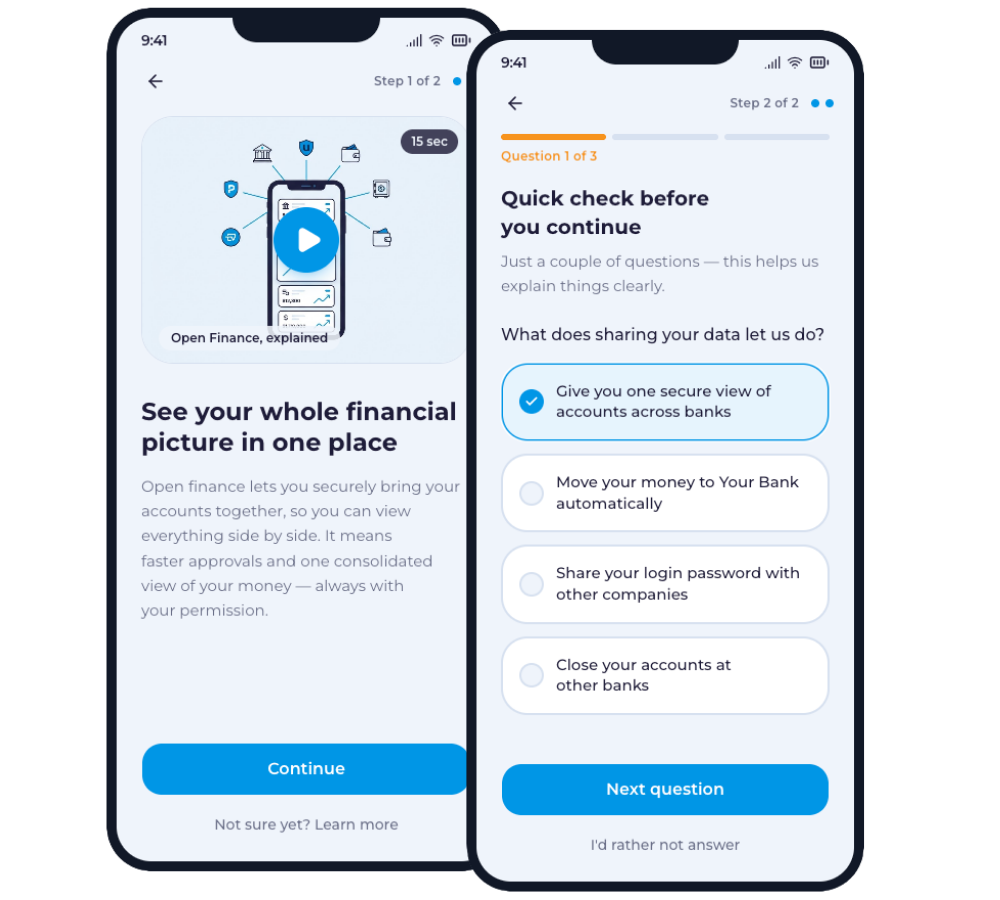
Instead of a bare consent toggle, a customer arriving at the open finance opt-in sees a short explainer, in plain language, on what data sharing means and what they stand to gain, such as faster approvals or a consolidated view of their finances. A brief follow-up question then checks understanding and willingness, rather than assuming silence means comprehension. If the customer is not ready to share, the flow captures why, so the bank can address the specific concern rather than simply representing the same request later.

Onboarding Journey

The engagement journey that treats segments differently. 

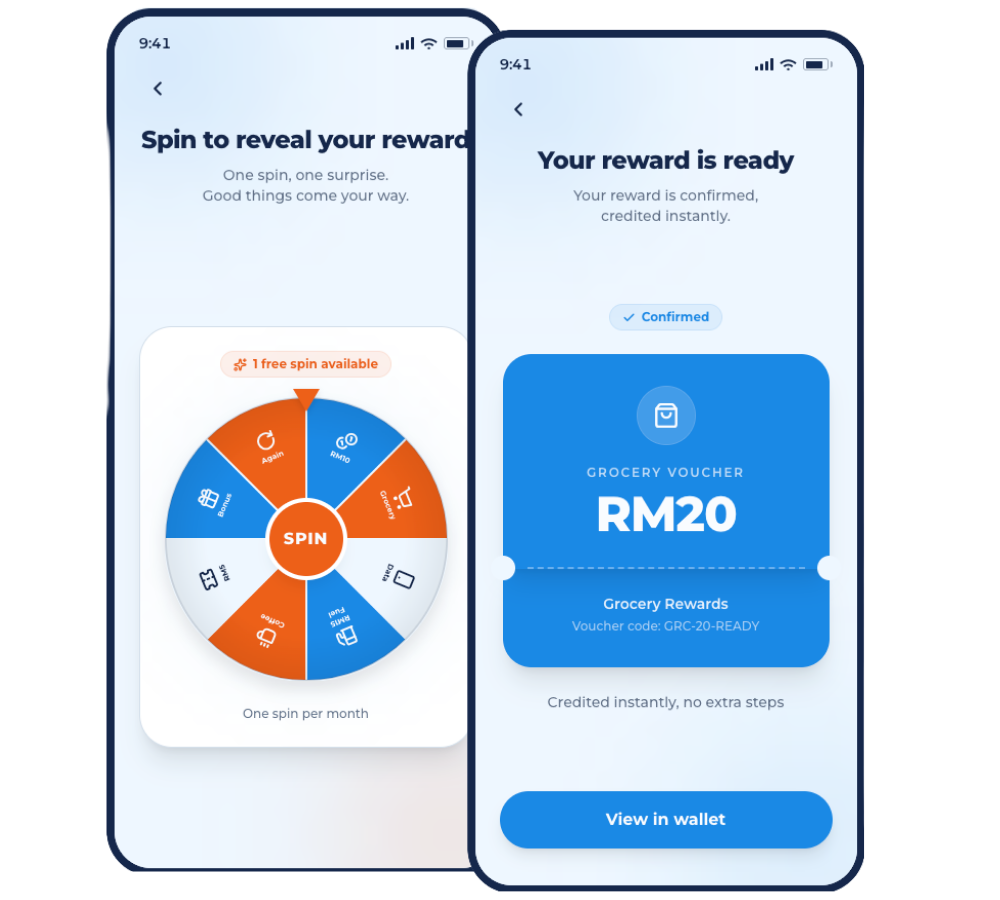
Two customers complete the same onboarding step, but the reward experience differs by what motivates them. One is offered a game-like, probability-based reward that adds a moment of anticipation. The other receives an immediate, guaranteed reward with no extra steps. Neither approach is “better,” they are matched to what actually drives each group to engage, rather than a single mechanic applied uniformly across the customer base.

Engagement Journey

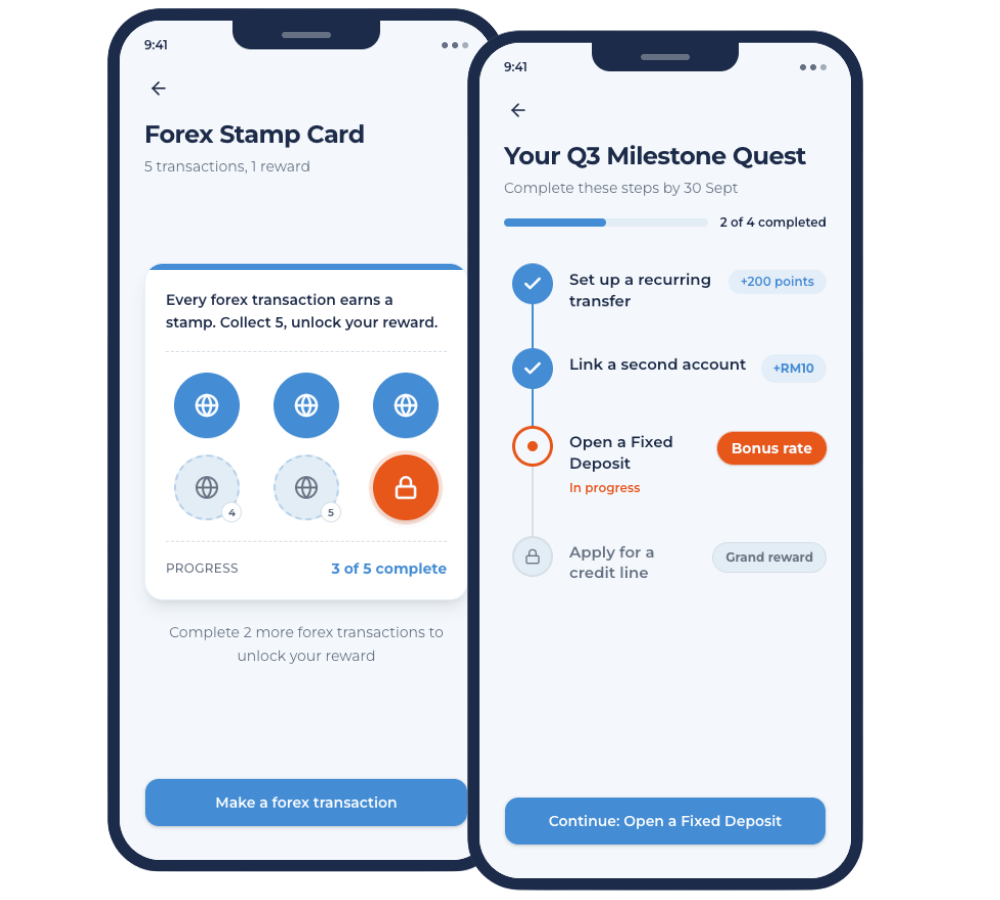
The retention journey that rewards good financial behaviour. Rather than only reacting when a customer withdraws funds or shows signs of disengagement, a milestone-based journey rewards the absence of a negative behaviour, for instance recognising a customer for each consecutive period they maintain a balance rather than draw it down, with a meaningful reward at a specific milestone. It is a small shift, from campaigns that chase customers after they’ve already started leaving, to ones that recognise and reinforce the behaviour a bank actually wants to see more of.

Retention Journey
None of these require exotic technology. They require treating open finance as a customer relationship to design, not only a data pipe to build.

Where Open Finance and Loyalty Are Heading Next

The open finance rollout will happen whether or not any individual bank gets the experience right. What is less certain is which banks will use it to deepen customer relationships and which will simply treat it as a compliance milestone to clear.

This is also where the next phase of what Perx is building becomes relevant. Alongside the loyalty and engagement journeys banks run today, we are working on giving banks a much fuller, real-time understanding of a customer’s overall financial health, not just their activity with a single product, so that the offers and journeys built on top of open finance data are genuinely useful rather than generic. More on that soon.

If you are working through what your own open finance rollout should look like, from consent design to the engagement layer sitting on top of it, we would be glad to talk it through.

FAQs

Common questions.

What is the difference between open banking and open finance?

Open banking generally refers to sharing payment and account information, often driven by regulation such as the UK’s Open Banking standard or the EU’s PSD2. Open finance extends the same consent-based data-sharing model to a broader set of financial products, including savings, credit, insurance, and investments.

When is open finance launching in Malaysia?

Bank Negara Malaysia released an exposure draft on Open Finance in November 2025, with industry feedback closing in March 2026. An early pilot had originally been targeted for mid-2026, but as of a July 2026 industry address, BNM’s governor has framed the rollout as a phased implementation starting from 2027, as part of a new Financial Sector Blueprint covering 2027 to 2030. Larger banks are expected to onboard first.

Which other Southeast Asian markets have open finance frameworks?

Singapore’s SGFinDex, run jointly by the Monetary Authority of Singapore and GovTech, has been live for several years and covers banks, insurers, and government agencies. Indonesia’s Bank Indonesia has developed the SNAP standard for open API payments, with a broader open finance roadmap expected to extend into lending, insurance, and investment data.

Why do customers hesitate to share financial data, even with regulatory protection?

Most hesitation comes down to unclear communication rather than distrust of the regulation itself. Customers commonly want to know what exactly is being shared, what they get in return, and whether visibility could be used against them, such as through sharper pricing or unwanted product offers.

How can banks make open finance consent flows more effective?

Plain-language education before the consent screen, understanding the specific reason behind a decline rather than just recording it, and following up appropriately all help. Consent works better as an ongoing conversation than a one-time legal gate.

Samit Deb

Samit Deb is Director of Enterprise Sales at Perx Technologies in Singapore. ACA and CISA qualified, with a background at PwC and KPMG, he writes on open finance, BFSI, and AI-enabled customer engagement. Connect on LinkedIn.

Recommended for you

What Does a Revenue Intelligence Engine Do?

What Does a Revenue Intelligence Engine Actually Do? A Framework for BFSI Leaders

Revenue Intelligence

Praveen Vadla

Senior Marketer | Jul 10, 2026

What Does a Revenue Intelligence Engine Actually Do? A Framework for BFSI Leaders

The phrase has been appearing with growing frequency in BFSI technology conversations: revenue intelligence. Vendors are using it. Analysts are writing about it. CDOs are asking their teams what it means for their engagement stack.

Most of the answers being offered are vague. Revenue intelligence is described as ‘AI-powered personalisation’ or ‘data-driven engagement’ or ‘next-generation loyalty’ — descriptions that could apply to almost any platform in the market and therefore describe none of them with any precision.

This piece is an attempt at a more useful answer. Not a vendor pitch. Not a vision document. A functional framework — six specific capabilities that a genuine revenue intelligence engine must perform, what each one does at the operational level, and what its absence costs a BFSI institution in measurable commercial terms.

If you are a CDO, CMO, Head of Digital, or Head of Loyalty evaluating whether your current engagement stack is built for the next five years, this framework is the diagnostic. Each capability is a question you can put to your existing system — and the answers will tell you where the gaps are.

TL;DR – Quick Summary

  • “Revenue intelligence” is the newest vague buzzword in BFSI martech — this piece defines it precisely as six connected functional capabilities, not a marketing category.
  • The six capabilities: data unification, customer intelligence, growth strategy, execution without friction, experience delivery, and revenue attribution. Missing any one breaks the chain from customer data to revenue outcome.
  • Most BFSI engagement platforms in production handle execution and experience delivery reasonably well — the consistent gaps sit in data unification, customer intelligence, growth strategy, and revenue attribution.
  • Each capability comes with a diagnostic signal: a specific, observable test a CDO or CMO can run against their current stack to see where it falls short.
  • The core distinction: a platform performing five of six capabilities well is a capable engagement tool; performing all six makes it a genuine revenue intelligence engine — a difference that’s measurable, not semantic.
  • Framed as a diagnostic, not a vendor pitch — it closes by pointing to the Tier 1 Engagement Audit for institutions that want to assess their own stack against the standard.

Why Precision Matters Before You Evaluate Any Platform

The BFSI technology market has a well-established pattern: a compelling concept emerges, vendors adopt its vocabulary, and within eighteen months the term has been applied to enough different products that it has lost its diagnostic value. Customer 360. Digital transformation. Omnichannel engagement. Each of these was once a precise description of a specific capability. Each became, over time, a marketing category.

Revenue intelligence is at risk of the same fate — and the stakes of imprecision here are higher than they were for those earlier terms. A bank that deploys the wrong CRM loses efficiency. A bank that deploys an engagement platform marketed as a revenue intelligence engine but lacking the functional capabilities that term implies will spend years and significant budget building around a gap its leadership did not know existed.

The six capabilities in this framework are not aspirational. They are the minimum functional requirements for a system that can genuinely connect customer data to revenue outcomes. A system that performs five of them well is a capable engagement platform. A system that performs all six is a revenue intelligence engine. The distinction is consequential — and it is measurable.

A system that performs five of these capabilities well is a capable engagement platform. A system that performs all six is a revenue intelligence engine. The distinction is consequential — and it is measurable.
The result is a lopsided AI transformation. Institutions are deploying sophisticated intelligence to decide whether to lend to a customer — and basic, rule-driven automation to decide whether to engage with them.
The Six-Capability Framework
A revenue intelligence engine for BFSI performs six connected functions. The absence of any one of them breaks the value chain from customer data to revenue outcome.
  1. Data Unification — Building a complete, standardised Customer 360 from all available sources
  2. Customer Intelligence — Converting unified data into individual-level behavioural and predictive signals
  3. Growth Strategy — Translating intelligence into KPI-aligned engagement recommendations
  4. Execution Without Friction — Deploying strategies at marketing speed, without IT dependency
  5. Experience Delivery — Delivering personalised interactions at the individual level across channels
  6. Revenue Attribution — Closing the loop between engagement actions and measurable P&L outcomes

Capability 1: Data Unification — Building a Complete Customer Picture

The most common failure point in BFSI engagement systems is not visible to the teams running them. It sits beneath the surface, in the data layer: the platform is operating on a partial picture of the customer, and nobody has quantified how partial.

A genuine revenue intelligence engine begins with data unification — ingesting and standardising customer information from every available source into a single, consistent intelligence profile. This means transaction data, yes — but also product holdings across the customer’s full relationship with the institution, digital engagement signals from the mobile app and web platform, notification interaction history, consent and compliance data by jurisdiction, rewards and redemption behaviour, and channel preferences.

The operative word is standardised. Many BFSI engagement platforms receive data from multiple sources but store it in fragmented, inconsistent schemas — different naming conventions, different event taxonomies, different update cadences. The result is that the ‘customer view’ the platform is building is not actually a unified view. It is a collection of partial records that the system treats as complete.

CAPABILITY 1: Data Unification — Building a Complete Customer Picture

What it does?
Ingests and standardises customer data from all available sources — transactions, product holdings, digital behaviour, engagement history, consent data — into a single, consistent intelligence profile per customer.

Why its absence has a cost?
When a platform operates on transaction data alone, it has approximately 30% of the information it needs to personalise relevantly. The remaining 70% — product holdings, behavioural signals, engagement trajectory, churn risk indicators — is invisible. Every personalisation decision made without this data is a guess with a budget attached.

The diagnostic signal?
If your platform cannot tell you, for a specific customer, which products they hold, how their app engagement has changed over the last 90 days, and what their current churn probability is — it is not operating on a unified customer profile.

Capability 2: Customer Intelligence — From Data to Predictive Signal

Data unification solves the completeness problem. Customer intelligence solves the comprehension problem. They are sequential, not interchangeable — and the second does not function without the first.

Customer intelligence converts a unified data profile into actionable signals: a financial health score that reflects a customer’s actual relationship with their money, not just their transaction frequency. A behavioural engagement score that tracks whether a customer is deepening their relationship with the institution or quietly withdrawing from it. A churn probability that calculates the likelihood of dormancy or departure before it happens, not after. A cross-sell propensity score that identifies which customers are in the right financial and behavioural position to respond to a specific product offer.

The distinction between data and intelligence is the distinction between knowing what a customer did and understanding what they are likely to do next. Most BFSI engagement platforms have access to the former. Very few have built the latter. The gap shows up in campaign performance, in personalisation quality, and in the inability of most engagement teams to answer questions about their customers that go beyond transactional history.

Capability 2: Customer Intelligence — From Data to Predictive Signal

What it does?
Builds individual-level intelligence profiles on top of unified data: financial health scores, behavioural engagement trajectories, churn probability signals, cross-sell and upsell propensity scores, and dormancy detection — all updated in real time as customer behaviour changes.

Why its absence has a cost?
Without this layer, engagement teams are working from historical descriptions of customer behaviour, not forward-looking predictions. They are sending cross-sell campaigns to customers who are already in churn trajectory. They are applying retention mechanics to customers who were never at risk. The cost is not just wasted campaign spend — it is the erosion of customer trust that comes from persistent irrelevance.

The diagnostic signal?
If your engagement team identifies churn risk by looking at who has already gone dormant — rather than receiving early warning signals before dormancy — the intelligence capability is missing.

Capability 3: Growth Strategy — From Intelligence to Recommended Action

The translation from customer intelligence to engagement strategy is, in most BFSI institutions, still a manual process. A marketing manager opens a campaign builder, selects a segment based on available filters, chooses a mechanic from a predefined library, sets a reward value, and submits the configuration for approval. The intelligence signals — if they exist — inform this decision loosely, based on the manager’s interpretation of what the data suggests.

A revenue intelligence engine does not leave this translation to interpretation. The growth strategy capability reads the intelligence signals from Capability 2, interprets them against the institution’s defined business KPIs — retention targets, cross-sell velocity goals, activation rates, revenue uplift targets — and generates a specific, prioritised set of recommended actions. Not a menu of options. A ranked recommendation with reasoning: this segment, this mechanic, this reward structure, this channel, at this moment, because the signal indicates this outcome is achievable at this cost.

Critically, the recommendation includes a predicted ROI and a compliance validation. Before a single configuration is prepared, the system has assessed whether the proposed intervention is within reward cap limits, frequency constraints, and applicable regulatory requirements. The strategy arrives compliance-checked, not compliance-pending.

Capability 3: Growth Strategy — From Intelligence to Recommended Action

What it does?
Interprets customer intelligence signals against defined business KPIs and generates specific, prioritised engagement recommendations — including campaign type, target segment, reward structure, channel, predicted ROI, and compliance validation status — before any configuration work begins.

Why its absence has a cost?
Without this capability, strategy is whatever the marketing team has capacity to design this sprint. That means the institution’s engagement activity is bounded by human bandwidth, not by market opportunity. The customers who most need intervention at any given moment are reached only if someone on the team happened to look at the right data at the right time. Most do not.

The diagnostic signal?
If your engagement team’s campaign calendar is driven by campaign slots and creative availability rather than by a system-generated view of where the highest-ROI interventions are right now — the growth strategy capability is absent.

Capability 4: Execution Without Friction — Speed as a Competitive Capability

Strategy that cannot be executed quickly is a planning document. The fourth capability is not glamorous — but its absence is one of the most commercially costly gaps in BFSI engagement operations.

Execution without friction means that a marketing team can move from a growth strategy recommendation to a live campaign without raising an IT ticket, waiting for a sprint slot, or navigating a multi-week change management process. The no-code execution capability does not just save time — it changes the commercial calculus of customer engagement entirely. Every week of delay between identifying a customer intervention opportunity and deploying it is a week in which a competitor may have acted first.

In regulated BFSI environments, execution without friction does not mean execution without governance. The Maker-Checker model preserves institutional control: the system prepares the full campaign configuration — rules, rewards, segments, notification logic — and submits it for human review and approval before anything goes live. The marketer’s job shifts from configuration to oversight. The institution gains velocity without sacrificing the governance requirements that compliance and risk teams mandate.

The commercial evidence for this capability is not theoretical. Reducing campaign time-to-market from weeks to hours changes the frequency at which an institution can respond to customer behaviour signals. That frequency compounds — more interventions, more data, more refined intelligence, more relevant subsequent interventions.

Capability 4: Execution Without Friction — Speed as a Competitive Capability

What it does?
Enables marketing teams to move from strategy to live campaign without IT dependency. The system generates full campaign configurations — rules, rewards, segments, channels, notification logic — and submits them through a Maker-Checker governance workflow for human approval before deployment.

Why its absence has a cost?
Institutions that require IT involvement for every campaign change are operating on a release cadence measured in weeks or months. In APAC digital banking markets where challenger banks deploy new engagement mechanics daily, this is not a process inefficiency — it is a structural competitive disadvantage. The IT Bottleneck Tax compounds: every quarter of delayed campaigns is a quarter of customer behaviour data that was never collected, and a quarter of intervention opportunities that were never acted on.

The diagnostic signal?
If your marketing team measures campaign launch time in weeks rather than hours — or if any change to campaign logic, segment rules, or earning mechanics requires an IT ticket — execution friction is costing you more than you are measuring.

Capability 5: Experience Delivery — Personalisation at the Individual Level

The difference between a BFSI institution that feels like it knows you and one that does not is entirely in this capability. Personalisation as most engagement platforms practise it is segment-level: a customer receives a message relevant to a demographic cohort or a behavioural cluster. Personalisation as a revenue intelligence engine delivers it is individual-level: a specific customer receives an interaction designed for their current situation, informed by their specific intelligence profile, at the moment when their behavioural signals indicate they are most receptive.

Experience delivery connects the upstream intelligence and strategy work to the customer-facing touchpoint. It operates across the channels where customers actually engage — mobile app, web microsite, push notification, in-app message, SMS — and it delivers a consistent, contextually appropriate interaction at each. The mechanics themselves are varied: a progression-based quest for a customer in early activation, a streak mechanic for a customer the system has identified as habit-buildable, a targeted cross-sell moment for a customer whose financial health score indicates readiness, a win-back prompt for a customer whose engagement trajectory is declining.

Critically, every interaction generates data that feeds back into the intelligence layer. A customer who completes a quest generates a different signal than a customer who abandons it mid-way. A push notification that converts tells the system something different than one that goes unopened for 48 hours. The experience layer is not just a delivery mechanism — it is the primary source of behavioural data that refines the intelligence profiles that drive every subsequent decision.

Capability 5: Experience Delivery — Personalisation at the Individual Level

What it does?
Delivers contextually relevant, individualised customer interactions across all digital touchpoints — mobile app, microsite, push, SMS — using the full intelligence profile of each customer to determine the right mechanic, message, and moment. Every interaction feeds behavioural signals back into the intelligence layer.

Why its absence has a cost?
Without individual-level experience delivery, personalisation is demographic targeting with a loyalty wrapper. Customers receive communications relevant to people like them, not to them specifically. In a market where 40% of banking consumers report they cannot distinguish between financial brands, segment-level personalisation does not resolve the differentiation problem — it is part of it.

The diagnostic signal?
If your engagement platform delivers the same campaign to all customers who meet a segment criteria, regardless of their individual intelligence profile, engagement trajectory, or current financial health status — the experience delivery capability is operating below the intelligence layer available to it.

Capability 6: Revenue Attribution — Closing the Loop to the P&L

The sixth capability is the one that most directly determines whether a customer engagement programme survives budget scrutiny — and it is the capability most frequently absent from the engagement platforms currently in production at BFSI institutions.

Revenue attribution connects every engagement action — every campaign, every mechanic, every nudge, every personalised interaction — to a measurable revenue outcome. Not an engagement proxy. Not a campaign metric. Actual incremental revenue generated by specific engagement activity, expressed in the terms that a CFO can evaluate: transaction lift, churn prevented and its revenue equivalent, cross-sell events directly attributable to engagement interventions, and the margin impact of shifting customers from promo-dependent behaviour to habit-driven engagement.

Without this capability, the engagement programme is a cost centre by default. It may be generating significant revenue — but if the system cannot trace which interventions generated which outcomes, that value is invisible to the leadership team making budget allocation decisions. The engagement team speaks in redemption rates and campaign engagement scores. The CFO speaks in revenue and margin. The absence of a bridge between these vocabularies is not a communication problem — it is an architectural one, and it can only be resolved at the data and measurement layer.

The institutions that build this capability now will not just be able to justify their engagement budget. They will be able to grow it — because they can demonstrate, precisely, what each incremental pound of engagement spend generates in incremental revenue.

Capability 6: Revenue Attribution — Closing the Loop to the P&L

What it does?
Connects every engagement action to a measurable revenue outcome — tracking transaction lift, churn defensibility value, cross-sell attribution, and incremental revenue per campaign. Produces reporting in P&L terms that finance leadership can evaluate, not engagement proxy metrics that only marketing can interpret.

Why its absence has a cost?
Engagement programmes without revenue attribution are perpetually at budget risk. They cannot answer the CFO’s question. They cannot demonstrate the cost of switching off the programme. They cannot justify investment in capability improvements because they cannot prove what the current investment is generating. Over time, this makes the engagement programme vulnerable to the same fate as every cost centre: the first thing reviewed when performance pressure arrives.

The diagnostic signal?
If your quarterly engagement report leads with redemption rate, campaign impressions, or NPS movement — rather than with incremental revenue, churn defensibility value, or cross-sell velocity — the revenue attribution capability is the gap between your programme and its full potential.

Using This Framework as a Diagnostic

The six capabilities above are designed to be applied to your current engagement stack — not as an aspiration, but as an audit. For each capability, there is a diagnostic signal: a specific observable condition that indicates whether the capability is present, partial, or absent.

A few observations about how to use this framework honestly:

Capability

The question to ask your team

Data Unification

Can your system tell you, for any individual customer, which products they hold, how their app engagement has changed in the last 90 days, and what their current churn probability is?

Customer Intelligence

Does your system identify customers who are likely to churn before they go dormant — or only after?

Growth Strategy

Is your campaign calendar driven by system-generated intervention priorities, or by available creative slots and team bandwidth?

Execution Without Friction

How long does it take your marketing team to change a campaign’s segment logic or earning rule, from decision to live? If the answer involves IT, measure in weeks.

Experience Delivery

Do two customers with meaningfully different behavioural profiles receive differentiated experiences — or do they receive the same campaign because they share a demographic segment?

Revenue Attribution

Can you tell your CFO, for last quarter, how much incremental revenue your engagement programme generated — not engagement metrics, actual revenue?

Most BFSI engagement platforms currently in production perform Capabilities 4 and 5 adequately: they can execute campaigns without excessive IT friction (though many cannot), and they deliver some form of customer-facing experience. The gaps are most consistently found in Capabilities 1, 2, 3, and 6 — the intelligence foundation and the revenue closing loop.

That is not accidental. Capabilities 1, 2, 3, and 6 require the deepest integration with the institution’s data infrastructure, the most sophisticated measurement architecture, and the clearest alignment between engagement operations and P&L accountability. They are the hardest to build, the hardest to buy, and the hardest to evaluate from a vendor’s marketing materials. They are also the capabilities that determine whether an engagement programme is a cost centre or a revenue driver.

The gaps in BFSI engagement are most consistently found in data unification, customer intelligence, growth strategy, and revenue attribution — the capabilities that determine whether a programme is a cost centre or a revenue driver.

What This Framework Is — and Is Not

This framework is a diagnostic, not a procurement checklist. It does not tell you which vendor to choose. It tells you what to look for — specifically, what to ask in a product evaluation, what capabilities to request evidence for rather than accepting at face value, and what the absence of each capability is costing your programme in commercial terms.

The six capabilities are interconnected. A system that performs Capability 3 (growth strategy) without Capability 1 (data unification) will generate strategy recommendations based on an incomplete customer picture — the recommendations will be directionally correct but individually wrong. A system that performs Capability 6 (revenue attribution) without Capability 2 (customer intelligence) will be able to report revenue outcomes but unable to explain which customer signals predicted them or how to replicate them at scale.

The direction the market is moving is clear. The $60B in AI investment flowing into BFSI will reach the customer engagement layer — the question is whether your institution’s engagement infrastructure is ready to receive it, or whether a layer of architectural debt is standing between your customer intelligence and your revenue outcomes.

The Tier 1 Engagement Audit is a structured starting point for assessing exactly that — a diagnostic framework for BFSI leaders who want to understand where their current engagement stack sits against the six-capability standard described here.

The infrastructure for revenue intelligence already exists in most BFSI institutions.
What is missing, in most cases, is the architectural decision to connect it — and the system to close the loop from data to intelligence to strategy to execution to experience to revenue.

If you’re mapping your current loyalty architecture against these use cases and want to work through what your signal coverage actually looks like, we’re happy to think through it with you.

FAQs:

What is a revenue intelligence engine in banking?
A revenue intelligence engine is a customer engagement system that performs six connected functions: data unification, customer intelligence, growth strategy, execution, experience delivery, and revenue attribution. It connects customer behavioural data to measurable P&L outcomes. Unlike a loyalty platform, which manages rewards mechanics, a revenue intelligence engine answers the question: what customer behaviour do we need to drive, and what does driving it generate for the business?
A loyalty platform manages the mechanics of a rewards programme — earning rules, points balances, and redemption. A revenue intelligence engine connects customer data to business KPIs, generates engagement strategies with predicted ROI, executes them without IT bottlenecks, and attributes outcomes in revenue terms. The distinction is between a campaign management tool and a system that closes the loop between engagement activity and P&L.
Customer intelligence in banking engagement is the conversion of unified customer data into individual-level predictive signals: churn probability, cross-sell propensity, financial health score, and engagement trajectory. It is the difference between knowing what a customer did historically and understanding what they are likely to do next. Most BFSI platforms have customer data. Customer intelligence requires a structured analytical layer on top of that data.
Because most engagement platforms measure activity, not outcomes. Redemption rate, NPS movement, and campaign engagement are the standard outputs — none of which map to revenue. Without a revenue attribution capability that connects specific engagement actions to incremental transaction lift, churn defensibility value, and cross-sell events, the programme cannot answer the CFO’s question in the language finance uses to make budget decisions.
The Maker-Checker model is a governance workflow used in regulated BFSI environments. The system generates a complete campaign configuration — rules, rewards, segments, notifications — as a draft (the Maker role). An authorised team member reviews and approves the configuration before anything goes live (the Checker role). This preserves institutional control and audit-trail requirements while enabling campaign execution without manual configuration from scratch.
Ask three questions: Does the system identify churn risk before dormancy occurs, or after? Can it produce, for an individual customer, a financial health score and cross-sell propensity derived from behavioural and product data — not just transaction history? Does it update these signals in real time as customer behaviour changes? If any answer is no, the platform has data access but not customer intelligence.

Praveen Vadla

Praveen Vadla is Senior Digital Marketing Manager at Perx Technologies. With over 10 years of experience in B2B SaaS marketing across the US and Southeast Asia, he focuses on customer loyalty, engagement, and retention strategy. He writes on how brands build lasting customer relationships in a mobile-first economy. Connect with Praveen on LinkedIn.

Recommended for you

BFSI's $60B AI Opportunity Is Going to the Wrong Place?

Beyond Loyalty: Why BFSI’s $60B AI Opportunity Demands a Revenue Intelligence Layer

BFSI's $60B AI Opportunity Is Going to the Wrong Place?

Praveen Vadla

Senior Marketer| Jul 6, 2026

Beyond Loyalty: Why BFSI's $60B AI Opportunity Demands a Revenue Intelligence Layer

The investment is real. The ambition is clear. And the allocation is almost entirely wrong.

The global AI in BFSI market is projected to grow from USD 24.31 billion in 2025 to USD 60.09 billion by 2031 — a compound annual growth rate of 16.28% (ResearchAndMarkets, 2025). BFSI institutions across APAC and beyond are committing budget, headcount, and board-level attention to AI at a scale the industry has not seen since the shift to mobile banking.

But look at where that investment is actually landing. Fraud detection. Credit underwriting. Risk modelling. Back-office process automation. Anti-money-laundering systems. These are legitimate applications and meaningful improvements — and they are capturing the overwhelming majority of AI investment in financial services.

Meanwhile, the layer of the business that most directly determines whether a customer stays, grows, and chooses your institution over a competitor tomorrow morning is receiving a fraction of that attention. The customer-facing intelligence layer — the system responsible for understanding individual behaviour, driving engagement, and connecting those activities to revenue — remains the last unreformed frontier in BFSI’s AI transformation.

This piece examines why that gap exists, what it is costing institutions in real commercial terms, and what the architecture of the missing layer actually looks like.

TL;DR – Quick Summary

  • BFSI’s AI investment is real but misallocated. The market is projected to grow from USD 24.31 billion in 2025 to USD 60.09 billion by 2031 (ResearchAndMarkets, 2025), yet most of it flows into fraud, underwriting, risk, and back-office automation.
  • The customer-facing engagement layer, which most directly determines whether a customer stays, grows, and chooses your institution, is the last unreformed frontier in BFSI’s AI transformation.
  • The gap is about measurement, not value. Fraud AI proves ROI in weeks; engagement AI needs measurement infrastructure most institutions have not built, so the best-funded applications are the most measurable rather than the most valuable.
  • The cost is commercial: personalisation on transaction data alone misfires at scale, over 40% of consumers cannot distinguish between financial brands, and nearly 3 in 4 bank with more than one provider (UserTesting, Digital Banking Trends 2026).
  • What is missing is a revenue intelligence layer spanning six connected functions, from data unification to revenue attribution. The urgency is sharpest in APAC, and with 53% of financial services firms already running AI agents in production, mostly in risk and fraud (ResearchAndMarkets, 2025), the engagement layer is open white space where first-mover advantage compounds.

Where the $60B Is Going — and Where It Is Not

The AI investment story in BFSI follows a predictable pattern: the applications that receive the most funding are the ones closest to regulatory mandate and the ones where the ROI case is easiest to make to a risk committee.

Fraud detection AI can demonstrate value in weeks: blocked transactions, recovered losses, reduced false positives. Credit underwriting AI reduces default rates and improves portfolio health — outcomes that map directly to balance sheet performance. Anti-money-laundering AI reduces compliance risk and the cost of regulatory penalty. These are defensible, measurable, and familiar to the board.

Customer engagement AI is harder to defend in those terms — not because the value is smaller, but because most BFSI institutions do not yet have the measurement infrastructure to prove it. They cannot connect a behavioural nudge to an incremental deposit. They cannot attribute a cross-sell event to a specific engagement campaign. They cannot calculate the revenue cost of a customer who became inactive over three months of irrelevant communications.

The applications that receive AI investment are not necessarily the most valuable. They are the most measurable — and measurement infrastructure is itself an investment BFSI has not yet made in the engagement layer.
The result is a lopsided AI transformation. Institutions are deploying sophisticated intelligence to decide whether to lend to a customer — and basic, rule-driven automation to decide whether to engage with them.

$60B

Projected AI in BFSI market size by 2031

ResearchAndMarkets, 2025

53%

of financial services firms deploying AI agents in production

ResearchAndMarkets, 2025

42%

of compliance leaders cite regulatory uncertainty as AI blocker

ResearchAndMarkets, 2025

The Commercial Cost of the Engagement Intelligence Gap

The absence of a genuine intelligence layer in customer engagement is not a theoretical problem. It has specific, quantifiable commercial consequences — most of which BFSI institutions are currently absorbing as the baseline cost of running a loyalty programme.

1

Personalisation without intelligence produces the wrong outcomes at scale.
Most BFSI engagement systems operate on transaction data alone. They know what a customer purchased and when. They do not know what product the customer holds, whether their engagement with the mobile app is declining, what their likelihood of cross-sell is, or whether they are three weeks from churning. Personalisation built on that partial picture does not just fail to help — it actively erodes trust when customers receive recommendations that are demonstrably irrelevant to their actual relationship with the institution.

2

Differentiation has collapsed precisely because engagement is underpowered.
More than 40% of banking consumers report they cannot meaningfully distinguish between financial brands (UserTesting, Digital Banking Trends 2026). This is not primarily a product problem — most institutions offer broadly similar deposit rates, card products, and digital features. It is an engagement problem. The experience of being a customer at Bank A versus Bank B feels, to most customers, functionally identical. An intelligence layer that understands individual behaviour and responds to it relevantly is the only mechanism capable of creating genuine perceived differentiation at scale.

3

The multi-provider reality is a direct result of engagement failure.
Nearly three-quarters of consumers bank with more than one provider simultaneously (UserTesting, 2026). This is the market telling BFSI institutions that none of them has yet built an engagement experience compelling enough to consolidate the relationship. When a customer holds their salary account at one institution, their credit card at another, and their savings at a third, it is not because the first institution lacked a loyalty programme. It is because no institution gave them a reason to consolidate — and that reason, when it exists, is always an experience, not a product.

4

Reward spend is growing without a corresponding growth in retention.
The default response to engagement failure in BFSI has been to increase the generosity of the rewards programme — higher earn rates, broader redemption catalogues, welcome bonuses. This approach has a structural ceiling: it trains customers to respond to incentives rather than to value the relationship, and it creates a cost base that grows proportionally with the customer base without building the compounding loyalty effect that justifies the investment. A digital bank that maintained a 72% returning customer rate did so through automated progression loops and behavioural mechanics — not through reward spend escalation.
These consequences share a root cause: the engagement layer is operating without the intelligence infrastructure that every other part of the BFSI business now takes for granted.

What the Missing Layer Actually Is

The phrase ‘customer intelligence’ has been used loosely enough in BFSI that it has lost most of its precision. CRM vendors call their segmentation tools customer intelligence. CDP providers describe their data unification as customer intelligence. The term has become a marketing category rather than a functional description.

The intelligence layer that is genuinely missing from most BFSI engagement stacks is something more specific. It is a system that performs six connected functions — and the absence of any one of them breaks the value chain.

Capability

What It Does — and Why Its Absence Has a Cost

Data Unification

The system ingests and standardises data from multiple sources: transaction feeds, product holdings, digital engagement signals, consent and compliance data, rewards interactions, and channel behaviour. Not a selection of these — all of them. Partial data produces partial intelligence, and partial intelligence produces the misfired personalisation that most BFSI customers experience today.

Customer Intelligence

On top of unified data, the system builds a behavioural profile for each customer: what their engagement trajectory looks like, whether their digital activity is increasing or declining, what their propensity for specific products is, and where they sit in their relationship lifecycle with the institution. This is not segmentation. It is individual-level intelligence that changes in real time as behaviour changes.

Growth Strategy

The intelligence layer translates customer profiles into growth recommendations. For a customer whose deposit balance has been static for six months and whose app engagement has dropped by 40%, the system identifies the intervention — the right mechanic, the right message, the right moment. It does not wait for a campaign team to identify the segment and brief a creative agency. It generates and prioritises the recommendation.

Execution Without Friction

Strategy without execution velocity is a planning document. The layer must be able to deploy campaigns, journeys, and behavioural mechanics without IT involvement for every change. In APAC markets where a challenger bank can push a new engagement feature to ten million users in a day, the institution operating on quarterly release cycles is not competing on the same terms — and no intelligence layer compensates for an execution bottleneck.

Experience Delivery

At the individual level, the intelligence layer delivers the right experience through the right channel at the right moment. Not a campaign to a segment — an interaction with a person. This is the difference between a customer receiving a push notification that is relevant to their actual situation and one that is relevant to their demographic cohort.

Revenue Attribution

The layer closes the loop: it connects every engagement action, every nudge, every campaign, every mechanic, to a measurable revenue outcome. Not a proxy metric. Not an engagement rate. Actual incremental revenue generated, churn prevented, cross-sell velocity accelerated. Without this, the engagement programme cannot defend its budget to a CFO — and in most institutions today, it cannot.
The institutions building this six-function layer today are not ahead of the market. They are building the capability that the market will require of every institution within five years.

Why This Matters More in APAC Than Anywhere Else

The global AI in BFSI investment story is relevant everywhere — but the urgency of the engagement intelligence gap is more acute in APAC for three specific reasons.

Market velocity is higher. APAC’s digital banking markets operate at a speed that has no equivalent in Western financial services. Mobile banking penetration exceeds 90% in several markets. Challenger banks have built multi-million-user bases in years rather than decades. Customer expectations, set by the superapps that dominate daily life in the Philippines, Indonesia, Malaysia, and Thailand, are higher than in any other region. An engagement system that cannot respond in real time to individual behavioural signals is not merely suboptimal in this context — it is invisible.

Regulatory fragmentation demands architectural flexibility. APAC is not one market. It is a collection of distinct regulatory environments — MAS TRM in Singapore, OJK in Indonesia, PDPA in Thailand, NPC in the Philippines, APPs in Australia — each with specific requirements around data residency, customer consent, and the deployment of AI-driven systems. An intelligence layer that cannot adapt its architecture to meet these requirements without rebuilding from scratch is not deployable across the region. This is not a compliance problem. It is a design requirement.

The competitive pressure is asymmetric. Tier-1 banks in APAC are not just competing against each other. They are competing against digital-first challengers that have no legacy infrastructure, no batch processing constraints, and no organisational inertia to manage. Challenger banks in the Philippines and Indonesia are deploying behavioural engagement mechanics that drive daily active usage across millions of customers. The incumbents with the largest customer bases have the most to gain from deploying an intelligence layer — and the most to lose from continuing without one.

The Window for First-Mover Advantage

53% of financial services firms are already deploying AI agents in production (ResearchAndMarkets, 2025). Almost all of those deployments are in risk, fraud, and back-office functions. The engagement intelligence layer is, at this moment, a white space — and white spaces in enterprise technology close faster than most institutions plan for.

The institutions that deploy a genuine revenue intelligence layer in the next 12 to 18 months will build an advantage that compounds. Better data produces better predictions. Better predictions produce more relevant engagement. More relevant engagement produces stronger behavioural signals and more data. The cycle is self-reinforcing — and it means that the gap between institutions that start now and institutions that wait is not linear. It grows.

The $60B AI investment in BFSI is real. The question is not whether AI will transform financial services — that transformation is already underway. The question is which layer of the business captures the next wave, and which institutions are positioned to benefit from it.

The back office has had its transformation. The risk function is in the middle of one. The customer-facing engagement layer is next. The institutions that recognise this now — and build the intelligence infrastructure to support it — will not just capture a share of the $60B. They will define what BFSI customer relationships look like for the next decade.

The back office has had its AI transformation.
The customer engagement layer is next. The institutions that move first will not just capture a share of the market — they will set the standard for what comes after.

The Question BFSI Leaders Should Be Asking Now

BFSI institutions are not short of AI ambition. The $60B market projection reflects genuine commitment to intelligent, data-driven operations across the industry. The gap is not in intent — it is in allocation.

The operational layers of financial services — risk, fraud, compliance, underwriting — have been rebuilt around intelligence. The customer-facing engagement layer has been left running on architecture that pre-dates AI as an operational concept. The consequences of that asymmetry are showing up in engagement metrics, retention rates, and the inability of most institutions to answer a simple CFO question: what did our customer engagement programme generate for the business last quarter?

Closing that gap does not require waiting for the next technology cycle. The data assets are already there. The AI capabilities are mature and deployable. What is needed is an architectural decision — to build the engagement layer that connects customer intelligence to revenue outcomes with the same rigour that has already been applied to every other layer of the BFSI business.

If your institution is working through what that layer looks like in practice, the Tier 1 Engagement Audit offers a structured starting point — a diagnostic framework for assessing where your current engagement stack sits against the standard that this market is converging on.

The back office has had its AI transformation.
The customer engagement layer is next. The institutions that move first will not just capture a share of the market — they will set the standard for what comes after.

If you’re mapping your current loyalty architecture against these use cases and want to work through what your signal coverage actually looks like, we’re happy to think through it with you.

FAQs:

How is AI being used in BFSI customer engagement?
AI in BFSI has been deployed primarily in fraud detection, credit underwriting, and risk management. Its application to customer engagement — predicting individual behaviour, recommending relevant interventions, and attributing engagement activity to revenue outcomes — remains the least developed application area. This is the next frontier for AI investment in financial services, and the institutions that build this capability first will define the category.
A revenue intelligence layer connects customer data, behavioural signals, and business growth objectives into a single operating system for customer engagement. It unifies data, builds individual intelligence profiles, recommends growth strategies, executes them without IT bottlenecks, delivers personalised experiences, and attributes every engagement action to revenue outcomes. It is the system between knowing a customer exists and knowing how to grow the relationship.
Because the ROI case for engagement AI is harder to make than the ROI case for fraud AI. Fraud detection AI delivers measurable outcomes in weeks. Engagement AI requires measurement infrastructure — the ability to connect a behavioural nudge to an incremental revenue outcome — that most BFSI institutions have not yet built. The value is large; the measurement problem has delayed the investment.
Personalisation is a campaign capability — it delivers a tailored message to a defined segment. Customer intelligence is an operational capability — it builds an individual-level behavioural profile, predicts what a specific customer will do next, and recommends what the institution should do in response. Most BFSI institutions have personalisation. Very few have customer intelligence. The difference shows up in engagement rates, retention, and cross-sell velocity.
Three reasons: mobile banking penetration exceeds 90% in many APAC markets, raising customer expectations beyond Western benchmarks. Regulatory environments vary significantly across the region, requiring architecturally flexible deployment. And incumbent banks are competing directly against digital-first challengers with no legacy constraints — making engagement velocity and relevance a survival issue, not a competitive advantage.
Revenue-connected metrics: incremental transaction volume attributable to engagement campaigns, churn defensibility score, cross-sell velocity from enrolment to second product adoption, cost per activated user, and incremental revenue per campaign. These replace proxy metrics like redemption rate, NPS movement, and campaign open rate — which measure activity, not commercial outcomes, and cannot survive CFO scrutiny.

Praveen Vadla

Praveen Vadla is Senior Digital Marketing Manager at Perx Technologies. With over 10 years of experience in B2B SaaS marketing across the US and Southeast Asia, he focuses on customer loyalty, engagement, and retention strategy. He writes on how brands build lasting customer relationships in a mobile-first economy. Connect with Praveen on LinkedIn.

Recommended for you

The Traditional Loyalty Platform Is Dead. What Replaces It

The Traditional Loyalty Platform Is Dead. What Replaces It?

The Traditional Loyalty Platform Is Dead. What Replaces It

Nikita Shaha

Head of Product & Technology | Jun 30, 2026

The Traditional Loyalty Platform Is Dead. What Replaces It?

Most BFSI institutions are running a loyalty programme right now. Their customers are enrolled in it. Points are accumulating. Tiers are being maintained. Redemption reports are going out every quarter.

And most of those customers are simultaneously enrolled in a competitor’s programme, doing the exact same thing there.

That is not a loyalty problem. That is an architecture problem. The loyalty platform — as a category, as a concept, as the dominant model for how banks and financial institutions engage their customers — was built to answer a question that the market has quietly stopped asking. And the institutions that recognise this early will define the next decade of BFSI engagement. Those that keep optimising the answer to the wrong question will find the distance between themselves and their customers widening, one unredeemed points balance at a time.

This piece is about what happened, why it matters now, and what the architecture of the next generation actually looks like.

IN BRIEF
  • The traditional loyalty platform is reaching functional obsolescence for BFSI. It was designed for a low-data, low-optionality market that no longer exists, and its failures are architectural, not operational, which means they cannot be fixed by adding features to the existing model.
  • The market has moved past the model on two fronts: more than 40% of consumers cannot meaningfully distinguish between financial brands, and nearly 3 in 4 now bank with more than one provider at the same time (UserTesting, Digital Banking Trends 2026). That breaks both the differentiation and the customer lock-in that earn-and-burn depended on.
  • The deeper problems are structural. Most platforms personalise on roughly 30% of the picture because they see transaction feeds, not unified profiles, and they report on redemption and points issued rather than incremental revenue, which makes them hard to defend to a CFO.
  • What replaces the loyalty platform is a different category of system, not a better version of the old one: a shift from a campaign execution layer to a customer intelligence and growth layer that unifies data, predicts behaviour, simulates outcomes, executes without IT involvement, and reports in P&L terms.
  • The shift is already underway. 53% of financial services firms are deploying AI agents in production, mostly in risk and fraud (ResearchAndMarkets, 2025), and applying that same intelligence to customer engagement is the next logical step. The advantage compounds, so institutions that move first pull further ahead with every iteration.

How Loyalty Platforms Were Built — and What They Were Built For

To understand why the loyalty platform model is failing, you have to understand the world it was designed for.

The earn-and-burn model entered financial services from airlines and retail in the late 1990s. The logic was straightforward and, at the time, sound: give customers a tangible incentive to choose your institution over another, track that behaviour through a points ledger, and reward the customers who stayed. It was a rational solution to a real problem — low customer optionality, limited data infrastructure, and a market where the primary differentiators were branch location and interest rates.

The technology built around this model reflected its era. Points engines. Tier structures. Redemption catalogues. Batch data processing. Campaign logic that required weeks of IT involvement to change. The platforms were built to be stable, not agile. They were built to manage a programme, not to understand a customer.

And for a long time, that was enough. In a market where loyalty programmes were novel, the programme itself was the differentiator.

The platforms were built to manage a programme, not to understand a customer.

Why the Model Is Hitting a Ceiling in 2026

The problem is not that loyalty platforms stopped working. The problem is that the market moved faster than the model did — and the gap between what customers expect and what earn-and-burn delivers has become structurally unbridgeable.

The differentiation has collapsed. More than 40% of banking consumers report that they cannot meaningfully distinguish between financial brands (UserTesting, Digital Banking Trends 2026). When every bank offers points on card transactions, a rewards catalogue, and a tier structure, those things stop being differentiators. They become baseline expectations — the minimum required to stay in the consideration set, not a reason to choose one institution over another.

The lock-in assumption has broken down. The loyalty platform model was built on a premise of customer exclusivity — the idea that a sufficiently compelling programme would consolidate a customer’s financial behaviour with one institution. That premise is no longer operational. Nearly three-quarters of consumers today bank with more than one provider simultaneously (UserTesting, 2026). Loyalty programmes designed to create lock-in are running inside a market where lock-in has already been abandoned by the customer.

The data problem is structural, not fixable. Most loyalty platforms receive transaction event data: what was purchased, when, and for how much. They do not have access to product holdings across the customer’s relationship with the bank, behavioural signals from digital engagement, propensity indicators, or predictive churn scores. They are making personalisation decisions — decisions that are then marketed as individualised and relevant — with perhaps 30% of the picture. The result is personalisation that feels, to the customer, like anything but.

The metrics problem is costing programmes their budget. Ask the head of loyalty at most BFSI institutions what their programme generated for the P&L last quarter. The answer will involve redemption rates, points issued, campaign engagement, and possibly an NPS movement. It will not involve incremental revenue. It will not involve churn defensibility or cross-sell velocity. These are the metrics that loyalty platforms produce because they are what loyalty platforms are built to measure — and they are precisely the metrics that mean nothing to a CFO trying to evaluate whether the programme is worth its cost.

The velocity gap is a competitive liability. Traditional loyalty platforms require IT involvement for every meaningful change. New earning rules, updated campaign mechanics, segment logic, experience modifications — each requires a ticket, a roadmap slot, and a release cycle. In APAC’s digital banking markets, where customer expectations shift in weeks and competitor features appear monthly, a campaign velocity measured in quarters is not a minor inconvenience. It is a structural disadvantage that compounds over time.

These are not operational failures. They are architectural ones. And they cannot be resolved by adding features to the existing model.

40%+

of consumers cannot distinguish between financial brands
UserTesting, Digital Banking Trends 2026

3 in 4

of consumers bank with more than one provider simultaneously
UserTesting, Digital Banking Trends 2026

The Category Shift Nobody Is Announcing

Before describing where loyalty platforms are heading, consider this question — which most teams find surprisingly difficult to answer with precision:

The conversation in BFSI technology has been dominated, for the past three years, by AI — primarily in risk, fraud detection, underwriting, and back-office operations. The global AI in BFSI market is projected to grow from USD 24.31 billion in 2025 to USD 60.09 billion by 2031 (ResearchAndMarkets, 2025). The majority of that investment is going into the operational layers of the business.

The customer-facing engagement layer has been left behind.

While institutions have invested heavily in modernising their infrastructure — cloud migration, core banking replacement, fraud AI — the system that actually determines whether a customer feels understood, valued, and engaged has largely been left running on architecture from a different decade. The loyalty platform, in most institutions, is the last unreformed layer of the customer experience.

What is replacing it is not a better loyalty platform. It is a different category of system.

The shift is from a campaign execution layer to a customer intelligence and growth layer. The distinction sounds abstract until you map it to the functional requirements: the new model needs to ingest and unify customer data from multiple sources, not just transaction feeds. It needs to build behavioural intelligence on top of that data — understanding not just what a customer did, but what they are likely to do next, and what would need to happen to change that trajectory. It needs to translate that intelligence into growth strategies, simulate the likely outcomes of those strategies before they are deployed, and execute them at the individual level without requiring IT involvement for every iteration. And it needs to report outcomes in the terms that matter to finance leadership — revenue, not redemption.

The loyalty platform asks: how do we reward this transaction? The next-generation model asks: what behaviour do we need to drive, and what does that generate for the P&L?

Those are not variations of the same question. They are different design briefs, producing fundamentally different systems.

What BFSI Leaders Should Be Asking Right Now

The transition from loyalty platform to intelligence-led engagement is not theoretical. It is a procurement decision that a growing number of BFSI institutions are working through now and the framing of that decision determines whether they end up with a modernised version of the old model or with something genuinely different.

Three questions cut through the category noise:

1

Can your current platform tell you what the programme generated for the P&L last quarter?

Not redemption volume. Not campaign open rates. Not points issued. Actual incremental revenue attributable to the programme, in terms the CFO can evaluate. If the answer is no or if the answer requires a data science project to approximate the platform is operating below what the market now requires.

2

Can your marketing team change campaign logic, segment rules, or earning mechanics without raising an IT ticket?
The no-code question is not about convenience. It is about competitive responsiveness. In a market where a challenger bank can push a new engagement mechanic to ten million users in a day, the institution that needs three months and a sprint cycle to update its tier criteria is not competing on the same terms.

3

Does the system operate on a unified customer profile, or on a transaction feed?
The difference between these two is the difference between knowing a customer and knowing their spending habits. A unified profile combines transaction data with product holdings, digital engagement signals, behavioural patterns, and predictive health scores. A transaction feed tells you what someone bought. The former is the foundation for genuine personalisation. The latter produces recommendations that customers recognise correctly as generic.

If the answers to any of these questions are unfavourable, the conversation is not about how to get more from the existing platform. It is about whether the existing platform is the right architecture for the next five years of BFSI engagement.

The Window Is Open — But It Is Not Open Indefinitely

The institutions that will define BFSI engagement in the next decade are not the ones with the most sophisticated redemption catalogues. They are the ones that move first to connect customer intelligence to revenue outcomes — and build the organisational muscle to run that system at scale.

The advantage compounds. Better data produces better predictions. Better predictions produce more relevant engagement. More relevant engagement produces more customer data and stronger behavioural signals. Institutions that start this cycle early pull further ahead with every iteration. Those that enter it later are not just catching up — they are catching up to a moving target.

53% of financial services firms are already deploying AI agents in production, primarily in risk and fraud applications (ResearchAndMarkets, 2025). The application of the same intelligence infrastructure to customer engagement is the next logical step — and it is happening now, not in a future planning cycle.

The loyalty platform served its purpose. It was the right answer to the right question for the better part of two decades. But the question has changed. And the institutions that are still optimising the old answer — investing in better earn rates, broader redemption catalogues, more sophisticated tier structures — are doing so in a market that has quietly moved on.

The ones that ask the new question first are the ones that will own the answer.

Where This Leaves the Decision

The loyalty platform is not dying because it failed. It is being replaced because the market it was built for no longer exists in the same form — and the gap between what it was designed to do and what BFSI institutions now need from an engagement system has become too wide to bridge with incremental upgrades.

The next-generation model is already taking shape in the institutions that are asking the right questions: not ‘how do we improve our loyalty programme?’ but ‘how do we connect what we know about our customers to the revenue outcomes we need to drive — and how do we do it at a speed that matches the market?’

If you are working through that question for your institution, the Tier 1 Engagement Audit is a practical starting point — a diagnostic framework for understanding where your current engagement stack sits against the standard the market is converging on.

The window to lead this transition is open. It will not stay open for long.

FAQs:

Is the loyalty platform model still relevant for banks in 2026?
The traditional loyalty platform model — built around points issuance, tier management, and redemption — is approaching functional obsolescence for BFSI. It was designed for a low-data, low-optionality environment. In 2026, with customers holding multiple banking relationships simultaneously and expecting personalised engagement, a points engine alone no longer constitutes a competitive loyalty strategy.
A loyalty platform manages the mechanics of a rewards programme: earning rules, points balances, and redemption. A revenue intelligence system connects customer behavioural data to growth decisions, recommends and executes engagement strategies, and measures outcomes in P&L terms. The distinction is between a campaign execution layer and a customer intelligence layer — they are architecturally and strategically different categories.
Because the underlying model is now identical across institutions. When every bank offers points on card transactions, a rewards catalogue, and tier-based status, these become baseline expectations rather than differentiators. Meaningful differentiation in 2026 requires understanding individual customer behaviour and delivering relevant engagement at the right moment — which points mechanics alone cannot deliver.
Three capabilities matter most: first, the ability to operate on a unified customer profile combining transaction data, product holdings, and behavioural signals. Second, no-code campaign orchestration that removes IT dependency from programme execution. Third, revenue-outcome reporting that connects engagement activity directly to P&L metrics the CFO can evaluate and defend.
AI in banking has been deployed primarily in fraud detection and risk management. Its application to customer engagement is the next frontier. In a loyalty context, AI enables behavioural prediction: identifying which customers are likely to churn, which are ready for a cross-sell conversation, and which engagement triggers are most likely to drive a specific action — shifting loyalty from reactive reward delivery to proactive growth strategy.
Revenue-connected metrics: transaction lift (incremental transaction volume attributable to the programme), churn defensibility score (retention likelihood without the programme), cross-sell velocity (time from enrolment to second product adoption), cost per activated user, and incremental revenue per campaign. These connect engagement activity to outcomes that finance leadership can evaluate and act on.

Nikita Shaha

Nikita Shaha is Head of Product & Technology at Perx Technologies. With over 10 years of experience across banking, telecommunications, and software, she focuses on product strategy, AI transformation, and large-scale technical delivery. She writes on how enterprises build intelligent, data-driven customer engagement in a mobile-first economy. Connect with Nikita on LinkedIn.

Thinking Through What This Means for Your Programme?

At Perx, we are building our perspective on autonomous loyalty in public — one piece at a time. If you are a BFSI or telco marketing leader thinking through what this means for your organisation, we would love to hear where you are in that thinking. No pitch. Just a conversation.

Recommended for you

How Banks Can Use Agentic AI to Improve Customer Loyalty: A Practical Guide

Praveen Vadla

Senior Marketer | Jun 29, 2026

How Banks Can Use Agentic AI to Improve Customer Loyalty: A Practical Guide

Five use cases, the mechanics behind them, what the data looks like, and how to measure whether it’s working – for BFSI practitioners who are past the question of what agentic AI is and ready to act on it.

TL;DR – Quick Summary

  • If you already know what agentic AI is, this guide is about using it – the five highest-value BFSI loyalty use cases, the signals that trigger each one, and the metrics that tell you whether it’s working.
  • The five use cases: new customer activation, spend decline intervention, behaviour-triggered cross-sell, dormant customer recovery, and financial habit building for lifetime value.
  • Each use case has a specific signal, a specific mechanic, and a specific commercial outcome. The job of an agentic system is to close the loop between signal and outcome without human campaign management in the middle.
  • Jenius (part of SMBC Indonesia) deployed behaviour-triggered loyalty with Perx Technologies and achieved a 55% earn-to-burn ratio, US $599 million in actual customer card spend, and average monthly spend of US $460 per customer – 67% above Indonesia’s national average.
  • The common failure modes are not technical. They are a data problem (the platform can’t see the right signals), a timing problem (the system acts too slowly), or a relevance problem (the mechanic doesn’t fit the financial behaviour it’s trying to activate).

Perx Technologies is an AI-native loyalty and customer engagement platform purpose-built for banks, insurers, telcos, and financial services providers across APAC. This guide is for the practitioners – the CTOs, Heads of Digital, and loyalty programme owners who are past the question of what agentic AI is and are now working out how to actually run a BFSI loyalty programme with it.

If you need the foundational definition first, start with What Is Agentic AI in Loyalty Programs? – It covers the architecture, the six autonomous agents, and the readiness checklist. This guide picks up where that one ends.

What follows is use case by use case: the specific situations where agentic AI produces measurable loyalty outcomes in BFSI, the signals and mechanics involved, the metrics that confirm it’s working, and the failure modes that cause otherwise well-designed programmes to underperform.

Why BFSI Loyalty Needs a Different Playbook

Retail loyalty and BFSI loyalty are not the same problem. Understanding the difference is what makes the following use cases specific to banking, insurance, and financial services – not generic AI loyalty advice adapted from an e-commerce case study.

Three things are structurally different in BFSI:

Interaction frequency is low but signal density is high. A bank customer might initiate a deliberate interaction once a week – a login, a payment, a transfer. But they generate transactional data dozens of times a day: card swipes, contactless payments, merchant category signals, spending pattern shifts. Agentic AI uses these passive signals, not just active interactions, which means the data environment is richer than the engagement rate suggests.

The commercial stakes per customer are higher. The lifetime value of a retained banking customer – measured in product penetration, deposit balances, interest margin, and fee income – dwarfs the equivalent in retail. Losing a primary account customer to a competitor doesn’t cost you one purchase. It costs you years of compounding revenue. This changes the economics of what it is worth investing in a loyalty intervention.

Compliance is not optional. Every loyalty mechanic in BFSI operates inside a regulatory boundary. A campaign that works in retail may require product disclosure obligations in banking. Consent management, channel permissions, and audit trails are not a nice-to-have for a BFSI loyalty platform – they are the price of entry. Agentic AI in a banking context must enforce these constraints autonomously, in the same decision loop as the loyalty action itself.

IN BRIEF

BFSI loyalty works on a different signal profile, a different commercial stakes calculation, and a different compliance requirement than retail. The use cases and mechanics below are designed for that specific environment.

Five BFSI Loyalty Use Cases Where Agentic AI Changes the Outcome

These are not theoretical. Each one represents a specific failure mode of rules-based loyalty – a situation where the human-campaign-cycle model consistently underperforms – and where agentic AI closes the gap.

1. New Customer Activation — Before Dormancy Becomes the Default

The problem: Most BFSI institutions lose a significant portion of new customers to dormancy within 90 days. The customer signed up – often for an incentive – used one product, and quietly stopped engaging. By the time a win-back campaign fires, the habit of not engaging has already formed.

The signal: Days since first transaction. First product feature used. Second financial action not yet completed. These are the early-stage signals that tell you whether a new customer is forming an engagement habit or drifting toward dormancy.

The mechanic: A behaviour-triggered onboarding journey that rewards first actions – first savings deposit, first transfer, first bill payment – in sequence, within days of sign-up. Not an email series. A loyalty programme that treats the first 30 days as the highest-leverage window for habit formation and deploys rewards accordingly.

What agentic AI adds: The system monitors every new customer individually. When the cadence of first actions slows – a gap between expected and actual engagement – the system detects it and advances the next incentive without waiting for a campaign manager to notice. Each customer’s onboarding journey runs at the pace their own behaviour dictates, not at the pace of a campaign calendar.

✓ Commercial outcome: Higher 90-day retention rate. More customers crossing the threshold from single-product to multi-product before the first engagement cliff.

2. Spend Decline Intervention — Acting While There Is Still Something to Save

The problem: A customer’s credit card spend drops 40% over six weeks. Their primary transaction volume has shifted. In a rules-based loyalty programme, this triggers a winback campaign three weeks after the campaign team next runs their analysis. By that point, the competitor card has the primary position.

The signal: The critical distinction: measure against the customer’s own historical baseline, not a segment average. A customer who spends US $800 per month dropping to US $500 is a very different signal from a low-spender showing the same absolute number.

Transaction velocity drop vs personal baseline
Merchant category shift
Reduced reward redemption
Decreased app session frequency

The mechanic: A personalised spend-booster challenge deployed in real time when the decline signal is detected. The challenge is constructed from the customer’s own spending categories – if their decline is in dining and entertainment, the challenge targets dining and entertainment. If their primary spend has shifted to groceries, the challenge meets them there. The incentive level is set based on predicted response sensitivity, not a flat offer applied uniformly.

What agentic AI adds: Detection and response happen in hours, not weeks. The intervention is individual-level. And the system learns from response data – customers who respond to category challenges get more of them; customers who respond to milestone bonuses get those instead.

✓ Commercial outcome: Recovery of primary card spend before the competitor’s habit solidifies. Measurable revenue attribution per intervention.

3. Behaviour-Triggered Cross-Sell — When the Customer Is Ready, Not When the Product Team Is

The problem: Most BFSI cross-sell campaigns are timed by the product team’s quarterly targets. The result is broadly targeted offers that interrupt customers regardless of their financial readiness – and conversion rates that reflect that mismatch.

The signal: These are not predicted propensities from a model run monthly. They are live behavioural signals that indicate the customer is in the right financial posture for a specific product – right now.

Savings balance growth streak (→ investment product)
Consistent repayment record (→ limit upgrade)
Recurring insurance-adjacent spend (→ insurance product)
Salary deposit + zero investment product held (→ wealth management)

The mechanic: A loyalty reward tied directly to the product adoption action. Not a generic cash incentive for applying. A relevant reward – a savings milestone bonus for opening an investment account, a travel reward for activating a premium card, additional points for a first pension contribution – that makes the product adoption feel like a natural next step in the loyalty journey, not a separate sales interaction.

What agentic AI adds: The cross-sell trigger fires at the moment the behavioural signal appears – not at the next campaign cycle. The reward is sized and selected based on the individual customer’s past response to incentives. The compliance check – product disclosure, consent channel, regulatory limit – runs in the same decision loop as the offer deployment.

✓ Commercial outcome: Higher product penetration per active loyalty member. Cross-sell conversion rates that reflect customer readiness, not campaign timing.

4. Dormant Customer Recovery — Individual-Level Reactivation, Not Mass Winback

The problem: Mass winback campaigns apply the same intervention to every dormant customer. A customer who went dormant because rewards felt irrelevant gets the same email as a customer who went dormant because of a service issue. Neither gets what they actually needed.

The signal: Define dormancy against each customer’s own engagement pattern – not a blanket 30-day or 90-day rule. A customer who previously engaged daily and has been inactive for 14 days is more dormant than a customer who historically engaged monthly, and last appeared 25 days ago. The threshold should reflect the customer’s established cadence.

The mechanic: An escalating reactivation sequence, individually constructed from the customer’s historical engagement data. First, a low-friction re-entry – a surprise reward deposited directly into their account, requiring no action to claim. Then, if that doesn’t produce a login signal, a personalised challenge is built from their last active spend categories. Then, if still no response, an escalation to human-reviewed outreach – a flag for the relationship manager, not another automated push.

What agentic AI adds: The sequence starts at the right moment (based on individual cadence, not a calendar rule), escalates at the right pace (based on response signals, not a fixed timing schedule), and stops before it becomes noise. The system also tracks which recovery mechanics worked per customer cohort and applies that learning to future reactivation decisions.

✓ Commercial outcome: Higher reactivation rates than mass win-back campaigns. Reduced cost-per-reactivation. Lower churn contribution from the dormant segment.

5. Financial Habit Building — Loyalty That Increases Switching Cost Over Time

The problem: Most loyalty programmes reward what customers already do. A customer who spends US $2,000 per month earns points whether the loyalty programme exists or not. The programme creates no incremental value and no incremental cost of leaving.

The signal: The target behaviours are the ones that build financial commitment: consistent saving, streak-based repayment behaviour, product adoption sequences, and regular investment contributions. These are the behaviours that, once habitual, make leaving the bank meaningfully costly – the customer has built their financial routine around the institution.

The mechanic: Streak-based reward mechanics tied to recurring financial behaviours. A savings streak that rewards consistent monthly deposits. A repayment streak that rewards zero-balance maintenance. An investment contribution streak that rewards regular contributions to a savings or pension product. These are not one-time acquisition incentives – they are behavioural compounding engines that increase in value the longer the customer maintains the habit.

What agentic AI adds: The system monitors each streak individually, detects when a customer is at risk of breaking it (a predicted missed contribution, a balance signal that suggests the deposit may not come), and deploys a timely nudge before the break occurs – not a penalty campaign after it does.

✓ Commercial outcome: Increased customer lifetime value. Lower churn among engaged loyalty members. Measurable deposit growth and product utilisation rates among streak participants.

IN BRIEF

Each use case maps to a specific failure mode of rules-based loyalty: the gap between when a signal appears and when a system acts. Agentic AI closes that gap – the system detects, decides, and acts in hours rather than weeks, at the individual level rather than the segment level.

What This Produces in Practice: The Jenius Benchmark

Jenius, a flagship digital banking product of Bank BTPN – part of SMBC Indonesia – is one of the clearest proof points available in APAC for what behaviour-driven loyalty produces when the architecture is right. In June 2024, Jenius deployed Perx Technologies’ loyalty platform to move beyond transactional banking: rewarding customers for everyday financial actions, not just large purchases.

The deployment used an intelligent rules engine to trigger rewards against specific financial behaviour thresholds – a minimum spend rule, gamified savings milestones, and instant Yay Points for product usage actions. Customers earned rewards for actions across the Jenius product suite, redeemable against a personalised reward catalogue.

13.4M

Spend rule triggers fired between
Nov 2023 – Jul 2024

US $599M

Total actual customer card spend
unlocked

55%

Earn-to-burn ratio – well above
the BFSI industry norm of under 30%

The full picture across the eight-month period: the platform triggered the minimum spend rule 13.4 million times, generating a minimum credit card transaction value of IDR 134 billion (US $8.3 million). Actual customer spend across all rule triggers reached IDR 9.7 trillion (US $599 million), driven by 145,000 unique customers. Average monthly credit card spend per Jenius customer reached US $460 – against Indonesia’s national average of US $275 per customer per month (Source: Global Data). That is a 67% premium over the national benchmark.

The 55% earn-to-burn ratio is the number that confirms programme health. Most BFSI loyalty programmes sit below 30% – points accumulate, go unredeemed, and eventually expire as a balance sheet liability. A 55% redemption rate means the rewards catalogue was relevant enough that customers chose to use what they earned.

The Jenius deployment was built on intelligent, behaviour-triggered campaigns – not yet fully autonomous agentic AI. What it establishes is the baseline: what is achievable when loyalty is connected to financial behaviour signals rather than just purchase transactions. Agentic AI takes this further – the same pattern of signal detection and intervention, running autonomously across every customer, without manual campaign design for each scenario.

IN BRIEF

13.4 million behavioural triggers. US $599 million in unlocked card spend. 145,000 customers averaging US $460 per month – 67% above Indonesia’s national average. These numbers were produced by a rules-based system responding to financial behaviour signals. Agentic AI removes the manual configuration that produced each rule.

How to Measure Whether Your Agentic Loyalty Programme Is Working

The metrics that matter for an agentic BFSI loyalty programme are not the same as the metrics most programme dashboards are built to display. The table below maps the common vanity metrics against the revenue-relevant metrics they should be replaced with.

What Most Dashboards ShowWhy IS IT InsufficientWhat to Measure Instead
Total points issuedMeasures cost, not engagementEarn-to-burn ratio – the % of points issued that are redeemed. Below 30% signals reward irrelevance.
Enrolled membersEnrolment ≠ engagementActive loyalty participants as % of total enrolled – segment by engagement tier, not just enrolled / not enrolled.
Campaign open rateMeasures delivery, not behaviour changeIncremental transaction value per loyalty participant vs matched non-participant control group.
Redemption volumeTells you what was redeemed, not whyRevenue attribution per agent or campaign type – direct causal link between loyalty action and financial outcome.
Average points balanceA high balance is a sign of low redemption – a problem, not a metricChurn rate delta: active loyalty participants vs disengaged participants. The gap proves programme retention value.
Cost per pointAn input metric that tells you nothing about the outputCost per retained customer – total programme cost divided by customers retained above the baseline churn rate.

Two metrics deserve specific attention for agentic BFSI programmes

Time-to-intervention. In an agentic system, measure the elapsed time between a trigger signal firing and the intervention being delivered. A system detecting a spend decline signal and deploying a challenge within four hours is performing very differently from one where the same signal queues an intervention for the next weekly batch. This metric quantifies the core value proposition of agentic over rules-based loyalty.

Product penetration per active loyalty member. If your loyalty programme is working as intended, active loyalty participants should hold more products than non-participants – not because they were pushed more cross-sell campaigns, but because the loyalty programme surfaced the right product at the moment of behavioural readiness. Track this cohort comparison quarterly.

IN BRIEF

Replace enrolment, points-issued, and open-rate metrics with earn-to-burn ratio, incremental transaction value, churn rate delta, and revenue attribution per agent. The question is not how many customers are enrolled – it is how much revenue the programme generates that would not have existed without it.

The Three Reasons Agentic Loyalty Programmes Underperform in BFSI

Most agentic loyalty programmes that fail to produce results in BFSI fail for one of three reasons. None of them are primarily technical.

1. The platform can't see the right signals

An agentic system is only as good as the data it can act on. If your loyalty platform only ingests reward redemption events and purchase totals – not transaction-level card data, not app engagement signals, not product holding data – it is making decisions from a fraction of the available picture. The spend decline signal doesn’t appear in weekly redemption reports. It appears in daily transaction data. If your platform isn’t ingesting that data in near-real time, the agent fires too late or not at all.

2. The mechanic doesn't fit the behaviour it's trying to activate

A gamified savings challenge designed to reward a US $50 monthly deposit will not move a customer who has US $10,000 sitting in a current account. A spend-booster challenge targeted at dining and entertainment will not land with a customer whose spend is concentrated in utilities and groceries. The failure is not in the technology – it is in designing reward mechanics that are generic rather than financially calibrated to the specific behaviour and customer profile in question.

3. Compliance is a separate workflow, not part of the decision loop

This is specific to BFSI. An agentic system that identifies a cross-sell opportunity and fires an offer without checking consent status, channel permissions, and disclosure obligations in the same decision flow creates regulatory risk. If the compliance check happens after the offer is queued – in a separate review step – you have not built an autonomous compliance system. You have built an automated system with a manual compliance bottleneck. The governance layer must be in the same decision loop as the loyalty action, not downstream of it.

IN BRIEF

The three failure modes are a data visibility gap, a mechanic-behaviour mismatch, and a compliance workflow that isn’t part of the agent’s decision loop. All three are architecture decisions, not execution problems.

Where to Start: A Practical Sequencing for BFSI Teams

If you are moving from a rules-based loyalty programme toward an agentic AI operation, the sequencing matters. Deploying all five use cases simultaneously – before the data infrastructure and compliance architecture are verified – is the fastest route to underperformance.

PhaseFocusUse Cases to ActivateWhat to Prove
Phase 1 – Signal AuditVerify data availabilityNone yetCan your platform ingest real-time transaction data? What signals are currently invisible to your loyalty system?
Phase 2 – High-Value PilotProve commercial ROI in one use caseSpend decline intervention (Use Case 2)Measure incremental spend recovery vs control group. Establish cost-per-intervention baseline.
Phase 3 – Expand Signal CoverageAdd two more use casesNew customer activation (1) + Cross-sell trigger (3)Measure 90-day retention uplift and product penetration rate among active loyalty members.
Phase 4 – Full Programme AutonomyAll five use cases are running simultaneouslyAll five, including dormant recovery (4) and habit building (5)Measure churn rate delta, earn-to-burn ratio, and revenue attribution across the full programme.

The signal audit in Phase 1 is the step most teams skip because it does not produce a visible output. It is also the step that determines whether everything that follows will work. Know what data your platform can see before you build agents to act on it.

If you’re mapping your current loyalty architecture against these use cases and want to work through what your signal coverage actually looks like, we’re happy to think through it with you.

FAQs:

How can agentic AI reduce customer churn in banking?

Agentic AI reduces bank churn by detecting early disengagement signals – declining app sessions, reduced transaction frequency, stalled savings goals – days or weeks before a customer actually churns. It then autonomously deploys personalised interventions: a relevant reward, a savings challenge, a timely product nudge. Unlike rules-based win-back campaigns that fire after the customer has already disengaged, agentic systems act while there is still something to retain. In BFSI, where customer acquisition costs are high and switching costs are falling, intervening at week one versus week six can determine whether the customer stays.

The most effective approach combines real-time transaction signal monitoring with personalised spend-activation mechanics. An agentic AI system monitors each customer’s spending velocity against their own historical baseline – not a segment average. When a decline is detected, it deploys a spend-booster challenge tailored to that customer’s category preferences and past response patterns. Jenius (part of SMBC Indonesia) achieved this using Perx’s behaviour-triggered loyalty platform: 13.4 million spend rule triggers over eight months unlocked US $599 million in actual customer card spend, with average monthly spend per customer reaching US $460 – 67% above Indonesia’s national average of US $275 (Source: Global Data).

Effective cross-sell through loyalty requires two things traditional campaigns lack: the right signal and the right timing. Agentic AI monitors customer financial behaviour – savings accumulation patterns, repayment streaks, spending category shifts – and identifies the moment a customer is behaviourally ready for an adjacent product. A savings account customer whose balance has grown consistently for three months is a candidate for an investment product. Tying a loyalty reward to the product adoption action closes the loop between behaviour signal and commercial outcome, turning cross-sell from an interruption into a natural next step in the loyalty journey.

The metrics that matter are: earn-to-burn ratio (above 40% signals genuine reward relevance – the BFSI norm is under 30%), incremental transaction value per loyalty participant versus a matched control group, churn rate delta between active and disengaged loyalty members, product penetration rate among active participants, and revenue attribution per agent or campaign type. Vanity metrics – total points issued, enrolled members, campaign open rates – measure cost and delivery, not commercial outcomes. The question the metrics should answer is how much revenue the programme generates that would not have existed without it.

Spend activation and churn reduction results are typically visible within four to eight weeks of deployment, as agentic systems act on live transaction signals rather than campaign cycles. Cross-sell uplift and broader customer lifetime value improvements usually materialise within one to two quarters. The Jenius deployment with Perx began in June 2024 and produced measurable results – 13.4 million rule triggers and US $599 million in unlocked card spend – within eight months.

Praveen Vadla

Praveen Vadla is Senior Digital Marketing Manager at Perx Technologies. With over 10 years of experience in B2B SaaS marketing across the US and Southeast Asia, he focuses on customer loyalty, engagement, and retention strategy. He writes on how brands build lasting customer relationships in a mobile-first economy. Connect with Praveen on LinkedIn.

Recommended for you

The AI Loyalty Stack Reimagined

The AI Loyalty Stack Reimagined: From Campaigns to Agents

The AI Loyalty Stack Reimagined

Nikita Shaha

Head of Product & Technology | Jun 11, 2026

The AI Loyalty Stack Reimagined: From Campaigns to Autonomous Revenue Agents

Perx Technologies is a B2B SaaS loyalty and customer engagement platform serving BFSI and telco clients across APAC, redefining what a loyalty platform can be — from campaign execution to Autonomous Revenue Intelligence — powered by agentic AI and purpose-built for the revenue intelligence needs of BFSI and telco organisations across APAC.

IN BRIEF
  • 99% of companies plan to deploy agentic AI agents. Only 11% have actually done it. The gap between intention and execution is where competitive advantage is being built right now.
  • For BFSI and telco, the shift from campaign-era loyalty to agent-era loyalty is not a technology upgrade — it is a fundamental change in what a loyalty programme is capable of doing.
  • Loyalty programmes that stay at the campaign execution stage are no longer a competitive advantage. They are table stakes. The question is what comes next.

Here is a number worth sitting with: 99% of companies plan to put agentic AI agents into production. Only 11% have actually done it.

That gap between near-universal intention and the reality of execution, is not a technology problem. It is a clarity problem. Most organisations know they need to move. Very few have a precise picture of what moving looks like, what it requires, and what it unlocks.

This article is about that picture, specifically for loyalty programmes in banking and telecoms. Not a general argument for AI — that argument has been made, extensively, by people with larger research budgets. What follows is something more specific: a description of what the loyalty platform category actually looks like as it transitions from the campaign era to the agent era, and why BFSI and telco organisations are structurally best positioned to lead that transition.

The Market Is Moving. Your Programme May Not Be.

The agentic AI market in financial services stood at $5.51 billion in 2025 and is projected to reach $33.26 billion by 2030 — a 43% compound annual growth rate. This is not a long-range forecast. It is a description of investment and deployment already underway across global banking and insurance.

In parallel, loyalty programmes have reached a saturation point quietly undermining their value. The Open Loyalty 2026 industry report puts it directly:

"The number one challenge is differentiation — loyalty programmes have become ubiquitous, and a 'good' programme is no longer a competitive advantage. It is just table stakes."

The average consumer now belongs to 8 loyalty programmes but actively participates in only 5. The engagement gap is structural, not a consequence of poor execution.

For telco specifically: loyalty programmes drive a 43% increase in customer lifetime value — making them the single most powerful engagement-to-loyalty tool available to operators. But while 80% of telco operators offer a programme, only half of their customers are enrolled. The instrument works. The problem is reach, relevance, and response speed.

For banking, AI-powered digital experiences have already contributed to a 14% increase in retention across major banks. But that figure describes what is possible when AI is embedded deeply into the engagement architecture — not what happens when AI sits on top of a campaign-based programme designed for a different era.

43%

CAGR of agentic AI in financial services, 2025–2030
Mordor Intelligence

43%

increase in telco CLTV driven by loyalty programmes
Simon-Kucher Global Telco Study 2025

11%

of companies that have actually deployed agentic AI agents
KPMG 2026

A Question Every BFSI and Telco Leader Should Be Able to Answer

Before describing where loyalty platforms are heading, consider this question — which most teams find surprisingly difficult to answer with precision:

What is your loyalty programme actually capable of doing right now, without a human initiating it?

Not what it is configured to do. Not what it could do if you built the right campaign. What it does, autonomously, when customer behaviour signals that something requires a response.

For most programmes, the honest answer is: very little. It can send a triggered email if a rule fires. Expire points on a schedule. Surface a banner in an app if a segment condition is met. These are automated responses to pre-defined scenarios — genuinely useful, but not autonomous. Every scenario was anticipated by a human. Every response was configured in advance. The programme has no capacity to detect a novel situation and decide what to do about it.

This is not a criticism. It is an accurate description of where most programmes sit today — and the starting point for understanding what the transition to autonomous loyalty actually means.

The Four Stages of Loyalty Programme Maturity

Rather than describing platform architecture, it is more useful to describe what a loyalty programme is capable of at each stage of its maturity — and what that capability means in practice for BFSI and telco organisations.

1

Execution Capability
“We can run campaigns.”
Campaign orchestration, rewards management, gamification mechanics, engagement journeys, rules engine, APIs and integrations. This is where the majority of BFSI and telco programmes sit today. Perx-powered programmes at this stage have delivered measurable results — including helping Jenius (part of SMBC Indonesia) lift customer credit card spend 67% above Indonesia’s national average, generating US$599 million in transactions. The execution stage is not weak — but it has a ceiling: the ceiling of human campaign capacity.

2

Signal Capability
“We know what our customers are actually doing.”
Capturing real behavioural signals — card transactions, product usage events, app engagement, channel interaction data — not just reward redemptions. Banks and telcos already sit on the richest possible signal environment: every card swipe, every data session, every branch visit. The question is whether that signal is connected to the loyalty programme’s decision-making logic, or locked in a data warehouse a human accesses once a month.

3

Intelligence Capability
“We can see what the data means in real time.”
Converting live signals into actionable insight — real-time ROI dashboards, predictive forecasting, and revenue attribution that closes the loop between loyalty investment and commercial return. This is the stage where a loyalty programme stops being a marketing cost centre and becomes a revenue measurement instrument. The CFO can see in real time what the programme is worth. This is also where the commercial case for agentic AI becomes undeniable — the data is already there, structured and surfaced. What is missing is the system that acts on it.

4

Autonomous Capability
“Our programme acts on what it knows, without waiting for us.”
The programme does not wait for a human to design the next campaign. It observes live signals, detects patterns requiring a response, selects the optimal intervention, deploys it, and adjusts in real time. The human role shifts from campaign operator to goal architect: define what outcomes to optimise for, set the guardrails, and govern the results. This is the stage most organisations are planning for — and almost none have reached.

Why BFSI and Telco Are First in Line

Every industry will navigate this transition. BFSI and telco will do it first, for three structural reasons.

Reason 1: Transaction Signal Density

A retail loyalty programme sees a customer interact a few times a week. A bank sees them dozens of times a day — card swipes, app sessions, payment events, balance checks, product interactions. A telco sees continuous usage data: data consumption, roaming behaviour, plan interactions, support contacts. Agentic AI systems make better decisions when signal density is higher — BFSI and telco programmes do not need to build this environment. It already exists.

Reason 2: The Cost of Slow Response Is Measurable

In retail, a lapsed loyalty member is a missed sale. In banking, a customer who quietly reduces primary account usage and routes savings to a competitor represents tens of thousands of dollars in lifetime value in transit — often before any monthly report flags the trend. In telco, a customer in the consideration phase for switching has a narrow intervention window, often measured in days. The financial consequence of detecting these signals late is direct and quantifiable.

Reason 3: APAC Is the Fastest-Moving Market

Asia Pacific is projected to be the fastest-growing region for AI agents in financial services through 2035. Conversational AI was already integrated into over 79% of APAC banking platforms in 2025. EY’s 2026 regulatory analysis notes that institutions deploying agentic AI with strong governance frameworks are not facing additional regulatory barriers — they are demonstrating leadership in responsible AI adoption. BFSI and telco organisations in APAC are not waiting for a global trend to arrive. They are the trend.

What Autonomous Agents Actually Do

The clearest way to understand autonomous loyalty agents is through specific examples. Each represents a named, purpose-built agent designed for the BFSI and telco context — and each addresses a high-value revenue problem that the campaign era was simply too slow to solve.

Spend Acceleration Agent

Trigger Signal

Statistically significant decline in a customer’s spending velocity vs. their own historical baseline — not a generic threshold applied universally.
Selects the optimal mechanic — a personalised spend-booster challenge, limited-time reward tier, or category bonus — without waiting for a campaign cycle. Adjusts incentive value in real time.

01

Customer Reactivation Agent

Trigger Signal

Customer crossing a dormancy threshold relative to their own historical engagement pattern — an individualised signal, not a blanket 30-day rule.
Deploys a personalised win-back sequence based on transaction history and historical response patterns. Escalates if the first intervention produces no signal.

02

Cross-Sell Opportunity Agent

Trigger Signal

Behavioural patterns indicating product adjacency readiness — a savings customer whose transactions suggest they carry credit with a competitor.
Surfaces a contextually relevant cross-sell offer at the moment of highest receptivity — not at the end of the month when convenient for the business.

03

Reward Optimisation Agent

Trigger Signal

Continuous monitoring of redemption rates, incentive cost-per-engagement, and response patterns across customer segments.
Adjusts incentive levels in real time to maximise engagement at minimum cost. Reallocates reward budget autonomously. Yield management applied to loyalty economics.

04

Campaign Auto-Pilot Agent

Trigger Signal

Ongoing campaign performance monitoring — open rates, conversions, attribution outcomes, variant performance comparisons.
Manages scheduling, targeting adjustments, and budget allocation autonomously. Replaces underperforming variants. Keeps campaigns optimised between manual review cycles.

05

Gamified Engagement Agent

Trigger Signal

Drop in session frequency, challenge participation, or reward catalogue activity — signalling a customer’s interest in the programme is waning.
Dynamically designs and launches gamification mechanics — challenges, missions, leaderboards, surprise rewards — tailored to the individual’s historical engagement patterns.

06

Foundation Evidence — Singapore's Top Neo Bank x Perx
Singapore’s top neo bank used Perx’s rules engine and gamified stamp card mechanics to generate $6.6 million in campaign-driven transactions, delivering a 2x ROI on Perx platform costs — with a 72% returning customer rate and 70% average campaign engagement rate per user, running up to 15 simultaneous campaigns. That result was delivered by the execution stage alone. A gamified engagement agent would take the same foundation further: detecting individual engagement signal drops in real time and dynamically launching the next best mechanic, without requiring a team to plan each cycle from scratch.

$6.6M

campaign-driven transactions generated

2x

ROI on Perx platform costs

72%

returning customer rate

The Competitive Landscape — Where the Uncontested Space Sits

The market is moving. Understanding where others are positioning helps identify the genuinely open space.
Platform Agentic AI Move Primary Focus BFSI/Telco Depth
Antavo Timi AI — "world's first agentic AI for loyalty." Loyalty Planner + AI Optimizer. Retail, fashion, consumer brands Limited
Capillary aiRA assistant + multi-agent campaign configurator. AI-First Loyalty framework. Retail, QSR, FMCG Partial
Salesforce Agentforce — horizontal agentic AI. Banking-specific role-based agents. All industries (horizontal) Broad, not loyalty-native
Open Loyalty No agentic AI product. Open-source execution platform. Developer/technical audience None
Perx Building toward: Autonomous Revenue Intelligence — purpose-built for BFSI and telco transaction environments. BFSI, Telco — APAC BFSI/Telco native

The white space is clear: no competitor owns “agentic AI for loyalty-driven revenue in BFSI and telco.” Antavo and Capillary speak to retail brands. Salesforce speaks horizontally. The BFSI and telco agentic loyalty conversation is, right now, unowned.

What Readiness Actually Requires

Moving from Stage 1 to Stage 4 maturity does not happen in a single step and does not require replacing everything. But it does require honest assessment across four dimensions.
Data Infrastructure
Can your programme ingest real-time transaction signals — not just reward redemptions? Is customer data unified across channels, or siloed by product line? How quickly does a customer action appear in your analytics environment?
Platform Architecture
Is your loyalty platform API-first? Can it trigger actions based on real-time events, or only scheduled campaigns? Does your rules engine support dynamically composed, individualised incentive structures?
Governance & Compliance
Can compliance constraints — communication frequency caps, incentive disclosure rules, regulatory limits — be configured at the platform level? Does the system maintain audit trails of autonomous decisions for regulatory review?
Strategic Clarity
Does your leadership have clarity on which outcomes to optimise for — revenue uplift, churn reduction, product adoption? Are your teams ready to shift from campaign management to goal definition and performance governance?
These are the actual questions that separate organisations that will implement agentic loyalty effectively from those that will pilot it unsuccessfully. In most cases, the technology is ready. The surrounding infrastructure and strategic clarity are not.

Nikita Shaha

Nikita Shaha is Head of Product & Technology at Perx Technologies. With over 10 years of experience across banking, telecommunications, and software, she focuses on product strategy, AI transformation, and large-scale technical delivery. She writes on how enterprises build intelligent, data-driven customer engagement in a mobile-first economy. Connect with Nikita on LinkedIn.

FAQs:

Is the shift to agentic AI loyalty relevant to telco, or primarily a banking conversation?
Highly relevant to telco. Mobile operators sit on rich, continuous behavioural data — data usage patterns, roaming behaviour, plan change signals, churn indicators — structurally similar to the transaction data environment in banking. The Customer Reactivation Agent and Gamified Engagement Agent are particularly applicable to telco churn prevention, where detecting a switching-intent signal late is measured directly in customer lifetime value.
Marketing automation executes pre-defined customer journeys — it automates the delivery of campaigns humans have designed. Agentic AI goes further: it observes live signals, reasons about the optimal response to a novel situation, and acts without a human having configured that specific scenario in advance. An automation platform sends a birthday email because it was configured to. An agentic system identifies that a specific customer is at elevated churn risk, determines the optimal intervention, launches it, and adjusts based on response — all without a pre-configured trigger for that exact scenario.

No. The four stages of loyalty maturity describe a progression, not a replacement. Stage 1 (execution capability) remains the operational foundation. Stages 2, 3, and 4 build on top of it — adding signal capture, intelligence, and automation without dismantling what your team already operates. The practical path is assessing which stage your programme genuinely supports today and planning what progression to the next stage requires.

EY’s 2026 regulatory analysis notes that institutions deploying agentic AI with strong governance frameworks are not facing additional regulatory barriers — they are demonstrating leadership in responsible AI adoption. In Singapore, Indonesia, and Australia specifically, regulators focus on governance and transparency standards, not restriction. Well-designed agentic systems operating within configurable guardrails and maintaining full audit trails are well-aligned with the direction of APAC regulatory frameworks.
The minimum viable requirement is real-time or near-real-time access to transactional and behavioural data — not just reward redemption events. Card transaction data, product usage signals, and channel interaction data provide the signal density that makes agent decisions precise rather than generic. Programmes whose loyalty data is limited to redemption events will need to address data infrastructure before agents can operate effectively.

Based on deployment data across financial services, institutions typically see initial ROI within 6 to 13 months. KPMG documents an average 2.3x return on agentic AI investments within 13 months, with top performers achieving $8 for every $1 invested. The most significant ROI compounds over 18 to 36 months as agents expand across use cases and internal expertise develops.

Key Takeaways
  1. The market is moving fast and unevenly. 99% of companies plan agentic AI deployment. 11% have executed. The competitive window for first movers is open — and it will close.
  2. A good loyalty programme is no longer a competitive advantage in BFSI and telco. It is table stakes. The next differentiator is a programme that acts autonomously on the signals it already collects.
  3. BFSI and telco have structural advantages — transaction signal density, high cost of customer inaction, and APAC’s position as the fastest-growing region for financial services AI — that make the ROI case unusually clear.
  4. The four stages of loyalty maturity (execution, signal, intelligence, autonomous) provide a practical framework for assessing where your programme sits today and what progression requires.
  5. The uncontested space — agentic AI for loyalty-driven revenue specifically in BFSI and telco — is open right now. It will not stay open.

Thinking Through What This Means for Your Programme?

At Perx, we are building our perspective on autonomous loyalty in public — one piece at a time. If you are a BFSI or telco marketing leader thinking through what this means for your organisation, we would love to hear where you are in that thinking. No pitch. Just a conversation.

Recommended for you

Gen Z Isn’t Disloyal — They’re Just Waiting for a Reason to Stay

Praveen Vadla

Senior Marketer | Jun 4, 2026

Gen Z Isn't Disloyal — They're Just Waiting for a Reason to Stay

IN BRIEF
  • 20% of Gen Z plan to switch their primary bank within six months — not from dissatisfaction, but from a lack of compelling reasons to stay.
  • 76% of Gen Z act on personalised financial guidance — yet only 42% recall ever receiving it. This gap is where loyalty is silently lost.
  • Satisfaction is no longer a proxy for loyalty. Relevance is — and relevance must be earned continuously, at every interaction.
  • Southeast Asia’s Gen Z is still forming primary financial relationships. For banks and fintechs, this window is open — but narrowing fast.

Here’s a number that should stop every bank CMO mid-sentence: 20% of Gen Z customers plan to switch their primary financial institution within the next six months. Not because they’re dissatisfied — but because nothing is compelling enough to make them stay.

Research from brand experience firm Adrenaline confirms what many in Southeast Asia’s financial sector have quietly sensed: Gen Z isn’t inherently disloyal. They’re selectively loyal — and the bar for earning that loyalty has fundamentally shifted.

Key Statistics:
60%
of Gen Z use multiple financial providers simultaneously [1]
77%
say a brand’s purpose directly influences their support [2]
76%
act on personalised guidance — when they actually receive it [3]
42%
recall ever receiving personalised guidance from their bank [3]
That last gap is where the loyalty battle is being lost — quietly, consistently, at scale. Perx Technologies is a B2B SaaS loyalty and customer engagement platform purpose-built for financial institutions and telcos across APAC, helping them close that personalisation gap through intelligent, gamified, data-driven engagement.

The New Definition of a Primary Relationship

In Southeast Asia’s hyper-connected markets — where super apps, digital wallets, and neobanks compete for the same screen time — ‘primary banking relationship’ no longer means the institution that holds a customer’s salary. It means the one that feels most relevant to them, right now.

Gen Z holds accounts with an average of two banks and two digital wallets simultaneously. [1] They are not confused — they are deliberate. Each provider is chosen for a specific job it does well. The question for traditional banks and fintechs is whether they are earning the right to be the relationship that deepens over time.

Deloitte’s research reinforces this: Gen Z and millennials show the highest risk of switching from their primary bank — even when satisfaction levels are high. [4] Satisfaction is no longer sufficient. Relevance is the new retention metric.

“Value must be reinforced continuously across channels and touchpoints. Brand positioning, community engagement, and transparency in fees and policies are no longer peripheral — they are core drivers of retention.”

Engagement Is a Discipline, Not a Feature

What Gen Z responds to isn’t more products. It’s relevance — delivered at the right moment. Personalised offers tied to real behaviour. Rewards that reflect what they actually care about. Recognition that their financial life is evolving, and that their institution is evolving with them.

GEN Z ENGAGEMENT BENCHMARKS:

Insight Statistic Source
Want personalised onboarding 72% The Financial Brand [5]
Switch providers 2–3× more than parents Gen Z vs. older generations Mastercard [6]
Prioritise mobile-first simplicity 66% eMarketer [7]
Influenced by brand purpose 77% Adrenaline [2]

Mastercard’s 2025 data shows Gen Z switches providers two to three times more often than their parents — frequently triggered by real-time engagement gaps, not price. [6] This is an operational challenge with a content-and-experience answer: institutions that deliver personalised, rewarding journeys don’t just retain Gen Z customers — they deepen them. They cross-sell themselves. They refer. They advocate.

THE PERX CONTINUOUS ENGAGEMENT LOOP

Perx helps financial institutions move beyond one-off transactional touchpoints toward a continuous engagement cycle:

  • Acquire: Gamified onboarding journeys that convert from day one
  • Activate: Behavioural triggers that surface the right reward at the right moment
  • Monetise: Intelligent rules engines that drive higher spend and cross-sell
  • Retain & Grow: Adaptive rewards and milestone recognition that reinforce loyalty at every life stage

The Window Is Open — For Now

Southeast Asia’s Gen Z is still forming its primary financial relationships. Preferences are not yet fixed. Trust is still being established. For banks and fintechs, this is not a future problem — it is a present opportunity that narrows with every quarter of inaction.

eMarketer’s latest data shows traditional banks still hold the primary account stronghold among Gen Z — but 66% prioritise mobile-first simplicity, and the hybrid model (mobile + human touchpoints) remains the winning formula. [7] Institutions that deliver both digital fluency and personal relevance will own this generation’s financial relationship for the decade ahead.

The institutions that will lead are not necessarily those with the most branches or the largest marketing budgets. They will be the ones that made every interaction worth staying for — early enough to matter.

FAQs:

Why is Gen Z loyalty so hard for banks to retain?
Gen Z is selectively loyal, not inherently disloyal. They simultaneously use an average of two banks and two digital wallets, choosing each for a specific purpose. Satisfaction alone doesn’t create stickiness — relevance does. Banks that fail to deliver personalised, timely, and rewarding experiences lose ground to more agile competitors, even when there are no active complaints.
Gen Z responds to personalised guidance delivered at the right moment. Research shows 76% act on personalised financial advice — but only 42% recall receiving it. They also respond to gamified experiences, purpose-driven brands, and mobile-first interfaces. Rewards that reflect real behaviour and transparent, values-aligned communication are key drivers of deepening loyalty.
Banks can reduce Gen Z churn by: (1) deploying personalised onboarding journeys from day one, (2) using behavioural data to surface contextually relevant rewards and offers, (3) establishing gamified engagement loops that reinforce the relationship between transactions, and (4) embedding purpose-driven messaging that resonates with Gen Z values. Platforms like Perx are built specifically for this challenge, enabling BFSI institutions to run intelligent engagement at scale without heavy IT dependency.
Primarily experience. Mastercard’s 2025 research shows Gen Z switches providers two to three times more often than older generations — and the trigger is typically a real-time engagement gap, not pricing. When customers don’t feel recognised, rewarded, or understood, they switch to a provider that does — often a neobank or super app with a more responsive experience layer.
Gamification is one of the highest-performing tools for Gen Z engagement. Elements like challenges, milestones, streaks, and progress-based rewards transform routine financial interactions into experiences that reinforce loyalty. Perx’s gamification-in-loyalty content has achieved the highest citation share in its competitive set (~47%), reflecting the broader market demand for actionable frameworks in this area.

Sources & Further Reading:

Recommended for you

How to Choose a Loyalty Platform in 2026: The Enterprise Evaluation Guide

Praveen Vadla

Senior Marketer | May 29, 2026

How to Choose a Loyalty Platform in 2026: The Enterprise Evaluation Guide

IN BRIEF
  • Loyalty platforms are not interchangeable. BFSI brands in APAC face specific requirements — regulatory compliance, mobile-first architecture, BFSI-grade security, and AI-driven personalisation — that most generic platforms were not built to meet.
  • The average enterprise loyalty platform evaluation takes 4–6 months. The SCORE Framework in this guide reduces that to five structured criteria, purpose-built for regulated industries.
  • The most common evaluation mistake: shortlisting platforms on features alone, without asking for verified deployment results from banks or insurers.
  • Perx has processed $599M+ in transaction value and delivered 33x CAC reduction across BFSI deployments in APAC. Those benchmarks are included here so you know what ‘good’ actually looks like.
  • Use the evaluation checklist in Section 3 to score any platform you’re currently considering.
Choosing a loyalty platform for a bank, neobank, or insurer is not the same as choosing one for a retail brand or an e-commerce business. The stakes are different. The regulatory environment is different. The customer relationship is different.
When a loyalty programme fails for a BFSI brand, it doesn’t just underperform — it erodes trust at one of the highest-value touchpoints in the entire customer relationship. Acquiring a new banking customer costs 5–7x more than retaining an existing one (Bain & Company, 2024). A loyalty programme that creates a poor experience accelerates churn rather than preventing it.
Yet most loyalty platform evaluation processes are still built around generic SaaS procurement criteria: feature lists, pricing tiers, integration specifications. Those criteria matter — but they are not sufficient. A platform that excels in retail or SaaS loyalty may be wholly unsuited to the security requirements, data architecture, and personalisation depth that BFSI brands require.
This guide gives BFSI marketing and digital leaders a structured framework for evaluating loyalty platforms against BFSI-specific standards. It covers the eight criteria that matter most, the failure modes that most platforms won’t tell you about, and the performance benchmarks that define best-in-class outcomes from real BFSI deployments in APAC.
Perx Technologies is a loyalty and customer engagement platform serving BFSI and telco brands across APAC. The benchmarks in this guide are drawn from Perx platform data across deployments with banks, neobanks, and insurers in Singapore, Indonesia, Malaysia, and beyond.

1. Why BFSI Loyalty Platform Evaluation Is Different

Most loyalty platform vendors sell to everyone: retail, hospitality, airlines, SaaS companies, and financial services. This breadth is commercially logical for them, but it creates a meaningful risk for BFSI buyers: the platform’s core architecture, security posture, and personalisation capability were likely designed around a lower-complexity use case.
BFSI brands evaluating loyalty platforms should be asking three questions that rarely appear in a standard RFP:
  • Has this platform been deployed inside a bank or insurer before? Not ‘financial services adjacent’ — inside a regulated institution, handling real transaction data, under active regulatory scrutiny.
  • What certifications does it hold? ISO/IEC 27001:2013 and ISO 27018:2019 are the minimum bar. Regional compliance matters too: MAS Technology Risk Management guidelines in Singapore, OJK digital services compliance in Indonesia.
  • Can it personalise at the individual level — not just the segment level? BFSI customers are high-value and low-tolerance. Segment-level personalisation produces generic experiences. Individual-level behavioural personalisation is what moves the needle on engagement and retention.
If a platform cannot answer all three confidently and specifically — with named client references, certification documentation, and a clear explanation of their AI architecture — it should not make your shortlist, regardless of how impressive the demo looks.

2. The 8 Criteria That Matter Most for BFSI Loyalty Platforms

The following eight criteria are drawn from common evaluation gaps we observe in BFSI loyalty RFPs. They are ordered by frequency of failure — that is, where platforms most commonly underdeliver against BFSI-specific expectations.

1. BFSI-Grade Security & Compliance

A loyalty platform for a bank or insurer is not a marketing tool. It is a system that handles customer transaction data, personally identifiable information, and in some cases financial product behaviour. It must meet the same security standards you apply to any regulated-industry vendor.

What good looks like: ISO/IEC 27001:2013 certification as a baseline. ISO 27018:2019 for cloud-hosted PII. GDPR compatibility for multi-market deployments. Documented alignment with regional frameworks (MAS TRM, OJK). Data residency options that keep customer data within required jurisdictions.

What good looks like: ISO/IEC 27001:2013 certification as a baseline. ISO 27018:2019 for cloud-hosted PII. GDPR compatibility for multi-market deployments. Documented alignment with regional frameworks (MAS TRM, OJK). Data residency options that keep customer data within required jurisdictions.

2. AI-Driven Personalisation at the Individual Level

Loyalty programmes that apply the same mechanics to all customers in a segment are leaving significant engagement — and revenue — on the table. The most effective BFSI loyalty programmes adjust challenge types, reward thresholds, and engagement timing per individual, based on real-time behavioural signals.

What good looks like: A behavioural analytics layer that models individual customer patterns — not just demographic or transactional segments. AI that adjusts programme mechanics in real time without requiring manual campaign changes. Measurable uplift in engagement rates attributable to personalisation.

Red flags: Personalisation described as ‘dynamic content’ or ‘smart segmentation.’ No evidence of individual-level modelling. AI capability that is roadmap-only rather than live in production.

3. Gamification Depth

Points and badges are table stakes. For BFSI brands, the gamification layer is what drives the specific financial product behaviours that matter: card spend activation, savings product adoption, insurance premium compliance, cross-sell engagement. The platform must support a rich mechanics library that can be mapped to financial behaviour, not just generic engagement.

What good looks like: Challenges, streaks, milestone mechanics, leaderboards, referral quests, and adaptive difficulty — all configurable without engineering involvement. Perx gamification has driven $599M+ in transaction value and a 55% earn-to-burn ratio across BFSI deployments.

Red flags: Gamification described primarily as ‘points, badges, and leaderboards.’ Limited configurability without developer support. No BFSI-specific deployment examples.

4. Mobile-First Architecture

APAC’s BFSI customers are predominantly mobile. Singapore’s smartphone penetration exceeds 90%. Indonesia crossed 200 million active smartphone users in 2025, making it the fourth-largest smartphone market globally (GSMA Mobile Economy Asia Pacific, 2025). A loyalty platform built for web-first and retrofitted for mobile will produce a noticeably inferior customer experience.

What good looks like: Native mobile support for deep links, push notifications, in-app loyalty journeys, and biometric-authenticated redemptions. SDK integration that works within existing banking apps without requiring a separate loyalty app download.

Red flags: Mobile described as a ‘responsive web’ experience. No native SDK. Separate loyalty app required for full functionality.

5. Rewards Marketplace Breadth and APAC Relevance

A loyalty programme is only as engaging as its reward options. Redemption rates are the clearest signal of rewards catalogue quality — and low redemption is the single most common cause of loyalty programme failure.
For APAC BFSI brands, catalogue relevance means local relevance: regional airlines, domestic retail chains, local dining and entertainment partners, and in-country payment scheme integrations. A platform with a strong Western rewards catalogue is not automatically suitable for SEA.

What good looks like: An active rewards marketplace with regional APAC partners. High redemption rates as a verified outcome from existing BFSI clients. Flexibility to add proprietary rewards alongside third-party catalogue options.

Red flags: Rewards catalogue dominated by US or European brands. No APAC partner evidence. Redemption rates not disclosed or benchmarked in case studies.

6. Speed to Market

Enterprise loyalty programmes are often tied to product launch windows, regulatory change timelines, or competitive responses — none of which wait for a six-month implementation. The platform’s ability to go from brief to live campaign quickly is a practical business requirement, not a nice-to-have.

What good looks like: Campaign configuration without engineering dependency. Perx BFSI clients have moved from signed contract to live gamified campaign in under 48 hours for standalone campaigns. Full platform deployments completed in 8–12 weeks.

Red flags: Implementation timelines measured in months for any new campaign. Heavy reliance on vendor professional services for routine configuration changes. No self-serve campaign builder for marketing teams.

7. Verified Deployment Track Record in Regulated Industries

This is the criterion most commonly overlooked in standard RFPs, and the one most likely to determine programme success. Generic case studies — even impressive ones from retail or travel brands — do not transfer to BFSI. The compliance environment, data requirements, and product complexity are fundamentally different.

What to ask: ‘Show us three examples of loyalty programmes you have deployed for a bank, neobank, or insurer in APAC — with measurable outcomes on CAC, redemption rates, and customer engagement uplift.’ If the vendor cannot provide this specifically and named, weight the criterion accordingly.

Perx has driven €210M in incremental banking deposits and 33x CAC reduction for BFSI clients across APAC. These are not projections — they are verified deployment outcomes.

8. Integration Architecture & API Maturity

A loyalty platform must integrate with core banking systems, CRM platforms, data warehouses, and in some cases third-party risk and compliance tools. The quality of this integration layer determines how much real-time behavioural data the loyalty programme can access — which directly affects personalisation depth.

What good looks like: Well-documented REST APIs with enterprise-grade rate limits. Pre-built connectors for common core banking and CRM systems. A clear data model that maps to banking transaction structures without extensive custom development.

Red flags: API documentation that requires a professional services engagement to interpret. No pre-built banking system connectors. Integration described as ‘fully customisable’ without specifics — often a signal of high implementation complexity.

3. The SCORE Framework: A Structured Evaluation Tool for BFSI Loyalty Platforms

The eight criteria above can be distilled into a five-step evaluation framework purpose-built for regulated industries. Use this to assess any platform you are currently shortlisting.
Step What It Stands For The Critical Question to Ask
S SecurityCertifications, compliance posture, data residency Is it ISO 27001 + 27018 certified? Where is customer data hosted? Is it aligned with MAS TRM / OJK requirements?
C CustomisationGamification depth, campaign builder, rules engine Can my marketing team launch a gamified challenge without a developer? How long does a net-new campaign take from brief to live?
O OutcomesVerified BFSI deployment results, not generic case studies Show me results from a bank or insurer deployment in APAC. What was the CAC reduction? Redemption rate? Transaction value driven?
R RewardsCatalogue size, APAC coverage, local partner relevance How many active APAC reward partners? Can customers redeem on local platforms and regional airlines? What is the average redemption rate across BFSI deployments?
E EvolutionAI capability, autonomous loyalty roadmap, upgrade cadence How does the platform use AI today — not on the roadmap, but in live production? Is there a path from rule-based to AI-adaptive to autonomous loyalty?
How to use this: Score each platform from 1–5 on each SCORE criterion during your evaluation. Any platform that scores below 3 on S (Security) or O (Outcomes) should be removed from consideration regardless of how it performs on other criteria. For BFSI, these are non-negotiable.

4. What Many Loyalty Platforms Get Wrong for BFSI

Most loyalty platform vendors will not proactively surface their limitations for a BFSI audience. Here are the four failure modes we see most frequently — and the questions to ask before they become your problem.

Built for Retail, Retrofitted for Banking

Many loyalty platforms were designed for retail or e-commerce, where data sensitivity, compliance requirements, and product complexity are fundamentally lower than in banking. The signs of a retail-first architecture are subtle but consistent: security documentation that describes perimeter defences rather than data handling practices; case studies that lead with consumer brands and treat BFSI as a vertical footnote; personalisation models built around purchase history rather than financial behaviour.
Ask directly: ‘What percentage of your current client base is in regulated financial services?’ The answer matters.

Personalisation That Is Really Just Segmentation

The term ‘AI personalisation’ appears in almost every loyalty platform pitch deck. What it means in practice varies enormously. Segment-level targeting — ‘customers aged 25–34 in Singapore who spend above $500 per month’ — is not individual-level personalisation. It is segmentation with a more sophisticated label.

True individual-level personalisation requires a behavioural analytics layer that models each customer independently: what mechanics they respond to, at what frequency, with what reward threshold, at what moment in their financial product lifecycle. Ask to see a working demonstration of individual-level adaptation, not a slide about AI capability.

Rewards Catalogues That Do Not Fit APAC

Redemption rate is the most honest measure of a rewards catalogue’s quality. Platforms with strong Western catalogues consistently underperform in APAC BFSI deployments because the reward options — US streaming services, European retail brands, Western airline miles — are not meaningfully relevant to customers in Singapore, Indonesia, or Malaysia.

Request redemption rate data specifically from APAC BFSI deployments, not blended global figures. The difference is often significant.

Long Deployment Timelines That Destroy Time-to-Value

A loyalty platform with a six-month implementation timeline for a standing campaign change is not a product — it is a services business that happens to have software. For BFSI brands operating in competitive, fast-moving markets, the ability to respond quickly to competitor moves, regulatory changes, or product launches is a genuine strategic requirement.

During any vendor evaluation, ask for a live demonstration of a campaign being configured and launched — not a recorded video. The time it takes to go from brief to test environment is a reliable proxy for production speed.

5. What ‘Good’ Looks Like: BFSI Loyalty Performance Benchmarks

One of the most common challenges in loyalty platform evaluation is the absence of credible benchmarks. Vendors present case study data selectively; industry reports aggregate across verticals. The table below provides BFSI-specific benchmarks drawn from Perx platform data across deployments with banks, neobanks, and insurers in APAC.
Use these benchmarks to pressure-test the performance claims of any platform you are evaluating. If a vendor cannot demonstrate outcomes that meet or approach the ‘industry average’ column for your vertical, ask why.
Metric Underperforming Industry Average Best-in-Class (Perx BFSI Benchmark)
Earn-to-Burn Ratio < 15% 20–30% 55%
CAC Reduction vs. Non-Loyalty < 2x 3–5x Up to 33x
Customer Spend vs. Non-Loyalty Peers At par +10–20% +67% above national average
Campaign Launch Time > 3 months 4–6 weeks < 48 hours
App MAU Uplift Post-Gamification < 5% 8–15% +28% in one quarter
Redemption Rate < 10% 15–25% > 40% with gamified earn mechanics
Incremental Deposits (Banking) Marginal Moderate uplift €210M (single deployment)
Source: Perx Technologies platform data, 2022–2025. Aggregated across BFSI and telco deployments in Singapore, Indonesia, Malaysia, Philippines, and ANZ.

Frequently Asked Questions

What is the most important factor when choosing a loyalty platform for a bank or insurer?
Deployment track record in regulated industries. Features can be demoed; outcomes from real BFSI clients cannot be fabricated. Ask any platform you are evaluating for specific, named examples of bank or insurer deployments in your region — with measurable results on CAC, redemption rates, and engagement uplift. If they cannot provide this specifically, treat it as a significant risk signal. A platform that has never deployed inside a regulated institution will face learning curves that you will pay for.
Traditional enterprise loyalty implementations typically take 6–12 months. Modern platforms with flexible API architecture and self-serve campaign builders can reduce this significantly. Perx BFSI clients have moved from signed contract to live gamified campaign in under 48 hours for standalone campaigns, with full platform deployments typically completed in 8–12 weeks. The key variable is integration complexity with core banking systems — which is why API maturity is one of the eight evaluation criteria in this guide.
AI enables personalisation at the individual level — adjusting challenge types, reward thresholds, and engagement timing per customer rather than per segment. For BFSI brands, this means savings challenges that adapt to each customer’s actual savings behaviour, spend campaigns that respond to individual transaction patterns, and early-warning models that trigger retention mechanics before a customer begins disengaging. The result is meaningfully higher engagement rates, lower reward liability through better targeting, and reduced churn at the highest-value customer touchpoints.
At minimum: ISO/IEC 27001:2013 (information security management) and ISO 27018:2019 (protection of personally identifiable information in cloud environments). Regional compliance matters too — for Singapore, MAS Technology Risk Management guideline alignment; for Indonesia, OJK digital services compliance; for multi-market APAC deployments, GDPR compatibility. Platforms that cannot demonstrate these certifications with current documentation should not be shortlisted for BFSI deployments, regardless of their feature depth or pricing.
A loyalty platform manages the full programme lifecycle: points accrual, redemption, rewards catalogue, customer tiers, partner integrations, and analytics. A gamification layer adds the engagement mechanics — challenges, streaks, leaderboards, milestone rewards, referral quests — that drive specific financial product behaviours within the loyalty programme. The most effective enterprise solutions combine both in a single integrated platform. Evaluating them separately and integrating two vendors creates data fragmentation, operational overhead, and attribution complexity. For BFSI brands, a unified platform with native gamification capability is strongly preferable to a bolt-on approach.

The Bottom Line: Choose for Your Industry, Not for the Average Buyer

Most loyalty platform evaluations are designed for the average buyer. BFSI brands are not the average buyer.
The right loyalty platform for a bank or insurer is not the one with the longest feature list or the most impressive consumer brand logos. It is the one with the deepest track record in regulated industries, the strongest APAC rewards ecosystem, the security posture to operate inside a regulated institution, and the AI capability to personalise at individual — not segment — scale.
Use the SCORE Framework from this guide as your evaluation structure. Hold every platform to BFSI-specific standards on Security and Outcomes before you spend time assessing anything else. And use the benchmark table to verify that the performance figures you are being shown are credible, not cherry-picked.
The difference between a loyalty programme that drives €210M in incremental deposits and one that sits at 12% redemption and gets quietly retired two years later is not luck. It is the platform choice made at the evaluation stage.
See the SCORE Framework applied to your programme
Perx has deployed loyalty programmes for BFSI brands across Singapore, Indonesia, Malaysia, the Philippines, and ANZ — driving $599M+ in transaction value, 33x CAC reduction, and €210M in incremental banking deposits. Request a demo to see how the Perx loyalty platform performs against each of the SCORE criteria for your specific brief.

Recommended for you

What Is Agentic AI in Loyalty Programs? BFSI & Telco Guide

Azmeen Ansar

Azmeen Ansar

Head of Marketing | May 20, 2026

What Is Agentic AI in Loyalty Programs?

A Complete Guide for BFSI and Telco Leaders

Perx Technologies is a B2B SaaS loyalty and customer engagement platform serving BFSI and telco clients across APAC, redefining what a loyalty platform can be — from campaign execution to Autonomous Revenue Intelligence — powered by agentic AI and purpose-built for the revenue intelligence needs of BFSI and telco organisations across APAC.
IN BRIEF
  • Agentic AI goes beyond generative AI — it takes autonomous, goal-directed action without requiring a human prompt at every step.
  • For BFSI and telco leaders, agentic AI transforms loyalty from a cost centre into an autonomous revenue growth engine — detecting spend declines, reactivating lapsed customers, and optimising incentives in real time.
  • 67% of loyalty programme operators say they are comfortable using AI-powered agents to manage their programmes (Antavo Global Loyalty Report 2025). The window to build first-mover advantage is now.

For most of the last decade, loyalty programmes in banking and telecoms operated on a familiar loop: plan a campaign, build the rules, launch, wait, review results, and repeat. Smart marketing teams learned to get faster at this loop. Platforms got better at automating parts of it. But the fundamental model — human-designed, human-triggered, human-reviewed — stayed intact.

That model is now obsolete.

Not because the people running loyalty programmes lack talent. But because the competitive environment has shifted so dramatically, a monthly or even weekly campaign cadence is no longer fast enough to keep pace with individual customer behaviour. A customer who begins showing signs of spend decline on a Tuesday doesn’t need a campaign next week. They need a relevant, personalised intervention on Wednesday — before the behaviour becomes a habit.

Agentic AI makes that possible. And for BFSI and telco organisations operating at scale, it is rapidly becoming the defining capability that separates platforms that drive revenue from platforms that merely report on it.

This guide explains what agentic AI is, how it differs from the AI tools your teams are already using, what it means specifically for loyalty programmes in banking and telecoms, and how to think about readiness for this transition.

What Is Agentic AI? A Clear Definition

Agentic AI refers to artificial intelligence systems designed to pursue goals autonomously — planning, deciding, and acting across multi-step workflows without requiring a human to prompt each individual step.

This is meaningfully different from the AI most marketing teams encounter today. To understand why, it helps to map the three generations of AI capability:

Generation What it does Loyalty example
Rule-based automation Executes predefined if/then logic. Fast but rigid. "Send birthday email if customer birthday = today"
Generative AI Produces outputs (text, images, summaries) based on a prompt. Requires human direction. "Write three subject line variations for our points expiry campaign"
Agentic AI Pursues goals autonomously — detecting signals, making decisions, taking action, and learning from outcomes. No human prompt required per action. Detects a customer's spend declining, identifies the optimal intervention, launches a personalised spend-booster challenge, adjusts the incentive in real time, and reports the revenue outcome — all autonomously.

The critical distinction: generative AI is a tool you use. Agentic AI is a system that works.

When a bank’s marketing team asks generative AI to help with a retention campaign, they are still doing the thinking — writing the brief, reviewing the output, deciding what to launch, monitoring results. Agentic AI flips this. The system observes customer signals, reasons about what action will maximise the desired outcome, executes that action, and improves its own decision logic based on what worked. The human defines the goal. The agent handles the execution.

Why Agentic AI Matters Specifically for BFSI and Telco

Every industry will be affected by agentic AI. But BFSI and telco have three structural characteristics that make the opportunity — and the urgency — particularly acute.

1. Transaction volume creates the signal density that agentic AI needs

Agentic AI systems require rich, continuous behavioural signals to make good decisions. Banks and telcos sit on exactly this kind of data: card transactions, payment patterns, data usage behaviours, channel interactions, product uptake signals. A retail loyalty programme might see a customer interact a few times a week. A bank sees them dozens of times a day across channels. That signal density is what makes agentic AI interventions precise rather than generic.

2. The cost of customer inaction is high

In most retail settings, a lapsed loyalty member is an inconvenience. In banking, a customer who quietly reduces their primary account usage, transfers savings to a competitor, or stops using their credit card represents significant lifetime value at risk — often in the tens of thousands of dollars before the trend is even visible in a monthly report. Agentic AI detects these shifts in days rather than weeks, enabling intervention before the behaviour becomes a pattern.

3. Regulatory and compliance constraints make autonomous AI governance critical

BFSI organisations operate under strict regulatory requirements around customer communications, incentive disclosures, and data usage. Well-designed agentic AI systems respect these constraints by operating within defined guardrails — they do not override compliance rules but instead optimise within them. The key is selecting platforms where governance and audit trails are built into the agent architecture from the ground up.

The Agentic AI Market Opportunity

44%

of finance teams will use agentic AI in 2026

Wolters Kluwer

$3.50

average return for every $1 invested in agentic AI

KPMG 2025

67%

of loyalty programme operators comfortable using AI agents

Antavo Global Loyalty Report 2025

The Agentic Loyalty Stack: A Framework for BFSI and Telco

Understanding where agentic AI fits within a loyalty platform requires thinking in layers. At Perx, we describe this as the Agentic Loyalty Stack — a four-layer value architecture that maps the progression from basic execution to fully autonomous revenue intelligence.
Layer Name What it includes AI Maturity
1 Execution Layer Perx Core Platform
Campaign orchestration, rewards management, gamification mechanics, engagement journeys, APIs and integrations
Rule-based automation
2 Data & Signal Layer Transaction Evidence Engine
Card transactions, purchase events, app engagement signals, reward redemptions, product usage data — real behavioural intelligence, not survey data
Predictive analytics
3 Intelligence Layer Customer Command Centre
Real-time ROI dashboards, behavioural analytics, campaign performance intelligence, predictive forecasting, and revenue attribution — turning raw signals into decisions
Generative AI + ML
4 Autonomous Revenue Layer Agentic Automation
Autonomous AI agents that detect opportunities, execute interventions, and continuously optimise without human campaign management: Spend Acceleration, Customer Reactivation, Cross-Sell, Reward Optimisation, Campaign Auto-Pilot, and Gamified Engagement agents
Agentic AI ✔
Most BFSI and telco organisations today operate firmly in Layer 1, with some use of Layer 2 predictive analytics. The competitive advantage over the next two to three years will be determined by how quickly they progress to Layers 3 and 4.

What Do Agentic AI Agents Actually Do in a Loyalty Context?

The best way to understand agentic AI is not through definitions but through examples. Below are the six autonomous revenue agents that sit at the top of the Agentic Loyalty Stack, and what each one does in practice.

1. The Spend Acceleration Agent

What triggers it: A statistically significant decline in a customer’s spending velocity — detected in real time against their historical baseline.

What it does: Identifies the customer as high-priority, selects the optimal intervention (a personalised spend-booster challenge, a limited-time reward tier, a category-specific bonus), launches it without waiting for a human campaign review, adjusts incentive value based on engagement signals, and closes the loop with an attributed revenue outcome.

The vision: A spend acceleration agent operating on Perx’s existing transaction signal infrastructure could target spend decline patterns and deploy personalised interventions in real time — the kind of outcome that currently requires significant manual campaign effort to approximate.

What this makes possible: Jenius (part of SMBC Indonesia) used Perx’s gamified loyalty mechanics to lift customer credit card spend 67% above Indonesia’s national average — US$460 per customer per month versus the national average of US$275 (source: Global Data). The rules engine triggered 13.4 million spend interactions over eight months, generating US$599 million in actual customer transactions. That volume of real-time transaction signal is exactly the data environment a spend acceleration agent would need — detecting individual spend declines as they happen and intervening before they become a pattern, rather than waiting for a human to spot the trend in a monthly report.

2. The Customer Reactivation Agent

What triggers it: A customer crossing a dormancy threshold — a defined period of inactivity relative to their own historical engagement pattern, not a generic 30-day rule applied uniformly.

What it does: Deploys a personalised win-back sequence — not a mass email, but an individually tailored offer based on the customer’s transaction history, product preferences, and past response patterns. Sequences escalate if the first intervention doesn’t produce a signal.

Why it matters for telco: In markets with high SIM churn, a customer who stops using mobile data above a certain threshold is often in the consideration phase for switching providers. The reactivation agent detects this window and intervenes before the switch happens.

3. The Cross-Sell Opportunity Agent

What triggers it: Behavioural signals that indicate a customer is ready for an adjacent product — a savings account customer whose transaction patterns suggest they are carrying a credit balance with another bank, or a telco customer whose data usage patterns suggest they would benefit from a different plan.

What it does: Surfaces a contextually relevant cross-sell offer at the moment of highest receptivity — not at the end of the month when it’s convenient for the business, but when the customer’s own behaviour signals readiness. Connects loyalty incentives directly to product adoption.

The distinction from traditional cross-sell: Traditional cross-sell campaigns are broad, scheduled, and segment-level. The Cross-Sell Opportunity Agent is individualised, event-triggered, and outcome-attributed.

4. The Reward Optimisation Agent

What triggers it: Continuous monitoring of reward redemption rates, incentive cost-per-engagement, and behavioural response patterns across customer segments.

What it does: Adjusts incentive levels in real time to maximise engagement at minimum cost. If a segment is responding strongly to lower-value rewards, the agent reduces incentive spend for that segment and reallocates budget to segments that require higher motivation. This is yield management applied to loyalty economics.

5. The Campaign Auto-Pilot Agent

What triggers it: Ongoing campaign performance monitoring — tracking open rates, conversion rates, attribution outcomes, and comparative performance across variants.

What it does: Manages scheduling, targeting adjustments, and budget allocation autonomously. Identifies underperforming campaign elements and either replaces them with better-performing variants or escalates for human review when performance falls outside expected thresholds. Keeps campaigns optimised between manual review cycles.

6. The Gamified Engagement Agent

What triggers it: A drop in engagement metrics — session frequency, challenge participation rates, reward catalogue browsing — that signals a customer’s interest in the programme is waning.

What it does: Dynamically designs and launches gamification mechanics — challenges, missions, leaderboards, surprise rewards — tailored to the specific engagement patterns of the individual customer. Sustains programme momentum between major campaign cycles without requiring a marketing team to design each intervention.

What this makes possible: Singapore’s top neo bank — one of the world’s fastest-growing digital banks, with over 700,000 customers — used Perx’s gamified rules engine and reward-led in-app journeys to generate $6.6 million in campaign-driven transactions, delivering a 2x ROI on Perx platform costs. The same engagement mechanics drove a 72% returning customer rate and a 70% average campaign engagement rate per user. A gamified engagement agent would take this foundation further — autonomously detecting when individual engagement signals drop and dynamically launching the next best mechanic, rather than waiting for a team to plan the next campaign cycle.

How Agentic AI Differs from What Your Platform Does Today

BFSI and telco marketing teams are sophisticated. Most are already using some form of AI or automation in their loyalty operations. It is worth being precise about what agentic AI adds that existing approaches do not.
Capability Traditional / Generative AI Agentic AI
Trigger mechanism Human-initiated campaign or scheduled automation Self-initiated from live behavioural signals
Decision-making Human reviews recommendations, decides action Agent reasons, decides, and acts autonomously
Speed to intervention Days to weeks (campaign cycle) Hours to real time
Personalisation depth Segment-level targeting Individual-level, dynamically composed
Optimisation Manual A/B testing, monthly review Continuous, in-flight, without human intervention
Revenue attribution Modelled, often delayed Direct, real-time loop between action and outcome
Scale Limited by team bandwidth Unlimited — agents work across all customers simultaneously

Is Your Organisation Ready for Agentic AI? A Readiness Checklist

Agentic AI is not a plug-in. It requires a certain level of data and platform maturity to operate effectively. Before evaluating agentic AI solutions, BFSI and telco organisations should assess their readiness across four dimensions.

Data Infrastructure Readiness

Agentic AI needs real-time or near-real-time access to transactional and behavioural data. Ask:

  • Can your loyalty platform ingest card transaction data, not just reward redemptions?
  • Is customer data unified across channels, or siloed by product line?
  • How long does it take for a customer action to appear in your analytics environment — hours, days, or weeks?

Platform Architecture Readiness

Agentic AI requires a platform architecture that supports event-driven workflows and API-level integrations. Ask:

  • Is your loyalty platform API-first, or does it require custom development for every integration?
  • Can your platform trigger actions based on real-time events, or only scheduled campaigns?
  • Does your rules engine support dynamic, personalised incentive construction or only pre-configured reward types?

Governance and Compliance Readiness

For BFSI organisations especially, autonomous AI systems must operate within defined regulatory guardrails. Ask:

  • Can you configure compliance constraints — communication frequency caps, incentive disclosure rules, regulatory limits — at the platform level?
  • Does the platform maintain full audit trails of autonomous decisions for regulatory review?
  • Can human oversight be triggered when agent confidence falls below a defined threshold?

Strategic Readiness

Agentic AI changes how marketing teams operate — not by replacing them, but by shifting their focus. Ask:

  • Does your leadership have clarity on which customer outcomes agentic AI should optimise for — revenue uplift, churn reduction, product adoption, or a combination?
  • Are your marketing teams ready to shift from campaign management to goal definition and performance governance?
  • Is there executive buy-in for a phased investment in intelligence and automation layers, not just the execution layer?

The Competitive Landscape: Where Agentic AI Is Heading in Loyalty

Agentic AI in loyalty is not a future concept. It is being deployed now, and the market is moving fast.

Antavo launched Timi AI — described as the world’s first agentic AI for loyalty programmes — in 2025, positioning it as a virtual loyalty assistant capable of autonomous programme management. Capillary Technologies introduced multi-agent architectures for campaign orchestration under their AI-First Loyalty framework, building on their aiRA assistant and Nudge Framework. Salesforce launched Agentforce — a horizontal agentic AI platform — with banking-specific role-based agents.

What the market has not yet produced is an agentic AI system built specifically around the revenue intelligence needs of BFSI and telco organisations in APAC — where transaction signal density, regulatory complexity, and the specific economics of banking and telco loyalty create a distinct set of requirements that general-purpose platforms were not designed to serve.

That is the gap Perx is actively exploring — and we’d like to think through what it means for BFSI and telco organisations alongside you.

Key Takeaways

What BFSI and Telco Leaders Need to Remember

  1. Agentic AI is not a future trend — it is being deployed by loyalty platform vendors now, and the market is moving fast.
  2. For BFSI and telco, the combination of rich transaction data and high customer lifetime value makes agentic AI interventions both highly effective and economically essential.
  3. The Agentic Loyalty Stack provides a clear progression path: from execution to signals to intelligence to autonomous revenue — organisations should assess where they sit today and plan accordingly.
  4. Readiness requires data infrastructure, platform architecture, compliance governance, and strategic clarity — not just a technology selection decision.
  5. The organisations that build agentic AI capability now — before it becomes standard — will define the loyalty ROI benchmarks that everyone else is measured against in 2027 and beyond.

Frequently Asked Questions

What is the difference between agentic AI and generative AI in loyalty programmes?
Generative AI creates content — campaign copy, subject line variations, personalised messages — when a human asks it to. Agentic AI takes action — detecting behavioural signals, making decisions, launching interventions, and adjusting them in real time — without waiting for a human prompt. Generative AI is a tool your team uses. Agentic AI is a system that works independently toward your defined revenue goals.
Yes, when implemented on a platform designed with compliance as a first-class requirement. Agentic AI systems in BFSI operate within configurable guardrails — communication frequency caps, incentive disclosure rules, and regulatory limits — and maintain full audit trails of every autonomous decision. The key is selecting a platform where governance architecture is built in, not bolted on.
Initial results from individual agents — such as spend acceleration or customer reactivation — can be visible within weeks of deployment, as these agents act on live customer signals rather than waiting for a campaign cycle. Broader revenue intelligence outcomes, including cross-sell uplift and programme-level ROI improvements, typically materialise within one to two quarters as the agents accumulate decision-making experience.
No. Agentic AI replaces the most time-consuming and repetitive aspects of campaign management — the constant monitoring, adjusting, and re-launching — freeing marketing teams to focus on strategy, creative direction, and the high-judgment decisions that genuinely require human expertise. The role of the loyalty professional shifts from campaign operator to goal architect and performance governor.
The richer the signal, the better the decisions. At a minimum, agentic AI systems benefit from real-time or near-real-time access to transaction data (amount, merchant category, frequency), product usage signals (account types held, feature adoption), channel interaction data (app sessions, branch visits, call centre contacts), and historical campaign response data. Platforms that only ingest reward redemption events provide insufficient signal for effective agentic operation.
Well-designed agentic AI systems include suppression logic that excludes customers from automated interventions based on defined criteria — recent service complaints, open disputes, regulatory exclusion lists, or manual marketing holds. Compliance teams can configure these suppression rules at the platform level, and agents respect them across all their decision-making without requiring human review of each individual case.
The Autonomous Revenue Intelligence Maturity Model is Perx’s framework for describing the four stages of loyalty platform evolution: Stage 1 (Execution Layer — campaign operations), Stage 2 (Signal Layer — behavioural data capture), Stage 3 (Intelligence Layer — real-time analytics and revenue attribution), and Stage 4 (Autonomous Layer — agentic AI-driven revenue optimisation). Most BFSI organisations are currently at Stage 1 or Stage 2. The model provides a structured progression path toward full autonomous revenue intelligence.
For most BFSI organisations, the Spend Acceleration Agent or Customer Reactivation Agent provides the clearest path to measurable early ROI. Both are highly suited to the rich transaction signal environment of banking and telco, and both address high-value business problems — spend decline and customer churn — that create direct revenue impact. Starting with one agent allows teams to build confidence in autonomous decision-making before expanding to a full multi-agent deployment.
Marketing automation platforms are excellent at executing pre-defined customer journeys at scale. They automate the delivery of campaigns that humans have designed. Agentic AI goes further — it designs and optimises the interventions itself, based on real-time signal interpretation. An automation platform sends a birthday email because it was configured to. An agentic AI system identifies that a specific customer is at elevated churn risk, determines the optimal intervention, launches it, and adjusts based on response — without any human having configured that specific scenario.
The most important evaluation criteria are: (1) real-time data ingestion capability — can the platform act on live transaction signals, not batched data? (2) governance architecture — are compliance guardrails configurable and auditable? (3) agent specificity — are the agents designed for loyalty and BFSI use cases, or are they general-purpose? (4) attribution clarity — can the platform produce direct causal attribution between agent actions and revenue outcomes? (5) APAC regulatory alignment — does the platform vendor have deep experience with the regulatory environments of your operating markets?

Recommended for you

Loyalty Engagement Platform Built for the Mobile-first Economy
Privacy Overview

This website uses cookies so that we can provide you with the best user experience possible. Cookie information is stored in your browser and performs functions such as recognising you when you return to our website and helping our team to understand which sections of the website you find most interesting and useful.