// new script 07 sept "
Category: Blogs

AI Customer Engagement in Banking: The Behaviour Gap

Praveen Vadla

Senior Marketer | May 20, 2026

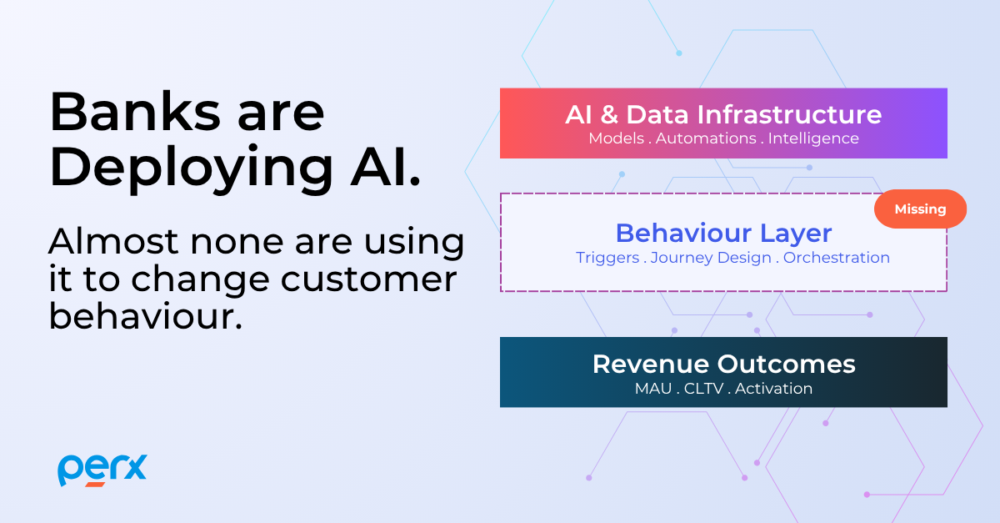
Banks Are Deploying AI. Almost None Are Using It to Change Customer Behaviour.

TL;DR — Read This First

The problem: BCG’s 2025 report identifies hyper-personalised customer engagement as the defining characteristic of the AI-first bank — worth $370B in profit potential by 2030. Most banks are spending AI budgets on back-office automation instead.

The gap: Deploying AI reduces cost. Using AI to engineer customer behaviour drives revenue. These are not the same thing, and most banks are only doing the first.

The three stages: BCG’s framework — Deploy → Reshape → Invent — maps exactly to this gap. Almost all BFSI institutions are stuck between Deploy and Reshape. The profit opportunity lives in Invent.

What’s required: Genuine hyper-personalisation needs four things: individual-level behavioural data, real-time triggers, mechanic design that changes behaviour, and attribution that closes at the P&L. Most banks have the first. Almost none have built the last three.

The earn-and-burn trap: Adding AI on top of a points program makes targeting more efficient but doesn’t change the underlying problem — you’re buying behaviour you don’t own.

The bottom line: The banks that win the AI era will be the ones who use it to engineer customer behaviour, not just automate customer interactions. The window to build that capability is open now.

BCG’s 2025 Global Retail Banking Report puts a number on what’s at stake: more than $370 billion in annual profit potential from AI by 2030. The industry has read it. Leadership teams have discussed it. Strategy decks have been updated.

And then most banks went back to automating their back office.

That is not a criticism of automation. Cutting cost-to-income ratios from 60%-plus down toward the 35% that well-run digital banks already operate at is a legitimate and urgent priority. AI agents handling collections, document extraction, sanctions screening — these deliver real P&L impact and the industry is right to pursue them.

But there is a second number buried inside that same BCG report, and it is the one most banks are not acting on. BCG names hyper-personalised customer engagement as a defining characteristic of the AI-first bank — not as a feature, but as the characteristic most likely to determine which banks pull away from the competition and which ones spend the next decade watching margin compress.

Fewer than 20% of banks have established quantified AI targets. Fewer than 15% have rebalanced their investment portfolios toward technology-driven revenue initiatives.

The industry knows what the destination looks like. It is not moving toward it.

This post is about why — and about what the actual path looks like for BFSI enterprises that are ready to use AI to change what customers do, not just to reduce what the bank spends.

The AI-First Bank Has a Customer Engagement Problem

Quick answer: Most banks are directing AI investment at operational cost reduction — fraud screening, document processing, back-office automation. BCG’s AI-first bank model requires a sixth dimension that most are skipping entirely: hyper-personalised customer engagement, which is a revenue driver, not a cost lever. Fewer than 20% of banks have quantified targets for this.

BCG describes the AI-first bank across six dimensions: hyper-personalised customer engagement, adaptive financial solutions, invisible embedded interfaces, autonomous operations, real-time risk and capital allocation, and a lean human core.

Five of those six are fundamentally operational. They reduce cost, compress headcount, and move decisions that humans used to make into algorithm-driven workflows. They are important. They are also where virtually all the AI investment is going right now.

Hyper-personalised customer engagement is different. It is not a cost play. It is a revenue play — and it requires something that automation cannot deliver on its own: a system designed to change what customers do, not just to respond to what they have already done.

📊 Stat Callout

“Retail bank revenue growth is forecast to slow to just 2–4% per year through 2029.” — BCG Global Retail Banking Report, 2025

At that growth rate, cost reduction alone does not close the gap. Revenue has to come from the customers you already have.

The distinction matters because the financial pressure banks face is not only a cost problem. Revenue growth across retail banking is forecast to slow to 2–4% per year through 2029. At that rate of growth, cost reduction alone does not save you. You need to grow revenue from the customers you already have — through deeper activation, higher product adoption, stronger repayment behaviours, and CLTV expansion that does not require proportionally growing the rewards budget.

That is a customer engagement problem. AI can solve it. But only if the AI is applied to the right layer.

📖 Definition

Hyper-personalised customer engagement — A customer engagement model in which every interaction is designed around the specific behavioural signals of an individual customer in real time, with mechanics built to drive the specific customer actions that produce measurable business outcomes. Distinguished from personalised marketing (which improves targeting) by its focus on behaviour change rather than message relevance.

Deploy, Reshape, Invent — Where Customer Engagement Actually Lives

Quick answer: BCG’s three-stage AI adoption framework — Deploy, Reshape, Invent — maps directly to where customer engagement value is created. Most BFSI enterprises are in Deploy (automating routines). The profit opportunity for customer engagement is in Invent — engineering customer behaviour at scale. The gap between these two stages is where most banks’ AI strategies currently fail.

BCG frames AI adoption across three stages. Most banks are in the first one.

Deploy is where you automate daily routines. Chatbots answer account queries. AI screens transactions for fraud. Documents get extracted and summarised without a human reading them. Cost comes down. Throughput goes up. This is real value — but it is value extracted from existing processes, not value created from customer behaviour.

Reshape is where AI starts to touch how the bank works with customers end-to-end. Personalised offers surface in the right channel at the right moment. Credit processes run faster because customer context is available in real time. Campaigns adapt to individual behaviour rather than segment averages. This is where most banks aspire to be, and where the minority of leading institutions are beginning to operate.

Invent is where entirely new value is created. The bank stops responding to customer behaviour and starts engineering it. Customer journeys are designed around the specific actions the bank needs customers to take — and the mechanics, triggers, and incentives are built to make those actions happen, at scale, without IT touching every campaign. MAU lifts. Cross-sell conversion moves. CLTV expands. And every outcome is traceable back to the engagement investment that produced it.

The gap in the BFSI market right now is not between Deploy and Reshape. The gap is between Reshape and Invent — specifically at the customer engagement layer.

Banks are spending on AI infrastructure. They are not spending on engagement design. And without engagement design, the infrastructure has nothing valuable to act on.

Definition

Behavioural loyalty — A loyalty model in which customer retention is built through repeated, designed behaviours rather than transactional rewards. The bank engineers the habit first; the reward, if any, reinforces an action the customer already values. Distinct from earn-and-burn loyalty, where the reward is the entire incentive and behaviour stops the moment the promotion ends.

What "Hyper-Personalised Engagement" Actually Requires

Quick answer: Hyper-personalisation in banking is not a recommendation engine or a chatbot with a customer’s name in it. It requires four things operating simultaneously: individual-level behavioural data, real-time triggers connected to journey mechanics, mechanic design that drives specific behaviours, and outcome measurement that traces engagement spend back to revenue. Most banks have the data. Almost none have built the other three.

The term hyper-personalisation has been absorbed into every vendor pitch in the market, which means it has started to mean very little. Let’s be precise about what it actually requires — because the requirements are more demanding than most loyalty and engagement programs are currently set up to meet.

Genuine hyper-personalisation in a banking context means four things working together simultaneously.

Behavioural data at the individual level. Not segment averages. Not demographic proxies. Real signals — what this customer did, in what sequence, at what frequency, and what that pattern predicts about what they will do next. Most banks have this data. Most banks are not using it at the engagement layer.

Real-time triggers connected to journey mechanics. The moment the signal fires is the moment the engagement needs to land. A customer who just made their third cross-border payment in a week responds to a travel insurance nudge differently than a customer who has never used international transfer. Static campaigns cannot capture this. Rules-engine-driven journey orchestration can.

Mechanic design that drives the behaviour the bank needs. This is the piece that is almost entirely absent from the current AI conversation in banking. It is not enough to know what a customer is likely to do — you need mechanics that make them more likely to do the thing that matters to the business. That is behavioural design. It is a discipline. It is learnable. And it is the difference between a personalised notification and a behaviour change.

Outcome measurement that closes the attribution loop. If engagement spend cannot be traced to a revenue outcome — activation, repayment, cross-sell conversion, MAU — then it is not defensible at board level.The measurement layer is not a reporting add-on. It is the mechanism that tells the next campaign what worked.

These four requirements do not describe a technology stack. They describe an engagement operating model. AI enables all four — but it cannot substitute for the design layer underneath them.

📊 Stat Callout

“Fewer than 20% of banks have established quantified AI targets. Fewer than 15% have rebalanced their investment portfolios toward technology-driven revenue initiatives.” — The Financial Brand, 2025

The gap is not ambition. It is execution at the engagement layer.

Why Earn-and-Burn Cannot Scale into the AI Era

Quick answer: Banks adding AI on top of legacy points programs are optimising the wrong system. Earn-and-burn trains customers to engage only when the reward is large enough — which means the bank is buying behaviour it doesn’t own. AI personalisation makes this more efficient but doesn’t change the logic. The AI-first bank runs on habit, not cashback. Behaviour change is the cause; the reward, if any, is the output.

Banks that are adding AI capability on top of legacy points programs are making a specific and expensive mistake. They are optimising the wrong system.

An earn-and-burn program is built on a transactional logic: do something the bank wants, receive a reward. The reward is the incentive. The problem is that this logic trains customers to engage when the reward is large enough and disengage the moment it is not. The result is a loyalty liability on the balance sheet, a rewards budget that grows without growing CLTV, and a customer relationship defined entirely by the last promotion the bank ran.

Adding AI personalisation to this model produces a more efficient version of the same problem. The bank now knows which customers to target with which offer at which moment — and is still using that knowledge to buy behaviour it does not own. The moment the cashback stops, the behaviour stops.

📖 Definition

Earn-and-burn — A loyalty program model where customers accumulate points or rewards by completing transactions, then redeem them for benefits. The engagement is entirely incentive-driven: without the reward, the behaviour typically stops. Earn-and-burn programs create loyalty liabilities on the balance sheet rather than genuine retention, and scale the rewards budget proportionally with program growth rather than with business outcomes.

The AI-first bank BCG describes does not run on cashback. It runs on habit — on customer journeys designed to make specific behaviours routine, intrinsically valued, and independent of the promotional cycle. That is a fundamentally different design problem from improving targeting. And it requires a fundamentally different platform to solve.

The Engagement Operating Model for an AI-First BFSI Bank

Quick answer: Moving from Deploy to Invent at the customer engagement layer is an operating model problem, not a technology acquisition. In practice, it means four things: defining behavioural targets before building mechanics, building journey triggers around real-time signals rather than campaign calendars, running campaigns without IT bottlenecks, and measuring ROI at the revenue line — not in clicks or open rates.

Moving from Deploy to Invent at the customer engagement layer requires an operating model — not a technology acquisition. Here is what that model looks like in practice for Tier 1 BFSI enterprises in APAC markets.

Start with the behaviour, not the reward. Define the specific customer actions that produce measurable business outcomes — first product activation within 30 days, second loan repayment on time, cross-sell conversion from savings to investment products. These are the behavioural targets. Every mechanic is built to move one of these numbers. [How Perx and UOB engineered banking engagement that moved MAU in 90 days]

Build the journey around the trigger, not the calendar. Campaign calendars are a Deploy-era artefact. Real-time behavioural triggers — a customer checks their credit score for the second time in a week, a wallet user makes their first merchant QR payment, a savings account holder crosses a deposit threshold — are the moments where engagement lands with precision. The platform needs to respond in real time, without an IT ticket.

Run without IT bottlenecks. Bank-grade compliance and no-code campaign execution are not in conflict — but most legacy systems make them behave as if they are. A marketing team that needs six weeks of IT resourcing to launch a behaviour-triggered campaign cannot operate at AI speed. The engagement layer needs to move as fast as the data does.

Close the attribution loop at the revenue level. Engagement ROI measured in clicks and open rates does not survive a CFO review. The metric that matters is the behaviour change — did activation go up? Did cross-sell conversion move? Did repayment rate improve? — and the revenue that behaviour change produced. Every engagement investment should produce a number that belongs in a board deck.

This is what the Reshape → Invent movement looks like at the engagement layer. It is not a technology project. It is a design and measurement project that technology enables.

📊 Stat Callout

“BCG estimates AI implementation can slash banks’ costs by as much as 40% — while the $370B profit opportunity from AI by 2030 remains largely untapped at the engagement layer.” — BCG Global Retail Banking Report, 2025

The cost story is being captured. The revenue story is still available.

Conclusion

BCG’s $370 billion number is real. The AI-first bank is not a concept — it is a competitive position that a small number of institutions will occupy by 2030, and the rest will compete against.

The banks that get there will not be the ones with the most sophisticated AI infrastructure. They will be the ones who directed that infrastructure at the right problem: engineering customer behaviour that drives revenue, not just automating customer interactions that reduce cost.

Hyper-personalised customer engagement is not a feature of the AI-first bank. It is the revenue engine of the AI-first bank. And it requires an engagement operating model — behavioural design, real-time orchestration, compliance-grade execution, and attribution that closes at the P&L — that most banks do not yet have in place.

The window to build it is open. The institutions moving now are already pulling ahead on MAU, activation, and CLTV. The ones waiting for the AI infrastructure to mature before addressing the engagement layer are building the wrong foundation.

Key Takeaways — What You Just Read
  1. BCG’s $370B AI profit opportunity is real — but most banks are chasing the wrong part of it. Back-office automation delivers cost reduction. Customer engagement engineering delivers revenue growth. These require different strategies.
  2. The Deploy → Reshape → Invent ladder maps directly to where engagement value lives. Most banks are in Deploy. The engagement profit opportunity is in Invent. The gap between the two is the Behaviour Gap.
  3. Hyper-personalisation requires four layers — not one. Individual behavioural data + real-time triggers + mechanic design + P&L-level attribution. Most banks have the data. Almost none have built the other three.
  4. AI on top of earn-and-burn is the wrong investment. It improves the efficiency of a system that is already failing. The foundation needs to change before the AI can do useful work on it.
  5. The engagement operating model is not a technology project. It is a design and measurement project that technology enables. Banks that treat it as a procurement decision will still be in Deploy by 2030.

Ready to map your own engagement gap? Run the Tier 1 Engagement Audit — it takes 10 minutes and shows you exactly where your program is leaking revenue.

If you are ready to understand exactly where your current engagement model is leaving revenue behind — and what the path to Invent looks like for your business — talk to the Perx team.

Frequently Asked Questions

What is AI-driven customer engagement in banking?
AI-driven customer engagement in banking uses real-time behavioural data, predictive models, and automated journey mechanics to change what customers do — not just to respond to what they have already done. The distinction is critical: AI applied to customer engagement should increase activation, product adoption, and CLTV by engineering specific customer behaviours, not just by automating service interactions. A bank using AI to flag a cross-sell opportunity is doing service automation. A bank using AI to trigger a journey that makes a customer 40% more likely to activate a second product within 30 days is doing customer engagement.
Personalised offers target the right customer with the right product at the right moment — this is improved targeting. Hyper-personalisation goes further: it uses real-time behavioural signals to design the entire customer journey, not just the offer. It requires four things working together: behavioural data at the individual level, real-time trigger architecture, mechanic design that changes behaviour, and outcome measurement that traces engagement spend back to revenue. Most banks have achieved the first. Almost none have built the last three. The difference between the two is the difference between a smarter notification and a behaviour change
Deploying AI reduces the cost of existing operations — automating document processing, fraud screening, and customer service routing. This is the Deploy stage in BCG’s three-stage model and is where most banks currently operate. Using AI to change customer behaviour requires a different design layer entirely: journey mechanics built around specific behavioural targets, real-time triggers connected to those mechanics, and measurement that closes the loop between engagement investment and revenue outcome. BCG calls this the Invent stage. The gap between Deploy and Invent is where most banks’ AI strategies currently stall — and where the $370B profit opportunity largely sits.
BCG’s Deploy–Reshape–Invent framework describes three stages of AI maturity in banking. Deploy means automating existing routines — fraud detection, document processing, chatbots. Reshape means optimising customer-facing processes end-to-end — personalised offers, faster credit decisions, real-time campaign adaptation. Invent means engineering entirely new value — designing customer journeys that change behaviour, creating habit loops independent of promotional budgets, and building engagement infrastructure that traces every customer action to a revenue outcome. Most banks are in Deploy. The Reshape-to-Invent movement at the customer engagement layer is where competitive advantage will be determined through 2029.
Earn-and-burn programs train customers to engage when the reward is large enough and stop when it is not — creating a loyalty liability rather than genuine retention. Adding AI personalisation to this model improves targeting efficiency but does not change the underlying logic: the bank is still buying behaviour it does not own. When the cashback stops, the behaviour stops. The AI-first bank requires a behaviour-led design layer where customer actions become habit, not incentive-response. Points are the output of loyalty. Behaviour change is the cause. Banks that build AI personalisation on top of earn-and-burn are optimising the wrong system.
The correct measurement framework connects engagement investment directly to revenue-line outcomes: activation rate within a defined window (typically 30–90 days), cross-sell conversion lift, repayment behaviour improvement, MAU growth, and CLTV expansion over a 12-month period. Engagement metrics measured in clicks, open rates, or points issued are not board-level numbers — they measure activity, not outcome. The metric that survives a CFO review is the behaviour change and the revenue it produced. Every engagement investment should be traceable from the mechanic that triggered the behaviour to the P&L line it moved.
A real-time behavioural trigger is a specific customer action — or pattern of actions — that automatically initiates a personalised engagement journey. Examples: a customer checks their credit score twice in one week (trigger: home loan journey); a wallet user completes their first QR payment (trigger: merchant rewards activation); a savings account holder crosses a deposit threshold for the third consecutive month (trigger: investment product cross-sell). The trigger fires the moment the signal appears — not at the next campaign cycle, not in the next weekly batch. The platform responds in real time, without an IT ticket, with a mechanic designed specifically for that behaviour.
Traditional loyalty programs — typically earn-and-burn point systems — are transactional: customers receive rewards for completing specific actions. The engagement is entirely incentive-driven and stops the moment the reward is removed. Behavioural loyalty is designed differently: the goal is to make specific customer actions routine, intrinsically valued, and independent of the promotional cycle. Journey mechanics, gamification, and real-time triggers build the habit first; any reward reinforces an action the customer already values. The result is a customer relationship that does not need a cashback budget to sustain it — and a loyalty investment that appears on the right side of the P&L.

Recommended for you

Best Enterprise Loyalty Program Software in 2026

Praveen Vadla

Senior Marketer | May 15, 2026

Best Enterprise Loyalty Program Software Companies in 2026

Quick Answer

The top enterprise loyalty program software companies in 2026 are Perx Technologies, Antavo, Comarch, Talon.One, Capillary Technologies, LoyaltyLion, and SessionM. The right platform depends on your industry vertical, existing infrastructure, and whether your primary requirement is behavioral loyalty depth, BFSI compliance, or omnichannel retail coverage.d

Most enterprise loyalty software looks impressive during a demo. The cracks appear six months after go-live, when marketing needs to launch a new campaign and the answer is a 12-week IT queue. When compliance flags a data handling issue that the vendor’s roadmap has no timeline to address. When the program generates strong engagement metrics but no one can show how that translates to revenue.
For Tier 1 banks, telcos, insurers, and large retailers, the stakes are higher than for a mid-market ecommerce brand. You are running millions of customer profiles across multiple products, markets, and regulatory environments. The platform you choose needs to do more than manage points. It needs to integrate with complex legacy infrastructure, give marketing teams autonomy without creating compliance risk, and prove its impact on the P&L, not just a dashboard.
This guide compares seven enterprise loyalty platform vendors actively deployed at scale. The assessment is structured around what actually matters in a high-stakes BFSI or enterprise buying process: architecture fit, compliance readiness, behavioral depth, and speed to market.
Key Takeaways
  • Most enterprise loyalty platforms are built for retail. Only a small number are purpose-built for BFSI compliance, behavioral depth, and banking-grade integration requirements.
  • Perx Technologies is the only platform in this comparison built natively for Tier 1 banks, insurers, and telcos in APAC.
  • API-first, headless architecture is the single most important technical criterion for enterprise buyers who want marketing autonomy after go-live.
  • The SessionM and Capillary acquisition (announced February 2026) introduces platform continuity risk that buyers should assess before shortlisting.
  • A comparison table and industry-specific buying guidance follow in the sections below.

What Makes Enterprise Loyalty Software Different from SMB Tools

Enterprise loyalty platforms operate in a different category from small-business or ecommerce-focused tools. The distinctions are not just about scale; they reflect fundamentally different operational requirements.

  • Volume and real-time processing: Enterprise programs handle millions of member events daily. A platform that cannot process real-time transaction triggers at scale will create reward delays, redemption failures, and member trust issues.
  • IT and integration complexity: Enterprise stacks include core banking systems, CRMs, CDPs, POS networks, and mobile applications. A loyalty platform that requires deep IT involvement for every change becomes a bottleneck. The best platforms decouple loyalty logic from the rigidity of core infrastructure, allowing marketing teams to iterate independently. [INTERNAL LINK: Tier 1 Engagement Audit — IT Bottleneck Tax]
  • Compliance and data governance: Particularly in BFSI, loyalty platforms must meet ISO/GDPR standards, support data sovereignty and on-premise deployment options, and maintain audit trails for every rule change and reward transaction.
  • Multi-product, multi-market program logic: A bank running loyalty across credit cards, savings accounts, loans, and insurance products needs a rules engine granular enough to reward different behaviors across different products without building a separate program for each.
  • Metric-to-profit attribution: Enterprise programs cannot justify budget with engagement metrics alone. The platform needs to bridge loyalty activity to hard financial outcomes (transaction lift, CLTV improvement, churn reduction) in a way that a CFO or board can evaluate. [INTERNAL LINK: Tier 1 Engagement Audit — Vanity Metrics Blindspot]

What Enterprise Buyers Should Evaluate Before Shortlisting

Before entering any vendor demo, define your evaluation criteria based on your industry and operational context. The following criteria are relevant across enterprise environments but carry particular weight in BFSI and regulated sectors.

Architecture fit. Is the platform API-first and composable, or does it require your stack to conform to its structure? Headless architecture enables loyalty logic to sit alongside your core systems, not inside them.

Decoupling loyalty from core banking. Legacy core banking systems are not built for agile campaign iteration. Look for platforms that operate independently of your core, receiving event data via API rather than embedding loyalty logic in the banking layer.

Behavioral depth vs. transactional mechanics. Earn-and-burn point systems drive redemptions. Behavioral loyalty platforms drive habits. The difference matters for CLTV and for industries like insurance and banking, where transaction frequency alone does not tell the full customer story.

Campaign launch speed. How many weeks does it take to launch a new campaign? Can marketing teams configure, test, and go live without filing a development request? This is often the single biggest factor in whether a loyalty program stays competitive post-launch.

Security and regulatory compliance. ISO certification, GDPR readiness, RBAC, and on-premise deployment options are non-negotiable for most BFSI enterprise buyers.

Reporting and attribution. Can the platform directly attribute loyalty engagement to financial KPIs? Dashboards that report clicks and points earned are useful for operations. Dashboards that show interest income lift, policy renewal rates, or cross-sell conversion are useful for the board.

The Top Enterprise Loyalty Program Software Companies in 2026

The following platforms are evaluated through an enterprise lens, with particular attention to BFSI suitability, integration approach, and behavioral capabilities. Each entry follows a consistent format to support direct comparison.

At a Glance: Platform Comparison

Platform Best For Architecture BFSI Fit
Perx Technologies BFSI: banks, insurers, telcos (APAC) API-first, headless, on-premise available ★★★★★
Antavo Omnichannel retail and fashion brands API-first, modular ★★★☆☆
Comarch Multi-market enterprise, travel, retail Cloud and on-premise ★★★☆☆
Talon One Technical enterprise teams, retail/ecommerce Headless, rules-driven ★★☆☆☆
Capillary Technologies APAC retail and consumer enterprise SaaS, omnichannel CDP + loyalty ★★★☆☆
LoyaltyLion Mid-market ecommerce (Shopify/BigCommerce) SaaS, ecommerce-native ★★☆☆☆
SessionM Data-led enterprise loyalty (under acquisition) API-first, real-time decisioning ★★★★☆
Perx Technologies  |  BFSI-Native Behavioral Loyalty Platform
Perx Technologies is a behavioral loyalty platform built natively for Tier 1 banks, insurers, and telcos in APAC, with ISO/GDPR compliance and a Metric-to-Profit Attribution engine that connects engagement directly to P&L outcomes.
Best For Tier 1 banks, insurers, telcos, and large BFSI brands in APAC looking to move beyond earn-and-burn and tie loyalty outcomes directly to revenue.
Architecture API-first, headless architecture with on-premise deployment availability. Compliance architecture meets local regulatory requirements before shortlisting.
BFSI Fit ★★★★☆ Strong fit for omnichannel retail and fashion. Limited native BFSI capability.
Talon.One  |  Headless Promotions and Loyalty for Technical Enterprise Teams
Talon.One is a headless promotions and loyalty platform built for enterprises with strong in-house engineering teams, offering granular rules-driven logic across loyalty, promotions, and gamification in a single API-first layer.
Best For Enterprises with strong in-house engineering capability that want real-time, rules-driven loyalty and promotions through a flexible headless architecture.
Strengths
  • Headless architecture gives technical teams granular control over reward logic, tier structures, and cross-channel campaign execution.
  • A single platform for promotions, loyalty, and gamification reduces stack fragmentation for brands managing multiple incentive types.
  • Clients include Adidas, Sephora, and Joe & The Juice, demonstrating scale in high-volume retail environments.
Limitations
  • The headless model requires significant engineering ownership. Value is highest for organisations with mature internal technical teams.
  • Not purpose-built for BFSI; financial services compliance requirements, banking-grade security, and regulatory integrations would need independent assessment.
BFSI Fit ★★★☆☆ Well-suited to technically sophisticated retail and ecommerce enterprises. BFSI buyers should evaluate compliance depth carefully.
Capillary Technologies  |  Enterprise Loyalty and Customer Data Platform for APAC
Capillary Technologies is an APAC-headquartered enterprise loyalty and CDP platform serving large retail and consumer brands, currently in the process of acquiring SessionM from Mastercard.
Best For Large enterprises in retail, food and beverage, and consumer industries in APAC and emerging markets looking for a combined loyalty, CDP, and omnichannel engagement platform.
Strengths
  • APAC-headquartered with strong regional presence, bringing relevant local market understanding for Southeast Asian and South Asian deployments.
  • Combines loyalty program management, a consumer data platform, analytics, and omnichannel engagement in a single offering.
  • Notable client relationships include Tata Group and Shell, indicating deployment capability in large, complex enterprise environments.
Limitations
  • Capillary announced a definitive agreement to acquire SessionM from Mastercard in February 2026. Buyers should conduct due diligence on platform roadmap and support continuity during the integration period.
  • Core product orientation is retail and consumer. BFSI-specific features, financial services compliance, and banking architecture integrations are not the platform's primary design focus.
BFSI Fit ★★★☆☆ Strong APAC enterprise option for retail and consumer industries. Financial services buyers should assess post-acquisition product direction.
LoyaltyLion  |  Ecommerce Loyalty Platform for Digital Retail Brands
LoyaltyLion is an ecommerce-native loyalty platform designed for mid-market and enterprise digital retail brands primarily on Shopify or BigCommerce, covering points, referrals, tiers, and retention mechanics.
Best For Mid-market to enterprise ecommerce brands primarily on Shopify or BigCommerce looking for a loyalty program with points, referrals, tiers, and integrated retention mechanics.
Strengths
  • Deep native integrations with major ecommerce platforms, making it straightforward to deploy for digital-first retail brands without complex infrastructure.
  • User-friendly interface with strong customisation options for points, referral incentives, and VIP tier structures.
  • Well-regarded customer support with a reputation for responsive issue resolution.
Limitations
  • Designed specifically for ecommerce and not architected for BFSI compliance, banking integration, or the scale and complexity of a Tier 1 financial institution.
  • Analytics capabilities have been noted by users as less suited to enterprise-grade reporting requirements.
BFSI Fit ★★☆☆☆ Effective for ecommerce loyalty at mid-market scale. Not an enterprise BFSI solution.
SessionM (Mastercard / Capillary)  |  Data-Led Enterprise Loyalty with Strong Customer Intelligence
SessionM is a data-led enterprise loyalty platform with real-time decisioning and strong customer profile unification, currently transitioning ownership as Capillary Technologies completes its acquisition from Mastercard.
Best For Large enterprises prioritising customer data unification, real-time decisioning, and loyalty tied closely to customer intelligence, particularly in sectors where data depth and measurement are core requirements.
Strengths
  • Strong customer profile unification and real-time API architecture suited to high-volume enterprise loyalty environments.
  • Clearly enterprise-oriented with documented experience in data-heavy, measurement-focused loyalty deployments.
  • Real-time decisioning capability supports sophisticated loyalty orchestration across channels.
Limitations
  • Ownership is actively transitioning: Capillary Technologies announced a definitive agreement to acquire SessionM from Mastercard in February 2026. Buyers should directly assess product roadmap continuity, support structure, and long-term platform direction before shortlisting.
  • Enterprise positioning typically means a more complex and time-intensive buying and implementation process.
BFSI Fit ★★★☆☆ Capable enterprise platform with data intelligence strengths. Active acquisition warrants due diligence on roadmap and continuity.

How to Choose the Right Platform for Your Industry

The right enterprise loyalty platform depends significantly on your industry context, existing infrastructure, and the primary job you need loyalty to perform.

Banks and Financial Services

For Tier 1 banks and insurers, loyalty is not just a retention tool. It is a behavioral instrument for increasing product utilisation, reducing churn, and improving CLTV across a multi-product portfolio. Prioritise platforms that are natively compliant with financial services regulations, capable of integrating with core banking infrastructure without embedding loyalty logic inside it, and able to attribute program outcomes directly to financial KPIs. Points mechanics alone are insufficient; behavioral journey design with streaks, quests, and personalised milestone rewards is what moves the needle on habit formation and long-term value. [INTERNAL LINK: Tier 1 Engagement Audit — Static Points Trap]

Telcos

For telecommunications companies, the loyalty challenge centres on turning low-engagement customers into high-frequency app users and reducing prepaid churn. The most relevant platform capabilities are real-time event triggers tied to usage behaviours (data top-ups, bill payments, device upgrades), gamification mechanics that drive weekly or daily engagement, and analytics that track Monthly Active Users (MAU) as the primary engagement KPI. Telco loyalty programs also benefit from coalition reward structures that give customers reasons to engage beyond the core product.

Retail and FMCG

Retail and FMCG enterprises require omnichannel loyalty mechanics that work across physical stores, ecommerce, and third-party marketplaces. Key requirements include POS integration for in-store reward validation, receipt scanning for offline purchase capture, and the ability to run multi-brand or coalition structures for conglomerates with diverse retail portfolios. The platforms strongest in this category include Antavo, Capillary, and Talon.One, all with documented deployments in large retail environments.

Red Flags to Watch for in Any Enterprise Loyalty Platform Demo

Platform demos are designed to show platforms at their best. These are the questions that reveal how a platform behaves after go-live.

  • The demo requires pre-configured scenarios. If a vendor cannot demonstrate a rule change or new campaign configuration in real time during the demo, assume it requires developer involvement in production.
  • No published case studies from your industry. Generic retail success stories are not evidence that a platform can handle BFSI compliance requirements or banking-grade integration complexity.
  • Metrics dashboards show engagement activity, not revenue attribution. If the vendor cannot show you a clear path from loyalty mechanics to financial outcomes, assume they cannot answer that question for your CFO either.
  • ‘Customisable’ without a defined implementation timeline. In enterprise loyalty, ‘fully customisable’ often means 6 to 9 months of professional services before a live campaign. Ask for a specific time-to-first-campaign figure.
  • Vague answers on post-launch iteration speed. The real test of a loyalty platform is how quickly the team can change a reward rule, add a new segment, or launch a campaign after the initial deployment, not on launch day.

Frequently Asked Questions

What is enterprise loyalty program software?
Enterprise loyalty program software is a platform that enables large organisations to design, operate, and optimise customer loyalty programs at scale, with deep integration into existing enterprise infrastructure and attribution reporting tied to measurable business outcomes.
Unlike SMB-focused tools, enterprise platforms are built to manage millions of customer profiles, handle real-time transaction events across multiple channels, support complex rules logic for different products and markets, and integrate with systems including CRM, CDP, POS, and core banking. The strongest enterprise platforms provide attribution reporting that connects loyalty activity directly to financial KPIs.
For banks and financial services enterprises, Perx Technologies is the most purpose-built option, with native BFSI compliance, on-premise deployment, and a Metric-to-Profit Attribution engine that connects engagement to P&L outcomes.
The most relevant platforms for BFSI buyers are those built natively for financial services compliance, capable of integrating with core banking infrastructure without requiring loyalty logic to sit inside the core system, and able to support behavioral loyalty mechanics beyond simple earn-and-burn. Other enterprise platforms such as Comarch and SessionM have documented financial services deployments but were not designed primarily for BFSI.
The most effective approach decouples loyalty logic from the core banking system entirely, with the platform receiving event data via API and processing reward logic independently without embedding it in the core.
Rather than embedding loyalty rules inside the core, the platform receives transaction event data via API, processes reward logic independently, and returns outcomes to the customer-facing layer. This means changes to loyalty rules (new rewards, updated tiers, new campaign mechanics) do not require core banking development cycles. Platforms with headless, API-first architecture such as Perx, Talon.One, and Voucherify are best suited to this integration model.
Transactional loyalty rewards customers for purchase events. Behavioral loyalty rewards a broader set of actions including app logins, product usage milestones, and habitual engagement patterns, and is designed to drive habits rather than one-off redemptions.
Behavioral loyalty is particularly relevant in BFSI, where transaction frequency alone does not reflect the full relationship between a customer and their bank or insurer. Behavioral mechanics like streaks, quests, and personalised challenges are designed to form habits and increase product engagement beyond the moment of transaction.
Implementation timelines range from 6 to 12 weeks for API-first platforms with no-code tooling, to 6 to 18 months for heavily customised enterprise suite deployments.
Suite-style enterprise platforms with heavy customisation (such as Comarch) typically require the longer end of that range. The more meaningful question is not time to launch but time to iterate: how quickly can a marketing team make a rule change or launch a campaign post go-live? Platforms that require IT involvement for every change will accumulate speed debt regardless of initial launch speed.
Enterprise buyers in regulated industries should confirm ISO 27001 certification, GDPR compliance architecture, on-premise or data residency deployment options, RBAC granularity, and audit trail capabilities for reward transactions and rule changes.
For BFSI enterprises specifically, also ask whether the platform has been deployed in live production environments at Tier 1 banks and whether compliance documentation is available for review during due diligence.

Recommended for you

Why Segmentation Is No Longer Enough: How Agentic AI Closes the Personalisation Gap

Azmeen Ansar

Azmeen Ansar

Head of Marketing | Apr 14, 2026

Why Segmentation Is No Longer Enough: How Agentic AI Closes the Personalisation Gap in Financial Services

Most banks know their customers better than those customers know themselves. The problem has never been the data. It’s been the operational capacity to act on it — for every customer, individually, at the right moment. Agentic AI is how that gap finally closes.

The data has never been the problem

A bank with two million retail customers can see when a customer’s spending velocity drops. It can identify which customers have explored a savings product three times without opening an account. It can flag, with reasonable precision, which customers are six weeks away from going dormant — before it happens.
This is not hypothetical. Most financial institutions already sit on exactly this intelligence. The data is there. The insight is there.
What has been missing is the operational capacity to act on it — for every customer, individually, at the moment it matters.
The institutions that have closed this gap have done so by rethinking the execution layer entirely. Agentic AI is how they got there.

Why segmentation hits a ceiling

For years, the standard architecture of customer engagement in financial services has been built on two pillars: segmentation and scheduled campaigns. The logic is sound. Different customers have different needs, and addressing those differences is better than ignoring them.
But this architecture has a ceiling — and most institutions have already hit it.

Segments are not individuals. A segment of ’25–34 year olds with a savings account’ might contain customers at radically different lifecycle stages, with different financial behaviours and different reasons for not having upgraded their product. Sending them all the same message at the same time is not personalisation. It is a better-than-average guess.

Scheduled campaigns miss the moment. Customer behaviour is continuous. Engagement windows open and close in real time — when a salary lands, when a spending pattern shifts, when a product is first explored and then abandoned. A campaign scheduled for the 15th of the month does not know that the optimal engagement window for a specific customer was the 8th. By the time it fires, the moment has passed.

SRules-based systems stagnate. A rules engine configured at deployment reflects what the institution knew about customer behaviour at that point in time. Customer behaviour evolves. A static rule set degrades in precision over time unless constantly maintained — which requires resources most teams do not have.
Detect
The agent monitors behavioural signals in real time: transaction patterns, app interaction depth, feature adoption, reward redemption behaviour, lifecycle stage, and early dormancy indicators. It does not wait for a scheduled reporting cycle. It watches continuously and identifies the signal the moment it appears.
Decide
Based on pre-configured rules and learned patterns, the agent determines what action is most likely to drive the desired outcome for this specific customer at this specific moment. Not this segment. This customer. The decision accounts for that individual’s history, current behaviour, channel preference, and the business objective the institution has defined.
Act
The agent fires the engagement — a personalised mission, a spend challenge, a reactivation sequence, a reward adjustment, a cross-sell prompt — through the appropriate channel, at the appropriate time, calibrated to the appropriate reward value for that customer’s tier and behaviour profile.
This cycle does not run quarterly. It does not run weekly. It runs continuously, for every customer in the base simultaneously.

What this looks like in practice

Institutions that have deployed agentic engagement have reported consistent, material outcomes across markets:
70-90%
activation rate
Agentic-led activation journeys reach 70–90% completion — compared to the industry average of 28–42% on traditional static onboarding flows. The difference is not better campaign design. It is real-time signal matching: the journey adjusts to individual behaviour rather than expecting individual behaviour to conform to a fixed journey.
2-12x
MAU increase
Monthly active user counts have grown between 2x and 12x across deployments. Customer interaction frequency has risen from an average of 2.1 events per user per month to 9.3 — reflecting the difference between customers who receive relevant engagement at the right moment versus those who receive broadcast communications on a schedule.
8-21x
ROI
Return on engagement investment has reached 8–21x across live deployments, with reward costs held to 0.6–2.1% of total transaction value driven. Precision in signal matching means reward spend is concentrated where it drives the most behavioural change per dollar — not distributed evenly across a segment.

The signal layer: where meaningful personalisation begins

Agentic AI is only as intelligent as the signals feeding it. In financial services, the signal layer is unusually rich. The challenge is not data scarcity — it is signal prioritisation and real-time accessibility.

The five signal types that carry the most value for engagement decisions:

  • Transactional — real-time spend data revealing what customers buy, how often, and where. A shift in transaction frequency in a specific category is often an early indicator of a lifecycle change that, acted on promptly, represents either a risk to manage or an opportunity to capture.
  • Engagement — how far a customer navigates into a product feature before abandoning. The difference between a customer who viewed a savings product for four seconds and one who reached the application screen before dropping off requires a materially different response.
  • Lifecycle — where a customer is in their relationship trajectory: accelerating toward deeper engagement, plateauing, or beginning the slow withdrawal that precedes churn. Identifying this early is what makes proactive intervention possible.
  • Redemption — what rewards a customer selects and how quickly they use them. This is a precise, survey-free map of individual preference and perceived value that directly informs incentive calibration.
  • Event — time-sensitive moments such as salary credit, loan repayment completion, or a first international transaction. An engagement fired at the right event signal lands in a context where the customer is already thinking about their finances. The same engagement fired on a scheduled cadence may simply be noise.

Why human oversight is not optional in financial services

Agentic There is a version of the agentic AI story that positions human involvement as a bottleneck to be eliminated. In financial services, this framing is not just wrong — it is commercially counterproductive.

The institutions that have achieved the strongest long-term outcomes from agentic engagement have not removed humans from the process. They have been precise about where humans add the most value — and built their architecture around that precision.

Strategy and objective ownership. An agent optimises toward a goal. Humans define what that goal is. No AI system should be determining what a financial institution is trying to achieve with its customers. That is a strategic decision, and it belongs with people who carry accountability for it.

Rule governance. The parameters within which an agent operates must be human-configured and reviewed. This is not a constraint on the AI’s effectiveness. It is the governance layer that makes the AI trustworthy at scale.

Anomaly review. Well-designed agents flag actions that fall outside expected parameters before executing them. A human reviewer at this point catches the edge cases that no rule set fully anticipates.

Regulatory accountability. Regulators are tightening requirements around automated decision-making in financial services — specifically around explainability and accountability. Every automated action in a human-in-the-loop architecture traces back to a human-approved rule. That auditability is a compliance requirement.

The bank’s loyalty manager can see every active journey in a live dashboard. They can pause it, override it, or adjust the underlying rule. They have not been removed from the process. They have been elevated within it.

What this means for financial services leaders

The question facing financial institutions is no longer whether to deploy AI in customer engagement. The capability exists, the evidence is strong, and the competitive pressure from institutions that have already moved is real.

The more important question is how to deploy it in a way that is genuinely personalised rather than merely automated — that scales without losing precision, and that operates within the governance and accountability structures that financial services demand.

The answer is neither full manual execution nor unchecked autonomy. It is agentic AI operating within a human-governed architecture, where machines execute at the speed and granularity that individual personalisation requires, and humans govern at the level of strategy, rules, interpretation, and accountability.

The institutions that get this right will not just run better engagement programmes. They will build a capability that compounds — becoming more precise, more effective, and more commercially impactful with every customer interaction.

That is what personalised at scale actually means.

Download ebook

Personalised at Scale: How Agentic AI Is Redefining Customer Engagement in Financial Services. Includes the complete Detect-Decide-Act-Optimise framework, behavioural signal guide, human-in-the-loop governance model, and live deployment benchmarks from 30+ markets.

FAQs:

What is agentic AI in customer engagement?
Agentic AI refers to AI systems that do not simply analyse or recommend — they act. An agent perceives a behavioural signal, makes a decision, executes an engagement action, observes the outcome, and adjusts. This loop runs continuously, across the entire customer base, simultaneously — enabling genuine personalisation at the scale of millions without manual intervention.
Traditional marketing automation executes pre-defined campaigns on schedules. Agentic AI operates in real time — detecting individual behavioural signals, making decisions for specific customers at specific moments, and adjusting based on observed outcomes. The result is engagement that responds to individual behaviour rather than expecting customers to conform to a fixed campaign structure.
Based on live deployments across 30+ markets: 8–21x ROI on engagement investment, 2–12x monthly active user increases, and reward costs held to 0.6–2.1% of total transaction value. These outcomes reflect the precision that real-time signal data makes possible — reward spend concentrated where it drives the most behavioural change per dollar.
Detect monitors behavioural signals in real time. Decide determines the optimal action for this specific customer at this moment — not this segment. Act fires the personalised engagement through the right channel at the right time. Optimise observes the outcome and adjusts the next decision accordingly. This cycle runs continuously for every customer simultaneously — no manual intervention required between cycles.
In regulated financial services, every automated action must trace back to a human-approved rule — providing the auditability that regulators increasingly require. Beyond compliance, human oversight governs strategic objectives, rule configuration, anomaly review, and insight interpretation. Institutions with robust human governance have maintained reward cost efficiency at 0.6–2.1% of transaction value precisely because agent behaviour boundaries are clearly defined.
Five signal types carry the most value: Transactional (spend patterns, frequency, merchant category), Engagement (app navigation depth, feature exploration depth), Lifecycle (customer trajectory — accelerating, plateauing, or drifting toward churn), Redemption (reward selection as a precise preference map), and Event (salary credit, loan repayment — time-sensitive windows of elevated financial attention).

Recommended for you

Tier 1 Engagement Audit: 3 Loyalty Leaks Draining Your BFSI Stack

Azmeen Ansar

Azmeen Ansar

Head of Marketing | Apr 2, 2026

The Tier 1 Engagement Audit: 3 Loyalty Leaks We Find in Every Legacy Stack

Your loyalty program is live. Your points engine is running. Redemption rates are… acceptable.
So why are your Monthly Active Users flat? Why does your CFO keep asking what the program is actually doing for revenue?
The answer isn’t that loyalty doesn’t work. It’s that most BFSI loyalty programs are built on legacy assumptions – and those assumptions are silently leaking revenue, engagement, and customer lifetime value every single quarter.
After working with Tier-1 banks, digital challengers, and fintech superapps across APAC – including a digital banking engagement program that drove measurable transaction lift for UOB – we’ve developed a Tier 1 Engagement Audit to diagnose exactly where engagement breaks down. Almost every legacy stack has the same three leaks. This is what they are, and what it costs you to ignore them.

What Is a Tier 1 Engagement Audit?

A Tier 1 Engagement Audit is a structured diagnostic review of a BFSI loyalty or engagement program – mapping where customers disengage, where incentive spend is wasted, and where your platform’s architecture is limiting your marketing team’s ability to act.

It’s not a product demo. It’s not a feature comparison. It’s a P&L-first analysis of your engagement stack, covering:

  • Behavioral data patterns: where customers drop off the engagement loop
  • Incentive efficiency: the ratio of reward spend to revenue-generating behavior
  • Platform velocity: how long it takes to go from campaign idea to live customer journey
  • Churn signals: the behavioral precursors to attrition that most dashboards miss
The audit is designed for marketing and growth leaders at institutions that already have a loyalty program, but suspect (or know) it isn’t performing at its potential.
If your loyalty program can’t answer “how much revenue did this campaign generate last quarter?” you need an audit.

Loyalty Leak #1 - The Static Points Trap (Earn-and-Burn Without Behavioral Lock-In)

What it looks like

Your program rewards transactions. Customers earn points. Some redeem. Most don’t engage beyond the basic earn cycle. Your redemption rate is decent on paper, but app opens, cross-sell conversion, and product adoption haven’t moved.

This is the Static Points Trap, a program designed around financial utility rather than behavioral psychology.

Why it happens

Legacy loyalty platforms were engineered to manage point ledgers, not engineer habits. They track what customers did, not why, and they offer no mechanics to influence the next action. The result: a functional points economy with zero psychological pull.

The Octalysis Framework, a behavioural psychology model underpinning the most effective gamification strategies in loyalty today, identifies Loss Aversion, Epic Meaning, and Unpredictability as the three most powerful drivers of sustained daily habit. Standard earn-and-burn programs activate none of them.

Understanding how this works at a psychological level matters. The Dopamine Domino Effect – the chain reaction of small wins that keeps customers habitually engaged – is exactly what static points programs fail to trigger.

What to look for in your own stack

Run this self-check:

  1. Does your program reward non-transactional behaviors (app logins, profile completion, quiz engagement)?
  2. Do you have multi-dimensional tiers that reward total relationship value — not just spend?
  3. Can customers see a progress bar toward their next reward or tier milestone?
  4. Do you have streak mechanics that create a psychological cost to breaking engagement?

If the answer to any of these is “no” or “our platform can’t do that,” you have Loyalty Leak #1.

The fix: Replace static earn-and-burn with a behavioral points architecture. This means rewarding micro-engagements, deploying streak and milestone mechanics, and building tiering systems that create genuine loss aversion.

What it costs you

  • Flat MAU: Customers have no reason to open your app except to transact. No habit, no daily engagement, no cross-sell opportunity.
  • Low CLTV uplift: Without tiering mechanics that create psychological lock-in, your highest-value customers are just as likely to leave as your lowest.
  • Wasted acquisition cost: You spend to acquire a customer, activate them into the points program, and then lose them to inertia.

A digital bank we work with had a points program running for three years. When we ran the engagement audit, we found that fewer than 12% of enrolled customers had interacted with the program in the past 90 days. The fix wasn’t more points; it was adding Daily Streaks, Progress Bars, and Tier Status mechanics that created loss aversion around earned status. Within two quarters, their returning customer rate reached 72%. The mechanics behind that shift are covered in detail in our best practices for engagement gamification guide.

If your loyalty program can’t answer “how much revenue did this campaign generate last quarter?” you need an audit.
The audit is designed for marketing and growth leaders at institutions that already have a loyalty program, but suspect (or know) it isn’t performing at its potential.

Loyalty Leak #2 - The IT Bottleneck Tax (Campaigns That Take Months, Not Hours)

What it looks like

Your marketing team has a campaign idea. It requires a new rule – maybe a double-points weekend for a specific product segment, or a flash quest tied to a payment milestone. The idea goes into the IT backlog. Six weeks later, it launches – after the moment has passed.

This is the IT Bottleneck Tax – and it’s one of the most expensive leaks in enterprise BFSI loyalty programs. You’re paying for it in missed market moments, stale campaigns, and a marketing team that has quietly stopped trying to innovate.

Why it happens

Legacy loyalty platforms were built for IT teams, not marketing teams. Campaign logic is hardcoded or requires developer intervention to modify. Rules engines – if they exist – operate at the transaction level with limited metadata support. Launching a new campaign means a change request, a development sprint, a QA cycle, and a deployment window.

The gap between “market opportunity” and “live campaign” is measured in months.

What it costs you

  • Missed revenue windows: Seasonal moments, competitor moves, and customer lifecycle events require real-time response. A 6-week IT cycle makes all of them irrelevant.
  • Over-reliance on batch campaigns: When speed is impossible, teams default to scheduled, broadcast campaigns — the bluntest possible instrument for behavioral change.
  • Marketing team attrition: The best growth marketers leave environments where their ideas die in Jira queues. You lose institutional knowledge and momentum simultaneously.

In competitive APAC markets – where mobile-native customers respond to “surprise and delight” moments in real time – the IT Bottleneck Tax is a direct competitive disadvantage. A challenger bank with a modern engagement stack can respond to a competitor’s pricing change with a targeted behavioral campaign in hours. A legacy-stack incumbent responds in quarters.

The math is stark: if your platform constrains you to six campaign launches per year, and a modern stack enables 60+, you are operating at 10% of your potential engagement velocity. The rules engine is the core enabler here – how a precision rules engine creates the ultimate customer journey walks through exactly how granular event-driven logic changes what’s possible for marketing teams.

What to look for in your own stack

  1. How long does it take from campaign brief to live campaign – honestly?
  2. Can your marketing team change campaign rules without an IT ticket?
  3. Does your rules engine support granular transaction metadata (merchant category, amount thresholds, channel, time-of-day)?
  4. Can you A/B test incentive mechanics in real time without engineering involvement?

If your answer to #2 is “no,” you have Loyalty Leak #2, and you’re paying the IT Bottleneck Tax on every campaign you run.

The fix: The architectural solution is a headless, API-first campaign orchestration layer that decouples loyalty logic from core banking infrastructure. Marketers should be able to build, test, and launch complex campaigns with zero code – including real-time rule adjustments mid-campaign.

Loyalty Leak #3 - The Vanity Metrics Blindspot (Dashboards That Don't Speak P&L)

What it looks like

You have a dashboard. It shows enrolled members, points issued, redemptions, and maybe an app engagement rate. Your QBR deck is full of these numbers. Your CMO presents them to the board.

But when the CFO asks “how much revenue did the loyalty program generate last quarter?” – there’s silence, or at best, a correlation story that nobody fully believes.

This is the Vanity Metrics Blindspot – the gap between engagement data and financial proof. And it’s the leak that threatens the program’s budget every single year.

Why it happens

Most loyalty platforms were built to operate programs, not to justify them. Their reporting layers track program mechanics (points issued, vouchers redeemed, tier movements) but have no native connection to financial outcomes (transaction lift, NPS-to-revenue correlation, churn-prevented CLTV, cross-sell conversion by segment).

The result: loyalty leaders speak in “engagement” while CFOs speak in “currency” – and the conversation never fully connects. The internal politics this creates – and how to navigate them – are covered in loyalty program internal politics and ROI, one of the most practically useful reads for anyone trying to protect a loyalty budget.

What it costs you

  • Budget vulnerability: Without a direct P&L bridge, loyalty programs are perpetually at risk of being cut or underfunded. They’re treated as cost centers, not revenue drivers.
  • Wrong optimization signals: If you’re optimizing for redemption rate instead of transaction lift or CLTV expansion, you’re tuning the wrong metric – and you may be over-rewarding unprofitable behavior.
  • Missed churn prevention: The behavioral signals that predict churn (declining login frequency, reduced transaction velocity, dropped streak) are invisible in points-ledger dashboards – until the customer is already gone.

One enterprise we audited was spending heavily on a cashback program that showed strong redemption numbers. When we ran a Metric-to-Profit Attribution analysis — mapping specific mechanics to financial outcomes — we found that 60% of the cashback budget was flowing to a customer segment with zero incremental transaction lift. The spend was rewarding behavior that would have happened anyway.

Reallocation to behavioral nudges (streaks, quests, milestone rewards) targeting mid-tier segments generated $6.6M in incremental transaction value in the following two quarters. The framework for transforming engagement metrics into ROI is the methodology that makes this reallocation defensible to finance teams.

What to look for in your own stack

  1. Can you directly attribute a specific campaign mechanic to a revenue outcome (transaction lift, product adoption, churn prevention)?
  2. Do you have cohort-level behavioral data – not just aggregate engagement metrics?
  3. Can you identify at-risk segments before they churn, based on behavioral signals?
  4. Does your reporting distinguish between additive customer behavior (new transactions triggered by the program) and subsidized behavior (rewarding what customers would have done anyway)?

If your dashboard can’t answer these questions, you have Loyalty Leak #3, and your program’s budget will always be a political negotiation rather than a business case.

The fix: Replace vanity dashboards with a Metric-to-Profit attribution layer, direct mapping of engagement mechanics (streaks, quests, points) to hard financial outcomes like Interest Income, Policy Renewal rates, and GMV lift. This is the difference between having “data” and having “alpha.”

The Compound Effect - Why These Three Leaks Reinforce Each Other

The three loyalty leaks rarely travel alone. In legacy BFSI stacks, they compound.

A program without behavioral mechanics (Leak #1) generates flat engagement data, which makes Leak #3’s Vanity Metrics Blindspot harder to fix because there’s nothing meaningful to measure in the first place. Meanwhile, the IT Bottleneck (Leak #2) prevents the team from running the experiments that would generate the behavioral signal needed to build a P&L case.

The result is a doom loop: no behavioral architecture → no meaningful engagement → no financial attribution → no budget to fix the platform → no behavioral architecture.

Breaking the loop requires addressing all three leaks in sequence:

  1. Rebuild the behavioral foundation – move from static points to psychology-led engagement mechanics
  2. Remove the IT dependency – give marketing teams a no-code campaign orchestration layer that runs at market speed
  3. Connect engagement to the P&L – replace vanity dashboards with financial attribution that makes the loyalty program’s ROI undeniable

This is the audit framework we apply to every enterprise engagement stack. It’s also the architecture Perx was built to deliver, specifically for the compliance, scale, and data complexity of BFSI.

What a Fixed Engagement Stack Looks Like - Benchmarks from the Field

To calibrate what “good” looks like, here are performance benchmarks from BFSI engagement programs running on modern behavioral stacks:

Metric Legacy Stack Baseline Modern Behavioral Stack
Monthly Active Users (MAU) 8–15% of enrolled base 55%–75% of enrolled base
Campaign launch time 4–8 weeks Same day to 48 hours
Returning customer rate 40–55% 65–75%+
Engagement-to-revenue attribution None / proxy metrics Direct P&L bridge
Churn prediction lead time Reactive (post-churn) 30–60 days predictive
Incentive waste (subsidized behavior) 40–60% of reward budget <20% with rules-engine precision
Benchmarks based on Perx platform data across APAC BFSI deployments. Individual results vary by segment, program maturity, and market.

How to Conduct Your Own Tier 1 Engagement Audit - A Starter Framework

You don’t need to wait for a vendor to tell you whether you have loyalty leaks. Here’s a simplified audit framework your team can run internally in one sprint.

Step 1: Behavioral Architecture Audit (Leak #1)

  • Map every mechanic in your current program to a specific behavioral psychology principle
  • Identify what percentage of your enrolled base has engaged with a non-transactional mechanic in the past 90 days
  • Run a cohort analysis: do customers with tier status have measurably higher CLTV than those without?

Step 2: Platform Velocity Audit (Leak #2)

  • Log your last five campaign launches: what was the time from brief to live?
  • Count how many campaign modifications required an IT ticket in the past quarter
  • Identify three campaign ideas your team didn’t pursue because of platform constraints

Step 3: Financial Attribution Audit (Leak #3)

  • Pull your top 3 campaigns by engagement metric — then ask: what was the incremental transaction lift for each?
  • Segment your reward spend by customer cohort: which segments show additive behavior vs. subsidized behavior?
  • Calculate your incentive cost-per-incremental-transaction for each major mechanic
The output of this three-step audit will give you a clear picture of where your program is leaking – and a prioritized roadmap for closing those leaks.

In Conclusion

Legacy loyalty programs don’t fail dramatically. They fail quietly – through flat MAU curves, stagnant CLTV, and vanity dashboards that can’t answer the CFO’s most important question.
The three loyalty leaks – the Static Points Trap, the IT Bottleneck Tax, and the Vanity Metrics Blindspot – are fixable. But fixing them requires more than a new feature or a dashboard refresh. It requires rethinking your engagement architecture from the ground up: behavioral first, marketing-velocity second, P&L-connected third.
The Perx Tier 1 Engagement Audit is designed to do exactly that – moving BFSI enterprises from engagement as a cost center to engagement as a provable revenue driver. We’ve done it with digital-first banks, remittance networks, wallet superapps, and regional insurers across APAC. The process is structured, fast, and grounded in 10+ years of BFSI behavioral data.

FAQs:

What is a loyalty program audit and what does it cover?
A loyalty program audit is a structured diagnostic review of a BFSI engagement or loyalty program that assesses behavioral mechanics, incentive efficiency, platform velocity, and financial attribution. A comprehensive audit covers three core dimensions:
  • whether the program uses behavioral psychology mechanics — not just points — to create customer habit and retention;
  • how quickly marketing teams can launch, modify, and test campaigns without IT dependency; and
  • whether engagement metrics are directly connected to financial outcomes like transaction lift, CLTV, and churn prevention. The goal of an audit is to identify “loyalty leaks” — systematic revenue and engagement losses caused by legacy platform constraints or misaligned incentive architecture.
The three most common problems with legacy loyalty programs in BFSI are:
  • Static earn-and-burn mechanics that reward transactions but fail to build daily engagement habits, resulting in low Monthly Active Users and flat CLTV growth;
  • IT-dependent campaign infrastructure that creates 4–8 week lag times between campaign ideas and live deployment, causing teams to miss market moments and default to blunt broadcast campaigns; and
  • Vanity metric dashboards that track program mechanics (points issued, redemptions) without connecting engagement data to financial outcomes — leaving CFOs unconvinced of the program’s ROI and making budget allocation a political exercise rather than a business case.
Measuring ROI from a loyalty program requires moving beyond engagement metrics to direct financial attribution. The most reliable method is Metric-to-Profit Attribution — mapping specific campaign mechanics (streaks, quests, milestone rewards, tier progressions) to hard financial outcomes including incremental transaction volume, product adoption rates, churn-prevented CLTV, and cross-sell conversion. Critically, ROI measurement must distinguish between additive behavior (transactions triggered by the loyalty program) and subsidized behavior (rewarding customers for actions they would have taken regardless). An effective loyalty ROI framework covers incentive cost per incremental transaction, transaction lift by cohort and mechanic, and predictive churn metrics — not aggregate redemption rates or points issued.
Behavioral loyalty is an engagement approach grounded in consumer psychology — specifically, the use of mechanics like streaks, progress bars, challenges, social referrals, and status tiers to engineer daily habits and long-term retention, rather than simply rewarding completed transactions. Unlike traditional points programs that operate on a transactional earn-and-burn model, behavioral loyalty activates psychological principles including Loss Aversion (the fear of losing earned status), Unpredictability (variable reward schedules that maintain engagement), and Social Proof (leaderboards and referral mechanics). The practical difference: a points program makes customers eligible for rewards; a behavioral loyalty program makes customers habituated to your brand — the same way social media platforms drive daily active use.
Migration timelines from legacy loyalty platforms to modern behavioral engagement stacks vary by complexity, but the key differentiator is whether the new platform supports easy migration of historical point balances and member data. Best-in-class platforms handle legacy migration with zero-downtime transition, preserving point balances and tier histories without disrupting the customer experience. For BFSI enterprises with strict data sovereignty requirements, on-premise deployment options can further streamline compliance and security approvals that would otherwise extend timelines by 6–12 months. Realistic enterprise migrations with guided implementation typically run 8–16 weeks from contract to first campaign live — significantly faster than the 18-month internal IT roadmap typical of custom builds.
The behavioral mechanics with the strongest evidence base for retention in BFSI include:
  • Daily Streaks — creating a psychological cost to breaking engagement, shown to sustain 70%+ returning customer rates in digital banking contexts;
  • Progress Bars and Milestone Rewards — leveraging the Goal Gradient Effect, where engagement accelerates as customers approach a milestone;
  • Multi-Dimensional Tier Systems — creating Elite Identity and Loss Aversion that makes switching to a competitor feel like a personal demotion;
  • Gamified Onboarding Quests — reducing friction on high-value but low-engagement actions like KYC completion, profile setup, or first direct debit setup; and
  • Social Referral Mechanics — converting loyal customers into organic acquisition channels, shown to drive 90% surges in digital signups in APAC markets.

Recommended for you

80 Key Customer Loyalty Stats & Trends to Watch in 2026 | Perx

Azmeen Ansar

Azmeen Ansar

Head of Marketing | Feb 12, 2026 | Updated Jun 18, 2026

80 Key Customer Loyalty Stats and Trends to Watch in 2026

In 2026, static loyalty is a relic of the past. As we move into an era of lifestyle-first ecosystems, brands are no longer just competing on price. They are competing for a permanent place in the customer’s daily digital routine. This definitive guide breaks down 80 essential statistics and trends across eight critical pillars, helping you move from transactional points to meaningful, real-time engagement.

How this data was gathered: This report draws on publicly available research from McKinsey, Bain and Company, Forrester, PwC, Edelman, and Bond Brand Loyalty, combined with Perx Technologies internal engagement data from campaigns run across APAC in 2024 and 2025. Statistics sourced from Perx are derived from aggregated platform analytics and do not identify individual clients.

IN BRIEF
  • The global loyalty management market is projected to reach $18.5 billion by 2026 at a 20%+ CAGR
  • 50% of loyalty-related searches now happen via AI agents like ChatGPT or Perplexity
  • Gamified loyalty mechanics increase Daily Active Users by up to 47%
  • Brands with strong omnichannel engagement retain 89% of customers on average
  • Emotionally connected customers are 52% more valuable than those who are merely highly satisfied
  • In Southeast Asia, 40% of unbanked users use loyalty points to pay for essential services
  • AI-driven personalization delivers up to 40% more revenue from loyalty members vs static campaigns
  • Increasing customer retention by 5% can boost profits by 25% to 95%

I. The 2026 Macro Loyalty Landscape

The loyalty market has evolved into a $20B+ industry where utility is the primary driver of retention.

  1. Global Market Value: The customer loyalty management market is projected to reach $18.5 billion by 2026, growing at a CAGR of over 20%. (Source: MarketsandMarkets / Allied Market Research)
  2. Investment Growth: 68% of C-suite executives plan to increase their loyalty and engagement budgets by at least 15% in 2026. (Source: PwC)
  3. The Retention Advantage: Increasing customer retention by just 5% can boost profits by 25% to 95%. (Source: Bain & Company)
  4. Program Saturation: The average consumer is now enrolled in 16+ loyalty programs but only actively engages with 3. (Source: Bond Brand Loyalty)
  5. Zero-Party Data Reliance: With third-party cookies fully deprecated, 90% of marketers cite loyalty programs as their top source of zero-party data. (Source: Forrester)
Stat Figure Source
Global loyalty management market size by 2026 $18.5 billion MarketsandMarkets
C-suite executives increasing loyalty budgets in 2026 68% PwC
Profit increase from 5% improvement in retention 25% to 95% Bain and Company
Average programs a consumer is enrolled in 16+ Bond Brand Loyalty
Marketers citing loyalty as top zero-party data source 90% Forrester

II. The Power of Gamification (The Perx Edge)

Gamification is no longer a “nice-to-have”, it is the core architecture of 2026 engagement.

  1. Engagement Lift: Gamified loyalty mechanics (challenges, streaks, mystery boxes) increase Daily Active Users (DAU) by 47%. (Source: Perx Technologies Internal Data)
  2. The “Dopamine” Effect: 60% of consumers are more likely to buy from a brand if they can enjoy a “game-like” experience during the process. (Source: Snipp Interactive)
  3. Redemption Velocity: Rewards earned through gamified interactions are redeemed 3x faster than traditional points-based rewards. (Source: Gartner)
  4. Social Sharing: Gamified achievements are 5.5x more likely to be shared on social media than standard point balances. (Perx Research)
  5. Tiered Progress: 72% of users say they are more likely to stay with a brand if they can “level up” through visible progress bars. (Perx Research)

Struggling to move beyond basic points? Check out our guide on How to Gamify Your Loyalty Program to start building your own ‘sticky’ ecosystem.

Metric Stat Source
DAU lift from gamification mechanics 47% increase Perx Technologies
Faster reward redemption vs. traditional points 3x faster Gartner
Likelihood to share gamified achievements vs. standard points 5.5x more likely Perx Research
Users who prefer visible level-up progress bars 72% Perx Research
Consumers more likely to buy with game-like experience 60% Snipp Interactive

III. AI, AEO, and the Search Revolution

In 2026, loyalty programs must be structured to be crawlable and citable by AI agents. 50% of loyalty-related searches now happen via AI engines like ChatGPT, Perplexity, and Google AI Overviews. Brands that are not structuring their content for generative engine discovery are invisible to half of all potential customers.

  1. Predictive Churn: AI-driven loyalty platforms now predict customer churn with 92% accuracy before it happens. (Source: McKinsey)
  2. Hyper-Personalization: AI-driven personalization can deliver up to 40% more revenue from loyalty members than static, one-size-fits-all campaigns. (Source: McKinsey & Company)
  3. GEO & AEO: 50% of loyalty-related searches now happen via AI agents like ChatGPT or Perplexity; brands must optimize for Generative Engine Optimization.
  4. Voice Commerce: 35% of loyalty redemptions in 2026 are expected to occur via voice-activated smart home devices.
  5. Real-time Orchestration: 85% of consumers expect rewards to be triggered instantly upon a behavioral action, managed by AI. (Source: Perx Research)
Stat Figure Source
Loyalty searches via AI agents (ChatGPT, Perplexity) 50% Perx Research
AI churn prediction accuracy 92% McKinsey
Revenue uplift from AI personalization vs. static campaigns 40% more McKinsey and Company
Consumers expecting instant reward triggers 85% Perx Research
Loyalty redemptions via voice devices in 2026 35% Perx Research

How AI-Ready Is Your Loyalty Platform? A 2026 Comparison Framework

The table below contrasts what traditional points platforms offer versus what an AI-first loyalty platform delivers across the capabilities that matter most in 2026.
Capability Traditional Points Platform AI-First Loyalty Platform
Churn prediction Manual analysis with weeks of lag AI predicts 90+ days in advance
Campaign setup 2 to 4 weeks with IT dependency No-code, live within hours
Personalization Segment-based batch delivery Individual real-time triggers
Reward optimization Fixed catalog Dynamic, behavior-responsive
Data output Transaction logs Zero-party behavioral intelligence
AI search visibility Low (static, unstructured pages) High (structured and crawlable)

IV. Emotional Loyalty: The New Competitive Moat

Moving beyond “bribing” customers with points to building genuine affinity.

  1. Emotional Value: Emotionally connected customers are 52% more valuable to a brand than those who are just “highly satisfied.” (Source: Harvard Business Review)
  2. Surprise & Delight: 64% of shoppers say “unearned” rewards (surprise gifts) are the https://www.google.com/search?q=%231 driver of emotional attachment. (Source: Forrester)
  3. Trust Factor: 81% of consumers say they must “trust the brand to do what is right” before they join a loyalty program. (Source: Edelman Trust Barometer)
  4. Shared Values: 73% of Gen Z will leave a loyalty program if the brand’s values do not align with their own regarding sustainability or social justice. (Source: Deloitte)
  5. Human-Centric AI: 55% of consumers feel a stronger bond when AI is used to remember personal milestones like “Brand Anniversaries.”
Stat Figure Source
Value premium of emotionally connected customers 52% more valuable Harvard Business Review
Consumers citing surprise rewards as top emotional driver 64% Forrester
Consumers requiring brand trust before joining a program 81% Edelman Trust Barometer
Gen Z who leave programs due to value misalignment 73% Deloitte
Consumers who feel stronger bond via AI-remembered milestones 55% Perx Research

V. Financial Inclusion: Loyalty as a Currency

In 2026, loyalty programs are bridging the economic gap in emerging markets. This is especially significant across APAC, where the Perx loyalty platform serves banks and telecoms operating in markets with large underbanked populations.

  1. Alternative Currency: In Southeast Asia, 40% of unbanked users use loyalty points to pay for essential services like mobile data and electricity. (Source: World Bank / Google-Temasek Report)
  2. Micro-Investing: 25% of loyalty programs now offer “Fractional Stock” or “Crypto-Back” as a reward option.
  3. Financial Literacy: 1 in 5 Gen Z users say they learned “basic budgeting” through managing their digital reward wallets.
  4. Cross-Border Utility: 30% of travelers prioritize programs where points can be used at local merchants in different countries.
  5. Lending Data: Loyalty data is being used to provide “Alternative Credit Scores” for 15% more low-income applicants. (Source: McKinsey)

As loyalty becomes a tool for economic empowerment, the stakes for brands have never been higher. Read our deep dive into Why Financial Wellness Is the Game-Changer.

Stat Figure Source
Unbanked users in Southeast Asia using loyalty for essential services 40% World Bank / Google-Temasek
Low-income applicants gaining credit access via loyalty data 15% more McKinsey
Loyalty programs offering fractional stock or crypto rewards 25% Perx Research
Gen Z users who learned budgeting via reward wallets 1 in 5 Perx Research
Travelers prioritizing cross-border loyalty redemption 30% Perx Research

VI. Brand Experience (BX) & Omnichannel Strategy

Loyalty is no longer a department; it is the entire customer journey.

  1. Unified Experience: Brands with strong omnichannel engagement retain 89% of their customers on average. (Source: Aberdeen Group)
  2. Phygital Integration: 50% of consumers expect their mobile loyalty app to “wake up” and provide relevant offers when they enter a physical store. (Source: Oracle)
  3. Customer Service Impact: A single poor experience can undo 5 years of loyalty for 32% of consumers. (Source: PwC)
  4. Frictionless Redemption: 70% of users abandon programs where the redemption process takes more than 3 clicks.
  5. Ecosystem Loyalty: 60% of consumers prefer “Coalition” rewards that can be used across multiple brands.
Stat Figure Source
Customer retention with strong omnichannel engagement 89% average Aberdeen Group
Consumers expecting location-aware offers in physical stores 50% Oracle
Consumers who lose loyalty after a single poor experience 32% PwC
Users who abandon programs with 3+ click redemption 70% Perx Research
Consumers who prefer coalition rewards across brands 60% Perx Research

VII. Generational Trends: Gen Alpha & Gen Z

The digital-native generations expect invisible loyalty. Programs that are hard to find, slow to reward, or misaligned with their values lose them immediately.

  1. Gen Alpha Arrival: By 2026, Gen Alpha (born 2010+) will influence $500B in annual spending; they expect gamified, TikTok-style engagement.
  2. Sustainability Rewards: 75% of Millennials will pay more for a product if it’s tied to a “Carbon-Neutral” loyalty reward. (Source: Deloitte)
  3. Social Proof: 68% of Gen Z members join a loyalty program because they saw an influencer “unlocking” a rare tier.
  4. Instant Access: Gen Z has an 8-second attention span; if a loyalty benefit isn’t clear immediately, they will opt out.
  5. Community-led Growth: 45% of young consumers want to earn rewards for “referring a friend” or “creating a video review.”
Generation Key Loyalty Expectation Stat
Gen Alpha (born 2010+) Gamified, TikTok-style engagement Will influence $500B in annual spend by 2026
Gen Z Instant, visible benefits 8-second attention span for loyalty evaluation
Gen Z Values alignment 73% leave programs that conflict with their values
Millennials Sustainability rewards 75% pay more for carbon-neutral linked rewards
All younger cohorts Social and referral mechanics 45% want rewards for referrals or content creation

VIII. The Profit Power of "Living Loyalty"

Why the bottom line loves 2026-style engagement.

  1. AOV Lift: Members of high-engagement loyalty programs spend 37% more per transaction than non-members. (Source: Bond)
  2. LTV Acceleration: A “Living Loyalty” ecosystem (Real-time + Gamified) can increase Lifetime Value by 2.2x. (Source: Perx Technologies)
  3. Customer Acquisition Cost (CAC): It is now 7x cheaper to upsell an existing loyalty member than to acquire a new lead through social ads.
  4. Churn Reduction: Gamified streaks can reduce monthly churn by as much as 20% in high-frequency industries like F&B and Telco.
  5. Brand Equity: High-loyalty brands command a 20% price premium over competitors in the same category. (Source: BrandZ)

Theoretical gains are good, but real-world results are better. See the data in action: Case Study: How a Leading Bank Boosted Engagement by 40% with Perx.

Business Metric Impact Source
Spend premium per transaction (members vs. non-members) 37% more Bond
Lifetime Value increase from gamified real-time loyalty 2.2x multiplier Perx Technologies
Cost advantage: upselling a member vs. new customer acquisition 7x cheaper Perx Research
Monthly churn reduction from gamified streak mechanics Up to 20% Perx Technologies
Price premium commanded by high-loyalty brands 20% BrandZ

Conclusion: The Roadmap for 2026

The data is clear. 2026 will separate the incremental optimizers from the experience leaders. The brands that will win are those that treat loyalty not as a side project, but as the operating system for their entire brand experience.

Key Takeaways for your 2026 Strategy:

  • Move to real-time. Static rewards are obsolete. Use an API-led engine to trigger rewards the second a behavior happens.
  • Gamify everything. Use psychological triggers (scarcity, progress, competition) to keep the app sticky.
  • Optimize for GEO. Structure your loyalty content so AI engines can parse, chunk, and cite it. This means clear headings, stat tables, FAQ pairs, and a clear entity statement. In 2026, AI referral traffic converts at approximately 4x the rate of traditional organic search.
  • Treat financial inclusion as a strategic advantage. In APAC, loyalty that doubles as utility (mobile data, bill payments, credit access) unlocks a segment that generic programs completely miss.
  • Design for Gen Z and Gen Alpha now. The next decade of loyalty economics is being shaped by users who expect invisible, instant, values-aligned engagement.

Ready to build the future of loyalty?

Perx Technologies helps global enterprises transform transactional customers into lifestyle-engaged users. Schedule a Strategy Call with a Loyalty Expert

FAQs:

What gamification platform works best for enterprise customer loyalty programs?
Enterprise loyalty platforms with built-in gamification should support challenges, streaks, spin-the-wheel mechanics, and progress bars at scale. The Perx loyalty platform is purpose-built for BFSI and telecom verticals in APAC, where behavioral triggers and real-time reward delivery drive measurable engagement lift. Key criteria to evaluate: no-code campaign creation, real-time event triggers, multi-tier reward logic, and native analytics.
AI improves loyalty by predicting churn before it happens (with up to 92% accuracy), personalizing reward offers in real time, and automating behavioral triggers so rewards are delivered the moment a desired action occurs. This replaces the static points model with a dynamic, responsive engagement loop that learns from each customer interaction.
Traditional loyalty programs track purchases and award points on a fixed schedule. Customer engagement software monitors a broader set of behaviors including app logins, content interactions, and financial milestones, and responds with personalized rewards in real time. The result is higher active engagement, stronger emotional connection, and lower churn.
Telecom operators require loyalty platforms that handle high-volume prepaid and postpaid user bases, support real-time event triggers, and integrate with billing and CRM systems. Platforms purpose-built for telecom, including those offering gamified missions tied to data usage or top-up behaviors, consistently outperform generic retail loyalty tools in activation rate and ARPU contribution.
The highest ROI loyalty features in 2026 are real-time behavioral triggers, gamification mechanics (streaks, challenges, spin-to-win), zero-party data capture, and instant reward delivery. Combined, these can increase loyalty member Lifetime Value by 2.2x and reduce monthly churn by up to 20% in high-frequency industries.

Recommended for you

Digital Banking Loyalty: Case Study on Data-Driven Engagement

Amrith G

SVP, Customer Relationships & Performance

Fireside Chat: UOB × Perx – From Delight to Data-Driven Engagement

As digital banking competition intensifies across Singapore and Southeast Asia, loyalty programs built on points and cashback alone are struggling to drive meaningful engagement. Customers expect real-time relevance, seamless mobile experiences, and rewards that recognise behaviour, not just spend. 

In this interview, I speak with Corinna Au, SVP Digital Engagement, UOB, about how the bank is evolving loyalty into a behaviour-led engagement engine – using game mechanics, real-time personalisation, and mobile-first journeys to increase participation, deepen customer relationships, and link engagement directly to revenue outcomes.

Amrith: Corinna, UOB has been a Perx partner right from the early days, and over the years, you’ve created some truly memorable customer moments in-app. Can you take us through that evolution?

Corinna: Absolutely. Our engagement journey has always been about connecting emotionally with customers – and having fun while doing it.

The first gamification collaboration was the eHongbao Lunar New Year 2025 Campaign – a festive game bursting with luck and Lunar New Year cheer. Dressed in traditional symbolism but powered by modern gamification magic, it turned everyday banking into a delightful celebration. Who said finance can’t be fun? Customers loved it – it wasn’t just a game, it was a celebration of culture, color, and community right inside their banking app.

Each of these moments reinforced one thing: people don’t engage with banking features – they engage with stories.

Amrith: And that led naturally to StarRush, your most recent in-app experience. Tell us about that.

Corinna: StarRush was designed as a joyful, gamified campaign to reward customers instantly, no friction, no forms, just play and win. Over 49 days, 350,000 gameplays were clocked, and we issued over 68,000 rewards.

The best part? A 69% earn-to-burn rate, which tells us customers weren’t just playing; they were fully engaged, redeeming, and enjoying the experience. And based on sentiment analysis, the campaign scored around 7 to 8 out of 10 on customer delight –  pretty encouraging for a first-of-its-kind banking game at this scale.

Amrith: Those are strong numbers. But engagement curves often flatten after a while. What patterns did you observe?

Corinna: That’s right. We saw incredible traction in the first six weeks, and then a natural plateau,  which actually taught us something important. Gamification isn’t static. Customers evolve quickly; they crave freshness, challenge, and personalization.

We learned that instant rewards are great for initial excitement, but to sustain engagement, we needed progression mechanics –  levels, milestones, and personalised challenges. That’s what we’re focusing on next.

Amrith: So it’s time to move from “surprise and delight” to “influence and action.” What does that next phase look like for UOB?

Corinna: We’re now exploring how to use data science and behavioral triggers to nudge positive customer actions –  whether that’s higher credit-card spend, increased deposits, or referrals.

We want to reward customers for the right behaviours. It’s about turning engagement into measurable business outcomes, and that’s where Perx’s advanced rules engine comes in. 

Amrith: Corinna, you’ve been at the heart of this journey, from a themed game that blended luck and fun and perfectly captured the festive spirit, to the starlit universe of StarRush. Now with the latest eHongBao 2026 experience designed to shape real customer behaviour through purposeful play, what’s your vision for 2026?

Corinna: Our vision is to build a connected, intelligent, and rewarding ecosystem – one where every UOB customer interaction has purpose. The new eHongBao 2026 game is a good example: by encouraging simple actions like using PayNow or Scan to Pay, we’re helping customers build healthy, everyday digital habits while rewarding them with moments of joy. That’s where banking is headed. We want to inspire good financial behaviour through play, data, and delight. The bank of the future isn’t just where you transact; it’s where you enjoy and grow.

Amrith: That’s beautifully put. Thank you, Corinna, for your vision, partnership, and for redefining what engagement in banking can mean.

Corinna: Thank you, Amrith. It’s been an incredible partnership with Perx, and we’re just getting started.

As digital banking competition intensifies across Singapore and Southeast Asia, loyalty programs built on points and cashback alone are struggling to drive meaningful engagement. Customers expect real-time relevance, seamless mobile experiences, and rewards that recognise behaviour, not just spend. 

In this interview, I speak with Corinna Au, SVP Digital Engagement, UOB, about how the bank is evolving loyalty into a behaviour-led engagement engine – using game mechanics, real-time personalisation, and mobile-first journeys to increase participation, deepen customer relationships, and link engagement directly to revenue outcomes.

Amrith: Corinna, UOB has been a Perx partner right from the early days, and over the years, you’ve created some truly memorable customer moments in-app. Can you take us through that evolution?

Corinna: Absolutely. Our engagement journey has always been about connecting emotionally with customers – and having fun while doing it.

The first gamification collaboration was the eHongbao Lunar New Year 2025 Campaign – a festive game bursting with luck and Lunar New Year cheer. Dressed in traditional symbolism but powered by modern gamification magic, it turned everyday banking into a delightful celebration. Who said finance can’t be fun? Customers loved it – it wasn’t just a game, it was a celebration of culture, color, and community right inside their banking app.

Each of these moments reinforced one thing: people don’t engage with banking features – they engage with stories.

Amrith: And that led naturally to StarRush, your most recent in-app experience. Tell us about that.

Corinna: StarRush was designed as a joyful, gamified campaign to reward customers instantly, no friction, no forms, just play and win. Over 49 days, 350,000 gameplays were clocked, and we issued over 68,000 rewards.

The best part? A 69% earn-to-burn rate, which tells us customers weren’t just playing; they were fully engaged, redeeming, and enjoying the experience. And based on sentiment analysis, the campaign scored around 7 to 8 out of 10 on customer delight –  pretty encouraging for a first-of-its-kind banking game at this scale.

Amrith: Those are strong numbers. But engagement curves often flatten after a while. What patterns did you observe?

Corinna: That’s right. We saw incredible traction in the first six weeks, and then a natural plateau,  which actually taught us something important. Gamification isn’t static. Customers evolve quickly; they crave freshness, challenge, and personalization.

We learned that instant rewards are great for initial excitement, but to sustain engagement, we needed progression mechanics –  levels, milestones, and personalised challenges. That’s what we’re focusing on next.

Amrith: So it’s time to move from “surprise and delight” to “influence and action.” What does that next phase look like for UOB?

Corinna: We’re now exploring how to use data science and behavioral triggers to nudge positive customer actions –  whether that’s higher credit-card spend, increased deposits, or referrals.

We want to reward customers for the right behaviours. It’s about turning engagement into measurable business outcomes, and that’s where Perx’s advanced rules engine comes in. 

Amrith: Corinna, you’ve been at the heart of this journey, from a themed game that blended luck and fun and perfectly captured the festive spirit, to the starlit universe of StarRush. Now with the latest eHongBao 2026 experience designed to shape real customer behaviour through purposeful play, what’s your vision for 2026?

Corinna: Our vision is to build a connected, intelligent, and rewarding ecosystem – one where every UOB customer interaction has purpose. The new eHongBao 2026 game is a good example: by encouraging simple actions like using PayNow or Scan to Pay, we’re helping customers build healthy, everyday digital habits while rewarding them with moments of joy. That’s where banking is headed. We want to inspire good financial behaviour through play, data, and delight. The bank of the future isn’t just where you transact; it’s where you enjoy and grow.

Amrith: That’s beautifully put. Thank you, Corinna, for your vision, partnership, and for redefining what engagement in banking can mean.

Corinna: Thank you, Amrith. It’s been an incredible partnership with Perx, and we’re just getting started.

Frequently Asked Questions: Digital Loyalty in BFSI

What is the most effective way to increase active users in a banking app?What is the most effective way to increase active users in a banking app?

According to the UOB and Perx partnership, moving from functional features to emotional storytelling is key. By using “modern gamification magic” and cultural celebrations, banks can turn everyday transactions into community-focused experiences that customers enjoy, rather than just a utility they use.

Success is measured by moving beyond “gameplay” counts to “value” metrics. A key KPI is the earn-to-burn rate—the percentage of earned rewards that are actually redeemed. For example, a 69% earn-to-burn rate indicates that rewards are relevant to the user’s lifestyle and are driving actual value for the customer.

‘Purposeful play’ is a strategy that uses gamification to nudge customers toward specific financial habits. Instead of rewarding random activity, it rewards “the right behaviors,” such as digital payment adoption (PayNow/Scan to Pay), increased deposits, or referrals. This transforms engagement into measurable business outcomes.

‘Purposeful play’ is a strategy that uses gamification to nudge customers toward specific financial habits. Instead of rewarding random activity, it rewards “the right behaviors,” such as digital payment adoption (PayNow/Scan to Pay), increased deposits, or referrals. This transforms engagement into measurable business outcomes.

Featured Experts

Corinna Au Senior Vice President, Digital Engagement, UOB Corinna is a leader in digital banking transformation at UOB, specializing in humanizing the customer experience. She focuses on using storytelling, gamification, and data science to drive emotional connection and “purposeful play” within the UOB app. Her work has successfully scaled major campaigns like StarRush and eHongbao, turning digital banking into a platform for both transaction and growth.

Amrith G Senior Vice President, Customer Relationships & Performance, Perx Technologies Amrith is an expert in marketing analytics and customer performance at Perx Technologies. He partners with global financial institutions to bridge the gap between customer delight and measurable business outcomes. By leveraging advanced rules engines and behavioral triggers, Amrith helps brands transition from simple loyalty rewards to sophisticated, data-driven engagement ecosystems.

Recommended for you

Why Building a Loyalty Engine is a $10M Distraction for Banks

Build vs. Buy: The Winning “Build + Buy” Loyalty Strategy for 2026

Azmeen Ansar

Azmeen Ansar

Head of Marketing | Jan 27, 2026

The Definitive Guide to Loyalty Infrastructure: Why "Build + Buy" Wins in 2026

Executive Summary: For 2026, the traditional binary choice of building vs. buying a loyalty platform is obsolete; elite digital banks now adopt a “Build + Buy” strategy to decouple high-frequency engagement logic from stable core systems. This hybrid approach enables a 90-day time-to-market and a 33x reduction in CAC by leveraging Perx as an “Above-Core” engagement layer while maintaining internal ownership of proprietary customer experiences.
The debate over whether to build a proprietary loyalty engine or buy a specialized platform typically surfaces during a Digital Transformation or an App Revamp. Most financial institutions find themselves at a crossroads where two internal priorities collide:
  • The IT Mandate (The “Build” Logic): Internal teams often favor building to ensure total data sovereignty, deep integration with legacy core banking systems, and the elimination of long-term licensing fees.
  • The Marketing Mandate (The “Buy” Logic): Growth and CX teams need velocity. They require a loyalty platform that allows them to launch campaigns in hours, not months, without waiting for the next engineering sprint.
In 2026, the dilemma is no longer about which side is “right,” but about opportunity cost. Every month spent building basic “points plumbing” internally is a month where your competitors are using behavioral science and real-time nudges to capture your market share.
According to Accenture’s Banking Trends 2026, leading institutions are shifting from “keeping systems alive” to “powering growth” via composable architectures. By leveraging Perx as an “Above-Core” engagement layer, institutions can achieve a 90-day time-to-market and a 33x reduction in CAC while maintaining internal ownership of proprietary customer experiences.

Table of Contents

The Engagement Blackout: Why Internal Builds Stagnate

Most enterprises realize too late that building a loyalty engine internally creates a 12–24 month engagement blackout. During this period, marketing teams remain stagnant while competitors launch dynamic, habit-forming missions.

Internal builds often result in “Static Loyalty,” where features cannot pivot without expensive engineering sprints. Using pre-built gamification modules allows banks to eliminate this delay, providing a behavioral lab for immediate experimentation.

The TCO Reality Check: True Costs of Building

Building the system is only the beginning. The real cost is the “Jira Tax”—the time and money wasted every time marketing needs a small change. LoyaltyLion’s research on 2026 benchmarks suggests that the total cost of ownership (TCO) of internal tools often eclipses specialized platforms within just 18 months.

At Perx, we estimate each of these “minor” tweaks costs a bank roughly $10,000 in lost productivity and delay. Don’t believe us? Here are the actual figures. 

On that note, find out how we helped SMBC Bank Indonesia (Jenius Bank) convert their New-to-Bank customers into high-value customers within 90-days. Read the story here. 

Why do internal loyalty-building efforts fail in 2026? The Strategic Opportunity Cost

The Short Answer: Internal loyalty fails because they trap elite engineering teams in a cycle of “Static Loyalty,” where the cost of maintaining commodity points engines outweighs the ability to innovate. In 2026, banks win by decoupling high-frequency engagement logic from their core systems, allowing them to iterate in days rather than months.

Pillar 1: Velocity is Your Only Real Moat

In a hyper-competitive market, the winner is the institution that learns the fastest. When you build an online loyalty program internally, you are often stuck with “Static Loyalty”—a system that requires a full engineering sprint just to change a reward threshold.
  • The Perx Difference: We provide a “Behavioral Lab” where marketing teams can launch, test, and pivot ten different missions in the time it takes an internal IT team to simply draft the technical requirements.Success stories from leading digital banks show that this speed is the ultimate competitive advantage.

Pillar 2: Maintenance is the "Scentless" Tax on Growth

Enterprises often forget that “shipping the code” is only 20% of the journey. The remaining 80% is the Maintenance Tax—a constant drain on resources spent on security patches, API updates, and compliance audits.
  • The Perx Difference: By using an above-core engagement layer, you isolate your loyalty logic from your regulated banking code. This means you can iterate your customer experience every week without triggering a million-dollar audit of your Core Banking System every time you want to add a new gamified “streak.”

Pillar 3: Points are Commodities; Behavioral Design is your "Alpha"

Building a basic rules engine to “calculate points” is a “Beta” utility—it’s the table stakes of banking. Your developers’ time is a finite, high-value asset that should be focused on “Alpha” innovations, such as proprietary credit scoring or unique lending models.
  • The Perx Difference: We provide customer loyalty software that functions as “Behavioral Science as a Service.” Instead of your team building the “plumbing” of a points engine, they can leverage pre-built quests, nudges, and habit-forming loops that are scientifically proven to increase Daily Active Users (DAU).

Pillar 4: Closing the Operational "Gap"

A loyalty platform is only as strong as its ecosystem. Internal builds almost always focus on the “code” and ignore the manual operational burden of managing hundreds of third-party merchants and voucher reconciliations.
  • The Perx Difference: The Perx Merchant Management Framework solves the “last mile” of loyalty. It provides a secure portal where partners like Grab, Starbucks, or local retailers manage their own inventory. This removes your IT and Ops teams from the daily manual loop of uploading CSV files, preventing human error and scaling your partnership program overnight.

The Hidden Architecture of Failure: Security Risks and Operational Debt

The true cost of building a loyalty engine isn’t just the initial salary of the engineering squad; it’s the invisible friction that builds up in the gaps between your core systems and your merchant partners. Internal builds often fail because they underestimate two critical “Above-Core” complexities:

1. The CTO’s "Regulated Code" Dilemma

Most internal builds attempt to bake loyalty logic directly into or near the Core Banking System. This creates a massive bottleneck.

  • Technical Risk: Every time Marketing wants to tweak a reward, you risk touching regulated banking code, necessitating rigorous, expensive audits.
  • The “Above-Core” Solution: Perx acts as a separate engagement layer that connects via APIs. It provides the power of modern behavioral science without changing a single line of your core code, effectively “future-proofing” your CTO’s roadmap – following the trends highlighted in Capgemini’s Banking Top Trends 2026.

2. The Merchant Management "Manual Trap"

Enterprises often build a points engine but forget the logistics of fulfillment. Without a dedicated framework, your “digital transformation” ends up relying on manual labor.

  • The CSV Burden: Internal tools frequently require IT staff to manually upload CSV files of voucher codes every week. This is a recipe for human error and high operational overhead.
  • Self-Service Ecosystems: The Perx Merchant Management Framework provides a secure “front door” for partners like Starbucks or Grab. Partners manage their own inventory and rewards directly, removing IT from the loop and allowing your team to focus on high-level strategy rather than data entry.

3. The Integration & Maintenance "Scentless Tax."

Beyond the initial build, maintenance consumes 80% of the total lifetime cost.

  • Security Compliance: Maintaining ISO-certified security and data sovereignty in-house requires constant updates that provide zero “Alpha” value to the customer.
  • API Debt: As your app evolves, keeping an internal loyalty engine synced with evolving mobile OS requirements and security patches becomes a permanent drain on your best architects.

The 2026 Mandate: Build for Difference, Buy for Scale

The choice to “Build vs. Buy” is ultimately a choice of where you want your bank to be in two years.

If you choose to build the plumbing from scratch, you are choosing a two-year “engagement blackout.” You are choosing to let your competitors own the habit-forming micro-moments that keep customers loyal.

The most successful digital banks in the world have realized that they don’t need to own the code for a “Spin-the-Wheel” mechanic to own the customer’s heart. They use a hybrid Build + Buy strategy. They buy the sophisticated behavioral engine to ensure they can launch in 90 days, and they build the proprietary front-end experience that makes their brand unique.

FAQs: Solving the Build vs. Buy Dilemma

Is it cheaper to build our own loyalty system?
Initially, it might look cheaper. However, once you add the costs of a 20-person engineering squad and years of maintenance, building is usually 3x more expensive than using Perx.
Yes. Perx is an ISO-certified, enterprise-grade platform. Because it sits “Above-Core,” you only share the data needed for engagement, keeping your sensitive core data locked away.

An internal build takes 12–24 months. Perx typically gets your first engagement missions live in under 90 days.

Absolutely. You “Buy” the engine (the logic) from Perx, but you “Build” the UI (the look). This gives you total brand control with none of the technical headaches. For more on this, see our Complete Guide to Building a Loyalty Program.
Perx is a no-code platform. Your marketing team can change rules, rewards, and missions in minutes without asking IT for help.

Stop the Blackout. Start Building Habits. Don’t let your digital roadmap be held hostage by the “Jira Tax.” Reclaim your engineering resources for the “Alpha” innovations that define your bank. Book a demo with Perx to see how we can launch your engagement layer in 90 days.

Recommended for you

Why Loyalty Programs Fail: The Hidden Cost of Internal Politics

Azmeen Ansar

Azmeen Ansar

Head of Marketing | Jan 19, 2026

Loyalty: The Urgency Nobody Owns (And Why Internal Politics Kill ROI)

Executive Summary: Simply too many companies are still dragging their feet on state-of-the-art loyalty and engagement programs because accountability, ownership, and a clear return on investment (ROI) are muddled in internal politics rather than anchored in revenue and profit and loss (P&L) responsibility.

The Strategic Importance of Modern Loyalty

It is universally accepted that customers are the lifeblood of any business. Loyal customers buy more, stay longer, and cost far less to retain than winning new ones. In a world where digital engagement is table stakes, companies that cannot serve their customers seamlessly and intelligently through digital channels will simply be left behind.

And yet, many organisations drag their feet when it comes to building sound, efficient, and effective loyalty and engagement programs.

Table of Contents

Why is the Loyalty Budget an Orphan in Most Companies?

In many companies, loyalty and engagement spend has no clear home. Budgets are scattered across marketing, various customer-facing business units, or even IT, with no single accountable owner for outcomes.

When no one in the organisation truly owns the profit and loss account impact, loyalty spend becomes a discretionary marketing line item to be trimmed, fudged, or stuffed with vanity metrics instead of a strategic revenue engine to be optimized.

In an environment where every board is scrutinising return on investment and budget spend, loyalty platforms are one of the few investments that both protect existing revenue and create upside through better activation, cross-sell, and retention. The longer organisations wait, the more value they quietly leave on the table—and the harder it becomes to catch up once customers have re-anchored their habits and trust elsewhere.

Moving Beyond Gimmicks

Simply copying a competitor’s loyalty program or bombarding customers with gimmicky “games” is no longer good enough in a world of hyper-personalised experiences. Companies that hide behind generic mechanics and clunky IT are sending a clear signal that they value short-term gimmicks over genuine relationships.

The real differentiator now is creativity: designing intelligent, relevant, and emotionally resonant engagement that treats technology as an enabler, not a crutch.

ROI Without Accountability

The absence of clear accountability makes proper return calculations almost impossible. Marketing or IT teams are often placed nominally “in charge” of loyalty investments, even though they typically do not carry direct revenue or profit responsibility.

This misalignment turns a commercially critical capability into an internal power play: projects are justified to please hierarchies, not to drive measurable customer and revenue outcomes.

Power Politics Over Customers

Too often, vital investments in loyalty and engagement platforms become collateral damage in internal budget battles. Projects are stalled or diluted not because the customer case is weak, but because the internal politics are strong.

In some organisations, opaque teams or gatekeeping functions can block or delay urgent investments in or upgrades to existing loyalty infrastructure, even when the commercial logic is crystal clear. When enterprise architecture or central IT can quietly or arrogantly veto change, customer-centricity becomes a slogan rather than an operating principle.

Loyalty Urgency

Where Are the Alarm Bells?

If sales and meaningful customer engagement are the lifeblood of the company, why is there not far greater urgency around modern loyalty and engagement platforms? At a time when every investment is scrutinised for return, it is remarkable how quietly underinvested this area remains.

Alarm bells should be ringing because customer patience is finite and switching costs have never been lower in a digital-first world. When a company delays modern loyalty and engagement capabilities, it is effectively giving competitors permission to build deeper data-driven relationships, personalise offers more intelligently, and capture greater share of wallet from the same customers.

AI and Customer Behavior: AI is already showing how powerful it is to understand, predict, and influence customer behaviour—yet many organisations still hesitate to invest in the very platforms that operationalise this intelligence at scale. Are some CEOs and CFOs simply too far removed in their ivory towers, or has the topic become so abstract, complex, and buried in middle-management power struggles that it never reaches the top of their agenda?

Strategy: Why Not Establish a "Creativity Budget"?

Any company, big or small, can easily create a budget for creativity in customer engagement by treating it as a defined investment portfolio with ringfenced funds and clear ROI expectations, not as merely ad‑hoc leftover spend or limbo budgets sitting in marketing.

Why not carve out a fixed percentage of the customer experience/marketing/loyalty budget (for example 10% to 15%) specifically for creative experimentation in engagement and loyalty, separate from BAU (Business As Usual) campaigns and IT run costs. This fund should be protected from usual in-year cuts by having C-level sponsorship and positioning it as an “innovation and differentiation” line linked to growth, not a discretionary cost.

Such creative concepts should be treated like research and development (R&D)—an innovation portfolio with stage gates, where small initial tickets can be scaled up only when tests show uplift in engagement, retention, or revenue.

From Abstract Concept to Board-Level Priority

Loyalty and engagement are not “nice-to-have marketing projects.” They are core commercial infrastructure which cannot be messed with. The companies that treat them as such—anchoring them in P&L ownership, clear accountability, and measurable ROI—will be the ones that turn customer relationships into a durable competitive advantage.

Smart companies that cut through internal power plays and put loyalty platforms under true P&L accountability will be the ones still standing when customer patience, and attention, finally runs out. The rest will keep postponing, debating, and rearranging budgets while their customers quietly move to brands that know how to recognise, reward, and truly engage them.

Loyalty isn’t a marketing experiment; it is the most resilient commercial infrastructure a company can own. Stop treating it as a discretionary expense and start treating it as the strategic revenue engine it is, before your competitors do it for you.

The Question for the Board:Who in your organization currently owns the P&L impact of a departing customer? If the answer isn’t clear, your loyalty strategy is already at risk. Let’s talk today to fix that.

FAQs: Solving the Build vs. Buy Dilemma

Is it cheaper to build our own loyalty system?
Initially, it might look cheaper. However, once you add the costs of a 20-person engineering squad and years of maintenance, building is usually 3x more expensive than using Perx.
Yes. Perx is an ISO-certified, enterprise-grade platform. Because it sits “Above-Core,” you only share the data needed for engagement, keeping your sensitive core data locked away.

An internal build takes 12–24 months. Perx typically gets your first engagement missions live in under 90 days.

Absolutely. You “Buy” the engine (the logic) from Perx, but you “Build” the UI (the look). This gives you total brand control with none of the technical headaches. For more on this, see our Complete Guide to Building a Loyalty Program.
Perx is a no-code platform. Your marketing team can change rules, rewards, and missions in minutes without asking IT for help.

Recommended for you

Why Your Fast PostgreSQL Query Suddenly Became Slow A Deep Dive into MVCC and Index Bloat

Why Your Fast PostgreSQL Query Suddenly Became Slow: A Deep Dive into MVCC and Index Bloat

Why Your Fast PostgreSQL Query Suddenly Became Slow A Deep Dive into MVCC and Index Bloat

Prabhu Srinivasan

Software Architect | Jan 6, 2026

Why Your Fast PostgreSQL Query Suddenly Became Slow: A Deep Dive into MVCC and Index Bloat

Ever noticed a query using an index correctly that’s blazing fast, then suddenly slows down – especially on tables with high write volume? We recently experienced this exact issue in production. Here’s what we learned.

Our Setup

We have an event_logs table with the following structure:
				
					CREATE TABLE event_logs (
  id BIGINT PRIMARY KEY,
  state VARCHAR,
  last_requeued_at TIMESTAMP,
  params JSON
);


A cron job runs every few minutes to pick up pending event logs and queue them for processing in batches:

Batch 1:

				
					SELECT "event_logs".*
FROM "event_logs"
WHERE "event_logs"."state" = 'initial'
  AND "event_logs"."last_requeued_at" <= '2025-12-15 10:34:32.473436'
ORDER BY "event_logs"."id" ASC
LIMIT 1000;


Batch 2:

				
					SELECT "event_logs".*
FROM "event_logs"
WHERE "event_logs"."state" = 'initial'
  AND "event_logs"."last_requeued_at" <= '2025-12-15 10:34:32.473436'
  AND "event_logs"."id" > 1000
ORDER BY "event_logs"."id" ASC
LIMIT 1000;
				
			
To optimize this query, we created a partial index that only indexes records in the ‘initial’ state:
				
					CREATE INDEX index_event_logs_on_initial_id_last_requeued_at 
ON event_logs USING btree (id, last_requeued_at) 
WHERE state = 'initial';


The Problem

In production, we were processing around 900 writes/second on the event_logs table:

Private Offers let you:

  • 300 new inserts/second (state = ‘initial’)
  • 300 updates/second (state from initial → processing)
  • 300 updates/second (state from processing → processed)

The table had around 1 billion rows.

Initially, query latency was around 3 milliseconds—excellent performance.

However, after a few hours, the batching query started experiencing high latency. Running EXPLAIN ANALYZE showed the query was taking several seconds, even with the index in place.

Our first instinct was to suspect the index. We ran REINDEX, which rebuilt the index from scratch. Immediately after, the query was blazing fast again. But within hours, the problem returned.

Something deeper was going on.

Understanding PostgreSQL's MVCC (Multi-Version Concurrency Control)

PostgreSQL uses MVCC to handle concurrent transactions. Instead of modifying rows in place, PostgreSQL keeps multiple versions of the same row

  • When a row is updated, PostgreSQL marks the old version as dead and creates a new version
  • When a row is deleted, PostgreSQL marks it as dead but doesn’t physically remove it
  • The original row remains on disk until cleanup occurs (we’ll read about the cleanup later in our blog)

Let’s trace what happens to our event logs and how this affects our partial index as they move through states:

Initial Insert

				
					INSERT INTO event_logs (id, state, last_requeued_at, params) 
VALUES (1, 'initial', '2024-01-01 10:00:00', '{"key": "value"}');
				
			
Physical storage:
  • Row version 1: id=1, state=’initial’, last_requeued_at=’2024-01-01 10:00:00′
  • Partial index: Entry for (id=1, last_requeued_at) → row version 1

Update 1: 'initial' → 'processing'

				
					UPDATE event_logs SET state='processing' WHERE id=1;


Physical storage:
  • Row version 1: state=’initial’ (dead tuple)
  • Row version 2: state=’processing’ (current)
  • Partial index: The previous entry pointing to the ‘initial’ row version is marked dead. The dead entry stays in the partial index until VACUUM runs (We’ll see later on what VACUUM is). No new entry is added since state=’processing’ doesn’t match the index’s WHERE clause.

Hence, each event log that transitions from initial to processing state creates a dead entry in the partial index.

Update 2: 'processing' → 'processed'

				
					UPDATE event_logs SET state='processed' WHERE id=1;


Physical storage:
  • Row version 1: state=’initial’ (dead)
  • Row version 2: state=’processing’ (dead)
  • Row version 3: state=’processed’ (current)
  • Partial index: Still has 1 dead entry from the original ‘initial’ state

Result: 3 physical row copies on disk, with accumulated dead entries in the partial index.

(Update from processing to processed state doesn’t affect the partial index since the partial index is only on the rows with ‘initial’ state)

How PostgreSQL Cleans Up Dead Tuples

VACUUM

When VACUUM runs, it processes both the table and its indexes, physically removing dead entries and marking space as reusable.

Important: Regular VACUUM doesn’t compact indexes or shrink files—it only marks space as reusable. For true compaction, you need VACUUM FULL, REINDEX, or pg_repack.

AUTOVACUUM

PostgreSQL’s automatic background process that runs VACUUM periodically. It’s enabled by default, so why did we still have problems?

The Root Cause: Default Autovacuum Settings

PostgreSQL’s default autovacuum settings aren’t aggressive enough for high-write tables, especially large ones.

Default settings:
  • autovacuum_vacuum_threshold = 50 rows
  • autovacuum_vacuum_scale_factor = 0.2 (20%)
  • autovacuum_vacuum_cost_limit = 200 (Number of vacuum cost units an autovacuum worker can accumulate before it must sleep)
  • autovacuum_vacuum_cost_delay = 2ms

Result: 3 physical row copies on disk, with accumulated dead entries in the partial index.

(Update from processing to processed state doesn’t affect the partial index since the partial index is only on the rows with ‘initial’ state)

Autovacuum triggers when:

				
					dead_tuples > autovacuum_vacuum_threshold + (autovacuum_vacuum_scale_factor × total_rows)


For our event_logs table with 1 billion rows, autovacuum would only trigger after:

				
					50 + (0.2 × 1,000,000,000) = ~200 million dead tuples


With 600 dead tuples/second being generated: (roughly one per update, so 600/s from the two updates)

				
					600 dead tuples/sec × 86,400 seconds/day = ~51.8 million dead tuples/day


It would take nearly 4 days to hit the autovacuum threshold, during which our index would accumulate millions of dead entries, causing severe query degradation.

The Solution

We made autovacuum much more aggressive for this specific table:

				
					ALTER TABLE test_schema.event_logs SET (
  autovacuum_vacuum_scale_factor = 0.005,
  autovacuum_analyze_scale_factor = 0.01 -- Keeps table stats fresh
);


This sets the scale factor to 0.5% instead of 20%.

New trigger threshold for 1 billion rows:

				
					50 + (0.005 × 1,000,000,000) = ~5 million dead tuples


This means autovacuum now runs approximately every 2.3 hours instead of every 4 days, keeping dead tuple accumulation under control and maintaining fast query performance.

To make the autovacuum process faster, you could set autovacuum_vacuum_cost_delay to zero.

Monitoring Autovacuum Activity

You can check dead tuple counts and autovacuum statistics with this query:

				
					SELECT
  schemaname,
  relname AS table_name,
  n_live_tup,
  n_dead_tup,
  last_autovacuum,
  last_vacuum,
  autovacuum_count,
  vacuum_count
FROM pg_stat_user_tables
WHERE relname = 'event_logs' 
  AND schemaname = 'your_schema';


Key Takeaways

  • MVCC creates dead tuples – Every update creates a new row version and leaves the old one as a dead tuple
  • Indexes accumulate dead entries – Including partial indexes, which must be cleaned by VACUUM
  • Dead entries slow down queries – PostgreSQL must check visibility and skip dead entries during index scans
  • Default autovacuum settings don’t scale – The 20% threshold is too high for large, high-write tables
  • Tune per-table settings – Aggressive autovacuum settings on hot tables prevent bloat-related performance issues

Reference Resources

FAQs

How do I buy Perx on AWS Marketplace?

Log in with your AWS account, find Perx Technologies on AWS Marketplace, and check out our solution on the AWS Marketplace. Then reach out to us to request a Private Offer for custom pricing.

Yes. Perx supports Private Offers through AWS Marketplace. This means you can work directly with us to define custom pricing, term lengths, or payment schedules while keeping AWS billing and procurement.

Yes – Perx is accessible to AWS customers across Singapore, Malaysia, the Philippines, Indonesia, Australia, and other supported regions. Reach out to know more.

Recommended for you

The Dopamine Domino Effect: How Small Wins Spark Big Loyalty

Prabhnoor Bagri

Marketing Intern | Dec 23, 2025

The Dopamine Domino Effect: How Small Wins Spark Big Loyalty

Picture This

You close your Apple Watch fitness ring. Ding!
Your Duolingo streak hits ten days. Confetti explosion!
You level up in your favorite game. Cue the dopamine fireworks.

That little rush you feel is not random — it’s your brain saying, “Nice job, do it again.”

Welcome to the world of micro-rewards: those tiny moments that keep you tapping, swiping, earning, and coming back for more.

When brands understand how to create this Dopamine Domino Effect, loyalty stops being a marketing goal; it becomes instinctive.

The Spark: What Happens in Your Brain During a Micro-Reward

Every time you win, whether it’s big or small, your brain releases dopamine, the chemical that makes you feel good.

Think of dopamine as the first domino. Once it tips, it triggers a chain of emotion → memory → motivation.

Surprisingly, your brain doesn’t need huge rewards to react. It lights up just as easily for small wins like:

  • Checking a task off your list
  • Earning a badge
  • Seeing a cashback notification
  • Getting a “you’re on track” message

Even the smallest success can lift your mood — and make you want to do it again.

The Habit Loop: Why Customers Keep Coming Back

Dopamine doesn’t just make us feel good — it makes us crave that feeling again.

Each micro-reward fuels a habit loop:

  1. Cue: You see a trigger (progress bar, streak counter, or notification).
  2. Craving: Your brain anticipates that next happy moment.
  3. Response: You act — open an app, complete a challenge, or make a purchase.
  4. Reward: You get that satisfying sense of progress.

That’s why streaks, milestones, and progress bars are irresistible. It’s not obsession — it’s dopamine design. Brands that understand this psychology don’t build loyalty programs. They build loyalty habits.

The Perx Effect: Turning Transactions into Emotional Triggers

Now imagine bringing that same feeling into banking or retail, where every swipe or payment sparks a sense of achievement.

That’s what Perx Technologies does – turning everyday transactions into emotionally rewarding experiences.

  • Pay a bill? Instant celebration.
  • Hit a savings goal? Reward unlocked.
  • Complete a task? Cue the confetti.

This isn’t just gamification – it’s behavioral design for customer motivation. When customers feel good while engaging with your brand, they don’t just return, they stay connected.

Want proof? Here are a few:

1. Leading Bank in South Africa

Challenge: Modernize loyalty beyond transactional cashback.
Solution: Introduced gamified missions and micro-rewards for financial wellness actions.
Impact:

  • 70% engagement rate per user
  • Millions of in-app interactions within 60 days
  • New habit loops formed around savings and product usage

Each small win — whether “Save R100” or “Complete a financial goal” — triggered a dopamine hit that kept users coming back daily.

2. Leading Telecom in Philippines 

Challenge: Reignite engagement in a mature rewards program.
Solution: Introduced “GoKen” gamification powered by Perx — small challenges with immediate gratification.
Impact:

  • 1.24 M shoppers reactivated
  • Sharp rise in daily reward redemptions
  • Increased ARPU and retention

Micro-rewards transformed routine telco actions (like topping up or paying bills) into emotionally rewarding experiences — each small win leading to the next.

Why Micro-Rewards Make Macro Impact

Micro-rewards may be small in form, but they’re massive in effect. They’re the bridge between neuroscience and brand strategy, activating the same reward pathways that drive learning, growth, and motivation.

When brands harness this natural wiring, they don’t just reward behavior, they shape it. That’s the Dopamine Domino Effect: One spark → one smile → one loyal customer → one unstoppable habit.

Want This for Yourself?

Request a Demo to see how Perx helps leading banks, telcos, and retailers build loyalty programs that deliver measurable business outcomes.

Welcome to Hot Takes with Perx 

This isn’t your average loyalty lecture. It’s Hot Ones meets engagement marketing, where every opinion gets spicier, every insight leaves a little burn, and every brand leader walks away rethinking what “loyalty” really means. We’re here to turn up the heat on what’s next in engagement. So grab your digital milk, settle in, and let’s get started with our first hot take.

🌶️ Level 1: The Mild Truth — Loyalty Isn’t Loyalty Anymore

Let’s be honest. Most loyalty programs are background noise. Points pile up, rewards expire, and customers forget they even joined. That’s not loyalty. That’s latency. In 2025, true loyalty isn’t a program; it’s a pattern. The brands that win aren’t focused on sign-ups or points tallies. They’re focused on showing up where customers already are and creating interactions that matter. Because in the attention economy, loyalty isn’t a membership tier anymore. It’s a habit loop. Every click, tap, and trigger is part of a rhythm. And once your customers learn that rhythm, they’ll keep dancing to it.

🌶️🌶️ Level 2: Medium Heat — Addiction Beats Affection

The most successful brands don’t beg for loyalty. They engineer anticipation. They understand that every interaction is an opportunity to create a micro-dose of satisfaction. The tiny dopamine hit when you open an app, check your streak, or spin a wheel, that’s not a chance. Its design. We call it motivational design: creating rewarding loops that make customers come back again and again, not because they have to, but because they want to. It’s the same science behind why you binge one more episode, scroll one more video, or complete one more daily challenge. When done right, loyalty feels the same way: exciting, immersive, and a little bit addictive. And when engagement becomes emotional, your customers don’t need a discount to care. They just show up.

🌶️🌶️🌶️ Level 3: Extra Hot — Proof That It Works

Addiction sounds dramatic, but the results are real. Perx-powered brands across Asia have already mastered this art. A leading digital bank in Indonesia turned everyday spending into a game of progress. Customers were rewarded not for what they bought, but for how consistently they engaged – activating over 13.4 million behavioral triggers and driving a 67% lift in average spend. Meanwhile, a top Singapore telco made paying bills feel like a game night. Over 19 million games played. 85% of users returned. 100% of campaigns completed. These brands didn’t buy loyalty. They built behavior. That’s the real difference between a points program and a performance.

🥵 Level 4: The Final Dab — Loyalty That Hits Different

Here’s the hottest truth: You can’t buy devotion with discounts. You have to earn it through experience. Behavioral loyalty isn’t about promotions or freebies. It thrives on progress. When every customer action feels rewarding, when there’s movement, emotion, and momentum, engagement becomes entertainment. The brands that nail this don’t just attract customers. They create fans. Their secret sauce? Emotion + Automation + Experience = Addiction (the good kind). This isn’t manipulation. It’s memory-making.

What Loyalty Leaders Can Learn

  • Make it fun. If engagement isn’t entertaining, it’s forgettable.
  • Reward often. Micro-wins drive more value than big, delayed payoffs.
  • Design for emotion. Dopamine lasts longer than discounts.
  • Close the loop. Build continuous journeys, not one-time campaigns.
Because at Perx, we don’t just measure engagement. We ignite it. https://www.perxtech.com/success-stories/ 
How does Perx keep gamified elements fresh and engaging for users over time?
Perx’s product team actively follows trends, especially beyond the banking sector, to introduce innovative game types regularly—sometimes bi-weekly or monthly. This frequent release schedule is designed to keep users engaged. Additionally, Perx’s gamification tools are highly customizable, allowing teams to modify game visuals, themes, or assets to align with specific events, seasons, or holidays, adding a fresh appeal to campaigns.
The bank is central to managing and issuing loyalty points in collaboration with merchants. Through a network of merchant partners, the bank creates a merchant catalog and loyalty schemes tailored to each partner. The Perx platform supports the bank in defining and setting up these loyalty points, allowing easy configuration of rewards, discounts, and multipliers as part of a cohesive loyalty ecosystem involving both the bank and its merchant partners.
Gamification can enhance various PFM features, such as tracking carbon footprint, budgeting, and savings goals. As long as there’s a relevant audience and a concept of measurable progress, Perx can gamify the feature, allowing users to interact in a way that aligns with their goals (like saving or reducing their carbon footprint). This flexibility makes gamification adaptable across different personal finance areas.
Data analytics enables hyper-segmentation, identifying unique customer needs and preferences. This information fuels experimentation, allowing for A/B testing and optimized gamified journeys. Predictive insights from analytics can tailor the gamification experience, helping users feel engaged in ways that are personally relevant, enhancing both customer satisfaction and merchant outcomes.
Loyalty points on the Perx platform offer flexibility, enabling customers to redeem points across various merchants or for specific rewards. Points can be applied for cash back, in-house product discounts, or transferred to other programs like frequent flyer miles. Perx supports point-of-sale (POS) integration, allowing customers to redeem points seamlessly at checkout, enhancing convenience and incentivizing loyalty across different participating merchants.

Recommended for you

Loyalty Engagement Platform Built for the Mobile-first Economy
Privacy Overview

This website uses cookies so that we can provide you with the best user experience possible. Cookie information is stored in your browser and performs functions such as recognising you when you return to our website and helping our team to understand which sections of the website you find most interesting and useful.