
An ISO/IEC27001:2013 and ISO 27018:2019 certified cloud solution

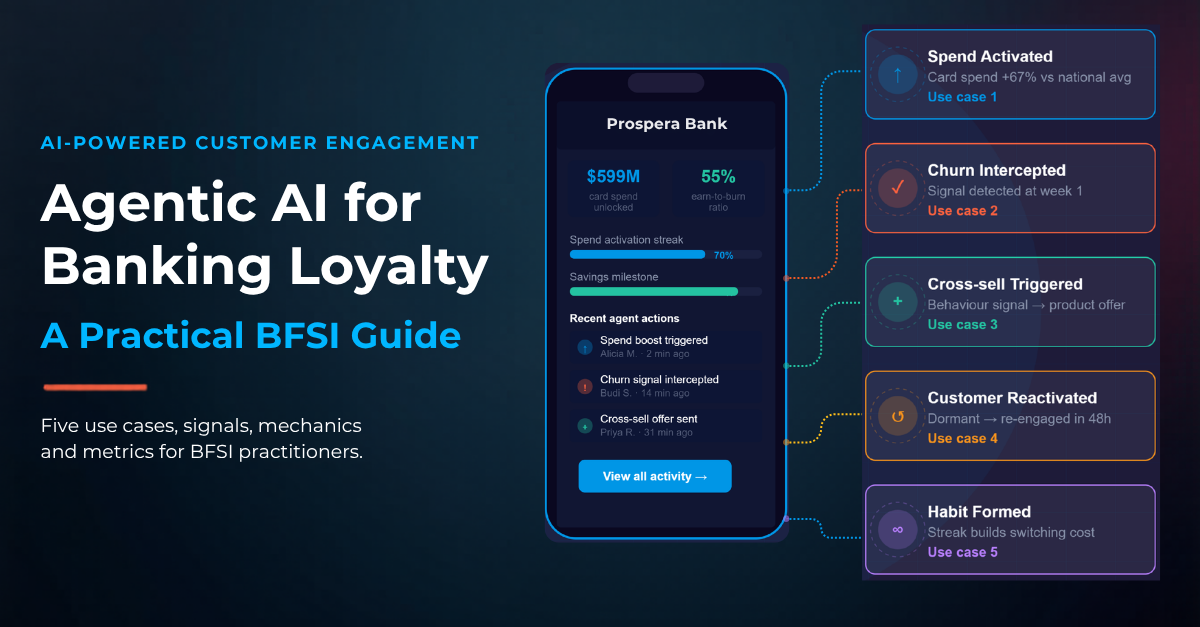
Five use cases, the mechanics behind them, what the data looks like, and how to measure whether it’s working – for BFSI practitioners who are past the question of what agentic AI is and ready to act on it.
TL;DR – Quick Summary
Perx Technologies is an AI-native loyalty and customer engagement platform purpose-built for banks, insurers, telcos, and financial services providers across APAC. This guide is for the practitioners – the CTOs, Heads of Digital, and loyalty programme owners who are past the question of what agentic AI is and are now working out how to actually run a BFSI loyalty programme with it.
If you need the foundational definition first, start with What Is Agentic AI in Loyalty Programs? – It covers the architecture, the six autonomous agents, and the readiness checklist. This guide picks up where that one ends.
What follows is use case by use case: the specific situations where agentic AI produces measurable loyalty outcomes in BFSI, the signals and mechanics involved, the metrics that confirm it’s working, and the failure modes that cause otherwise well-designed programmes to underperform.
Retail loyalty and BFSI loyalty are not the same problem. Understanding the difference is what makes the following use cases specific to banking, insurance, and financial services – not generic AI loyalty advice adapted from an e-commerce case study.
Three things are structurally different in BFSI:
Interaction frequency is low but signal density is high. A bank customer might initiate a deliberate interaction once a week – a login, a payment, a transfer. But they generate transactional data dozens of times a day: card swipes, contactless payments, merchant category signals, spending pattern shifts. Agentic AI uses these passive signals, not just active interactions, which means the data environment is richer than the engagement rate suggests.
The commercial stakes per customer are higher. The lifetime value of a retained banking customer – measured in product penetration, deposit balances, interest margin, and fee income – dwarfs the equivalent in retail. Losing a primary account customer to a competitor doesn’t cost you one purchase. It costs you years of compounding revenue. This changes the economics of what it is worth investing in a loyalty intervention.
Compliance is not optional. Every loyalty mechanic in BFSI operates inside a regulatory boundary. A campaign that works in retail may require product disclosure obligations in banking. Consent management, channel permissions, and audit trails are not a nice-to-have for a BFSI loyalty platform – they are the price of entry. Agentic AI in a banking context must enforce these constraints autonomously, in the same decision loop as the loyalty action itself.
IN BRIEF
BFSI loyalty works on a different signal profile, a different commercial stakes calculation, and a different compliance requirement than retail. The use cases and mechanics below are designed for that specific environment.
These are not theoretical. Each one represents a specific failure mode of rules-based loyalty – a situation where the human-campaign-cycle model consistently underperforms – and where agentic AI closes the gap.
The problem: Most BFSI institutions lose a significant portion of new customers to dormancy within 90 days. The customer signed up – often for an incentive – used one product, and quietly stopped engaging. By the time a win-back campaign fires, the habit of not engaging has already formed.
The signal: Days since first transaction. First product feature used. Second financial action not yet completed. These are the early-stage signals that tell you whether a new customer is forming an engagement habit or drifting toward dormancy.
The mechanic: A behaviour-triggered onboarding journey that rewards first actions – first savings deposit, first transfer, first bill payment – in sequence, within days of sign-up. Not an email series. A loyalty programme that treats the first 30 days as the highest-leverage window for habit formation and deploys rewards accordingly.
What agentic AI adds: The system monitors every new customer individually. When the cadence of first actions slows – a gap between expected and actual engagement – the system detects it and advances the next incentive without waiting for a campaign manager to notice. Each customer’s onboarding journey runs at the pace their own behaviour dictates, not at the pace of a campaign calendar.
✓ Commercial outcome: Higher 90-day retention rate. More customers crossing the threshold from single-product to multi-product before the first engagement cliff.
The problem: A customer’s credit card spend drops 40% over six weeks. Their primary transaction volume has shifted. In a rules-based loyalty programme, this triggers a winback campaign three weeks after the campaign team next runs their analysis. By that point, the competitor card has the primary position.
The signal: The critical distinction: measure against the customer’s own historical baseline, not a segment average. A customer who spends US $800 per month dropping to US $500 is a very different signal from a low-spender showing the same absolute number.
The mechanic: A personalised spend-booster challenge deployed in real time when the decline signal is detected. The challenge is constructed from the customer’s own spending categories – if their decline is in dining and entertainment, the challenge targets dining and entertainment. If their primary spend has shifted to groceries, the challenge meets them there. The incentive level is set based on predicted response sensitivity, not a flat offer applied uniformly.
What agentic AI adds: Detection and response happen in hours, not weeks. The intervention is individual-level. And the system learns from response data – customers who respond to category challenges get more of them; customers who respond to milestone bonuses get those instead.
✓ Commercial outcome: Recovery of primary card spend before the competitor’s habit solidifies. Measurable revenue attribution per intervention.
The problem: Most BFSI cross-sell campaigns are timed by the product team’s quarterly targets. The result is broadly targeted offers that interrupt customers regardless of their financial readiness – and conversion rates that reflect that mismatch.
The signal: These are not predicted propensities from a model run monthly. They are live behavioural signals that indicate the customer is in the right financial posture for a specific product – right now.
The mechanic: A loyalty reward tied directly to the product adoption action. Not a generic cash incentive for applying. A relevant reward – a savings milestone bonus for opening an investment account, a travel reward for activating a premium card, additional points for a first pension contribution – that makes the product adoption feel like a natural next step in the loyalty journey, not a separate sales interaction.
What agentic AI adds: The cross-sell trigger fires at the moment the behavioural signal appears – not at the next campaign cycle. The reward is sized and selected based on the individual customer’s past response to incentives. The compliance check – product disclosure, consent channel, regulatory limit – runs in the same decision loop as the offer deployment.
✓ Commercial outcome: Higher product penetration per active loyalty member. Cross-sell conversion rates that reflect customer readiness, not campaign timing.
The problem: Mass winback campaigns apply the same intervention to every dormant customer. A customer who went dormant because rewards felt irrelevant gets the same email as a customer who went dormant because of a service issue. Neither gets what they actually needed.
The signal: Define dormancy against each customer’s own engagement pattern – not a blanket 30-day or 90-day rule. A customer who previously engaged daily and has been inactive for 14 days is more dormant than a customer who historically engaged monthly, and last appeared 25 days ago. The threshold should reflect the customer’s established cadence.
The mechanic: An escalating reactivation sequence, individually constructed from the customer’s historical engagement data. First, a low-friction re-entry – a surprise reward deposited directly into their account, requiring no action to claim. Then, if that doesn’t produce a login signal, a personalised challenge is built from their last active spend categories. Then, if still no response, an escalation to human-reviewed outreach – a flag for the relationship manager, not another automated push.
What agentic AI adds: The sequence starts at the right moment (based on individual cadence, not a calendar rule), escalates at the right pace (based on response signals, not a fixed timing schedule), and stops before it becomes noise. The system also tracks which recovery mechanics worked per customer cohort and applies that learning to future reactivation decisions.
✓ Commercial outcome: Higher reactivation rates than mass win-back campaigns. Reduced cost-per-reactivation. Lower churn contribution from the dormant segment.
The problem: Most loyalty programmes reward what customers already do. A customer who spends US $2,000 per month earns points whether the loyalty programme exists or not. The programme creates no incremental value and no incremental cost of leaving.
The signal: The target behaviours are the ones that build financial commitment: consistent saving, streak-based repayment behaviour, product adoption sequences, and regular investment contributions. These are the behaviours that, once habitual, make leaving the bank meaningfully costly – the customer has built their financial routine around the institution.
The mechanic: Streak-based reward mechanics tied to recurring financial behaviours. A savings streak that rewards consistent monthly deposits. A repayment streak that rewards zero-balance maintenance. An investment contribution streak that rewards regular contributions to a savings or pension product. These are not one-time acquisition incentives – they are behavioural compounding engines that increase in value the longer the customer maintains the habit.
What agentic AI adds: The system monitors each streak individually, detects when a customer is at risk of breaking it (a predicted missed contribution, a balance signal that suggests the deposit may not come), and deploys a timely nudge before the break occurs – not a penalty campaign after it does.
✓ Commercial outcome: Increased customer lifetime value. Lower churn among engaged loyalty members. Measurable deposit growth and product utilisation rates among streak participants.
IN BRIEF
Each use case maps to a specific failure mode of rules-based loyalty: the gap between when a signal appears and when a system acts. Agentic AI closes that gap – the system detects, decides, and acts in hours rather than weeks, at the individual level rather than the segment level.
Jenius, a flagship digital banking product of Bank BTPN – part of SMBC Indonesia – is one of the clearest proof points available in APAC for what behaviour-driven loyalty produces when the architecture is right. In June 2024, Jenius deployed Perx Technologies’ loyalty platform to move beyond transactional banking: rewarding customers for everyday financial actions, not just large purchases.
The deployment used an intelligent rules engine to trigger rewards against specific financial behaviour thresholds – a minimum spend rule, gamified savings milestones, and instant Yay Points for product usage actions. Customers earned rewards for actions across the Jenius product suite, redeemable against a personalised reward catalogue.
Spend rule triggers fired between
Nov 2023 – Jul 2024
Total actual customer card spend
unlocked
Earn-to-burn ratio – well above
the BFSI industry norm of under 30%
The full picture across the eight-month period: the platform triggered the minimum spend rule 13.4 million times, generating a minimum credit card transaction value of IDR 134 billion (US $8.3 million). Actual customer spend across all rule triggers reached IDR 9.7 trillion (US $599 million), driven by 145,000 unique customers. Average monthly credit card spend per Jenius customer reached US $460 – against Indonesia’s national average of US $275 per customer per month (Source: Global Data). That is a 67% premium over the national benchmark.
The 55% earn-to-burn ratio is the number that confirms programme health. Most BFSI loyalty programmes sit below 30% – points accumulate, go unredeemed, and eventually expire as a balance sheet liability. A 55% redemption rate means the rewards catalogue was relevant enough that customers chose to use what they earned.
The Jenius deployment was built on intelligent, behaviour-triggered campaigns – not yet fully autonomous agentic AI. What it establishes is the baseline: what is achievable when loyalty is connected to financial behaviour signals rather than just purchase transactions. Agentic AI takes this further – the same pattern of signal detection and intervention, running autonomously across every customer, without manual campaign design for each scenario.
IN BRIEF
13.4 million behavioural triggers. US $599 million in unlocked card spend. 145,000 customers averaging US $460 per month – 67% above Indonesia’s national average. These numbers were produced by a rules-based system responding to financial behaviour signals. Agentic AI removes the manual configuration that produced each rule.
The metrics that matter for an agentic BFSI loyalty programme are not the same as the metrics most programme dashboards are built to display. The table below maps the common vanity metrics against the revenue-relevant metrics they should be replaced with.
| What Most Dashboards Show | Why IS IT Insufficient | What to Measure Instead |
|---|---|---|
| Total points issued | Measures cost, not engagement | Earn-to-burn ratio – the % of points issued that are redeemed. Below 30% signals reward irrelevance. |
| Enrolled members | Enrolment ≠ engagement | Active loyalty participants as % of total enrolled – segment by engagement tier, not just enrolled / not enrolled. |
| Campaign open rate | Measures delivery, not behaviour change | Incremental transaction value per loyalty participant vs matched non-participant control group. |
| Redemption volume | Tells you what was redeemed, not why | Revenue attribution per agent or campaign type – direct causal link between loyalty action and financial outcome. |
| Average points balance | A high balance is a sign of low redemption – a problem, not a metric | Churn rate delta: active loyalty participants vs disengaged participants. The gap proves programme retention value. |
| Cost per point | An input metric that tells you nothing about the output | Cost per retained customer – total programme cost divided by customers retained above the baseline churn rate. |
Two metrics deserve specific attention for agentic BFSI programmes
Time-to-intervention. In an agentic system, measure the elapsed time between a trigger signal firing and the intervention being delivered. A system detecting a spend decline signal and deploying a challenge within four hours is performing very differently from one where the same signal queues an intervention for the next weekly batch. This metric quantifies the core value proposition of agentic over rules-based loyalty.
Product penetration per active loyalty member. If your loyalty programme is working as intended, active loyalty participants should hold more products than non-participants – not because they were pushed more cross-sell campaigns, but because the loyalty programme surfaced the right product at the moment of behavioural readiness. Track this cohort comparison quarterly.
IN BRIEF
Replace enrolment, points-issued, and open-rate metrics with earn-to-burn ratio, incremental transaction value, churn rate delta, and revenue attribution per agent. The question is not how many customers are enrolled – it is how much revenue the programme generates that would not have existed without it.
Most agentic loyalty programmes that fail to produce results in BFSI fail for one of three reasons. None of them are primarily technical.
An agentic system is only as good as the data it can act on. If your loyalty platform only ingests reward redemption events and purchase totals – not transaction-level card data, not app engagement signals, not product holding data – it is making decisions from a fraction of the available picture. The spend decline signal doesn’t appear in weekly redemption reports. It appears in daily transaction data. If your platform isn’t ingesting that data in near-real time, the agent fires too late or not at all.
A gamified savings challenge designed to reward a US $50 monthly deposit will not move a customer who has US $10,000 sitting in a current account. A spend-booster challenge targeted at dining and entertainment will not land with a customer whose spend is concentrated in utilities and groceries. The failure is not in the technology – it is in designing reward mechanics that are generic rather than financially calibrated to the specific behaviour and customer profile in question.
This is specific to BFSI. An agentic system that identifies a cross-sell opportunity and fires an offer without checking consent status, channel permissions, and disclosure obligations in the same decision flow creates regulatory risk. If the compliance check happens after the offer is queued – in a separate review step – you have not built an autonomous compliance system. You have built an automated system with a manual compliance bottleneck. The governance layer must be in the same decision loop as the loyalty action, not downstream of it.
IN BRIEF
The three failure modes are a data visibility gap, a mechanic-behaviour mismatch, and a compliance workflow that isn’t part of the agent’s decision loop. All three are architecture decisions, not execution problems.
If you are moving from a rules-based loyalty programme toward an agentic AI operation, the sequencing matters. Deploying all five use cases simultaneously – before the data infrastructure and compliance architecture are verified – is the fastest route to underperformance.
| Phase | Focus | Use Cases to Activate | What to Prove |
|---|---|---|---|
| Phase 1 – Signal Audit | Verify data availability | None yet | Can your platform ingest real-time transaction data? What signals are currently invisible to your loyalty system? |
| Phase 2 – High-Value Pilot | Prove commercial ROI in one use case | Spend decline intervention (Use Case 2) | Measure incremental spend recovery vs control group. Establish cost-per-intervention baseline. |
| Phase 3 – Expand Signal Coverage | Add two more use cases | New customer activation (1) + Cross-sell trigger (3) | Measure 90-day retention uplift and product penetration rate among active loyalty members. |
| Phase 4 – Full Programme Autonomy | All five use cases are running simultaneously | All five, including dormant recovery (4) and habit building (5) | Measure churn rate delta, earn-to-burn ratio, and revenue attribution across the full programme. |
The signal audit in Phase 1 is the step most teams skip because it does not produce a visible output. It is also the step that determines whether everything that follows will work. Know what data your platform can see before you build agents to act on it.
If you’re mapping your current loyalty architecture against these use cases and want to work through what your signal coverage actually looks like, we’re happy to think through it with you.
Agentic AI reduces bank churn by detecting early disengagement signals – declining app sessions, reduced transaction frequency, stalled savings goals – days or weeks before a customer actually churns. It then autonomously deploys personalised interventions: a relevant reward, a savings challenge, a timely product nudge. Unlike rules-based win-back campaigns that fire after the customer has already disengaged, agentic systems act while there is still something to retain. In BFSI, where customer acquisition costs are high and switching costs are falling, intervening at week one versus week six can determine whether the customer stays.
The most effective approach combines real-time transaction signal monitoring with personalised spend-activation mechanics. An agentic AI system monitors each customer’s spending velocity against their own historical baseline – not a segment average. When a decline is detected, it deploys a spend-booster challenge tailored to that customer’s category preferences and past response patterns. Jenius (part of SMBC Indonesia) achieved this using Perx’s behaviour-triggered loyalty platform: 13.4 million spend rule triggers over eight months unlocked US $599 million in actual customer card spend, with average monthly spend per customer reaching US $460 – 67% above Indonesia’s national average of US $275 (Source: Global Data).
Effective cross-sell through loyalty requires two things traditional campaigns lack: the right signal and the right timing. Agentic AI monitors customer financial behaviour – savings accumulation patterns, repayment streaks, spending category shifts – and identifies the moment a customer is behaviourally ready for an adjacent product. A savings account customer whose balance has grown consistently for three months is a candidate for an investment product. Tying a loyalty reward to the product adoption action closes the loop between behaviour signal and commercial outcome, turning cross-sell from an interruption into a natural next step in the loyalty journey.
The metrics that matter are: earn-to-burn ratio (above 40% signals genuine reward relevance – the BFSI norm is under 30%), incremental transaction value per loyalty participant versus a matched control group, churn rate delta between active and disengaged loyalty members, product penetration rate among active participants, and revenue attribution per agent or campaign type. Vanity metrics – total points issued, enrolled members, campaign open rates – measure cost and delivery, not commercial outcomes. The question the metrics should answer is how much revenue the programme generates that would not have existed without it.
Spend activation and churn reduction results are typically visible within four to eight weeks of deployment, as agentic systems act on live transaction signals rather than campaign cycles. Cross-sell uplift and broader customer lifetime value improvements usually materialise within one to two quarters. The Jenius deployment with Perx began in June 2024 and produced measurable results – 13.4 million rule triggers and US $599 million in unlocked card spend – within eight months.

Praveen Vadla is Senior Digital Marketing Manager at Perx Technologies. With over 10 years of experience in B2B SaaS marketing across the US and Southeast Asia, he focuses on customer loyalty, engagement, and retention strategy. He writes on how brands build lasting customer relationships in a mobile-first economy. Connect with Praveen on LinkedIn.


Blogs

Blogs
Sustainability

Blogs

Blogs


Perx Technologies Pte Ltd
20A Tanjong Pagar Road
Singapore 088443
An ISO/IEC27001:2013 and ISO 27018:2019 compliant cloud solution

© 2026 Perx Technologies. All rights reserved.
© 2026 Perx Technologies. All rights reserved.
© 2026 Perx Technologies. All rights reserved.
Hey! Shashank