
An ISO/IEC27001:2013 and ISO 27018:2019 certified cloud solution

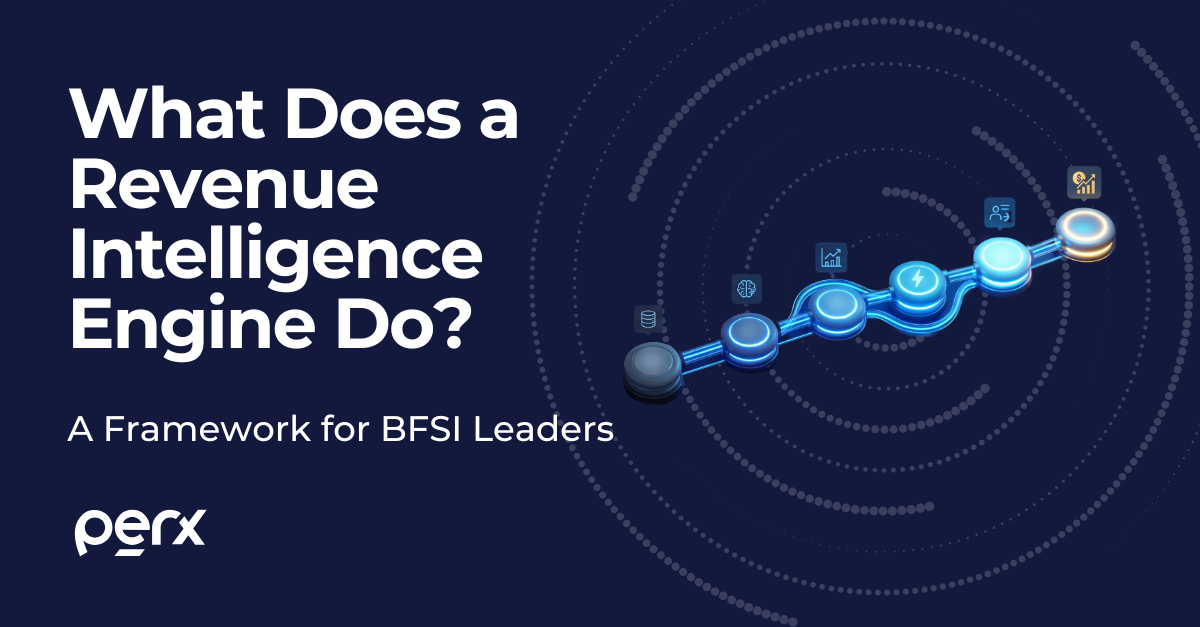
The phrase has been appearing with growing frequency in BFSI technology conversations: revenue intelligence. Vendors are using it. Analysts are writing about it. CDOs are asking their teams what it means for their engagement stack.
Most of the answers being offered are vague. Revenue intelligence is described as ‘AI-powered personalisation’ or ‘data-driven engagement’ or ‘next-generation loyalty’ — descriptions that could apply to almost any platform in the market and therefore describe none of them with any precision.
This piece is an attempt at a more useful answer. Not a vendor pitch. Not a vision document. A functional framework — six specific capabilities that a genuine revenue intelligence engine must perform, what each one does at the operational level, and what its absence costs a BFSI institution in measurable commercial terms.
If you are a CDO, CMO, Head of Digital, or Head of Loyalty evaluating whether your current engagement stack is built for the next five years, this framework is the diagnostic. Each capability is a question you can put to your existing system — and the answers will tell you where the gaps are.
TL;DR – Quick Summary
The BFSI technology market has a well-established pattern: a compelling concept emerges, vendors adopt its vocabulary, and within eighteen months the term has been applied to enough different products that it has lost its diagnostic value. Customer 360. Digital transformation. Omnichannel engagement. Each of these was once a precise description of a specific capability. Each became, over time, a marketing category.
Revenue intelligence is at risk of the same fate — and the stakes of imprecision here are higher than they were for those earlier terms. A bank that deploys the wrong CRM loses efficiency. A bank that deploys an engagement platform marketed as a revenue intelligence engine but lacking the functional capabilities that term implies will spend years and significant budget building around a gap its leadership did not know existed.
The six capabilities in this framework are not aspirational. They are the minimum functional requirements for a system that can genuinely connect customer data to revenue outcomes. A system that performs five of them well is a capable engagement platform. A system that performs all six is a revenue intelligence engine. The distinction is consequential — and it is measurable.
The most common failure point in BFSI engagement systems is not visible to the teams running them. It sits beneath the surface, in the data layer: the platform is operating on a partial picture of the customer, and nobody has quantified how partial.
A genuine revenue intelligence engine begins with data unification — ingesting and standardising customer information from every available source into a single, consistent intelligence profile. This means transaction data, yes — but also product holdings across the customer’s full relationship with the institution, digital engagement signals from the mobile app and web platform, notification interaction history, consent and compliance data by jurisdiction, rewards and redemption behaviour, and channel preferences.
The operative word is standardised. Many BFSI engagement platforms receive data from multiple sources but store it in fragmented, inconsistent schemas — different naming conventions, different event taxonomies, different update cadences. The result is that the ‘customer view’ the platform is building is not actually a unified view. It is a collection of partial records that the system treats as complete.
CAPABILITY 1: Data Unification — Building a Complete Customer Picture
What it does?
Ingests and standardises customer data from all available sources — transactions, product holdings, digital behaviour, engagement history, consent data — into a single, consistent intelligence profile per customer.
Why its absence has a cost?
When a platform operates on transaction data alone, it has approximately 30% of the information it needs to personalise relevantly. The remaining 70% — product holdings, behavioural signals, engagement trajectory, churn risk indicators — is invisible. Every personalisation decision made without this data is a guess with a budget attached.
The diagnostic signal?
If your platform cannot tell you, for a specific customer, which products they hold, how their app engagement has changed over the last 90 days, and what their current churn probability is — it is not operating on a unified customer profile.
Data unification solves the completeness problem. Customer intelligence solves the comprehension problem. They are sequential, not interchangeable — and the second does not function without the first.
Customer intelligence converts a unified data profile into actionable signals: a financial health score that reflects a customer’s actual relationship with their money, not just their transaction frequency. A behavioural engagement score that tracks whether a customer is deepening their relationship with the institution or quietly withdrawing from it. A churn probability that calculates the likelihood of dormancy or departure before it happens, not after. A cross-sell propensity score that identifies which customers are in the right financial and behavioural position to respond to a specific product offer.
The distinction between data and intelligence is the distinction between knowing what a customer did and understanding what they are likely to do next. Most BFSI engagement platforms have access to the former. Very few have built the latter. The gap shows up in campaign performance, in personalisation quality, and in the inability of most engagement teams to answer questions about their customers that go beyond transactional history.
Capability 2: Customer Intelligence — From Data to Predictive Signal
What it does?
Builds individual-level intelligence profiles on top of unified data: financial health scores, behavioural engagement trajectories, churn probability signals, cross-sell and upsell propensity scores, and dormancy detection — all updated in real time as customer behaviour changes.
Why its absence has a cost?
Without this layer, engagement teams are working from historical descriptions of customer behaviour, not forward-looking predictions. They are sending cross-sell campaigns to customers who are already in churn trajectory. They are applying retention mechanics to customers who were never at risk. The cost is not just wasted campaign spend — it is the erosion of customer trust that comes from persistent irrelevance.
The diagnostic signal?
If your engagement team identifies churn risk by looking at who has already gone dormant — rather than receiving early warning signals before dormancy — the intelligence capability is missing.
The translation from customer intelligence to engagement strategy is, in most BFSI institutions, still a manual process. A marketing manager opens a campaign builder, selects a segment based on available filters, chooses a mechanic from a predefined library, sets a reward value, and submits the configuration for approval. The intelligence signals — if they exist — inform this decision loosely, based on the manager’s interpretation of what the data suggests.
A revenue intelligence engine does not leave this translation to interpretation. The growth strategy capability reads the intelligence signals from Capability 2, interprets them against the institution’s defined business KPIs — retention targets, cross-sell velocity goals, activation rates, revenue uplift targets — and generates a specific, prioritised set of recommended actions. Not a menu of options. A ranked recommendation with reasoning: this segment, this mechanic, this reward structure, this channel, at this moment, because the signal indicates this outcome is achievable at this cost.
Critically, the recommendation includes a predicted ROI and a compliance validation. Before a single configuration is prepared, the system has assessed whether the proposed intervention is within reward cap limits, frequency constraints, and applicable regulatory requirements. The strategy arrives compliance-checked, not compliance-pending.
What it does?
Interprets customer intelligence signals against defined business KPIs and generates specific, prioritised engagement recommendations — including campaign type, target segment, reward structure, channel, predicted ROI, and compliance validation status — before any configuration work begins.
Why its absence has a cost?
Without this capability, strategy is whatever the marketing team has capacity to design this sprint. That means the institution’s engagement activity is bounded by human bandwidth, not by market opportunity. The customers who most need intervention at any given moment are reached only if someone on the team happened to look at the right data at the right time. Most do not.
The diagnostic signal?
If your engagement team’s campaign calendar is driven by campaign slots and creative availability rather than by a system-generated view of where the highest-ROI interventions are right now — the growth strategy capability is absent.
Strategy that cannot be executed quickly is a planning document. The fourth capability is not glamorous — but its absence is one of the most commercially costly gaps in BFSI engagement operations.
Execution without friction means that a marketing team can move from a growth strategy recommendation to a live campaign without raising an IT ticket, waiting for a sprint slot, or navigating a multi-week change management process. The no-code execution capability does not just save time — it changes the commercial calculus of customer engagement entirely. Every week of delay between identifying a customer intervention opportunity and deploying it is a week in which a competitor may have acted first.
In regulated BFSI environments, execution without friction does not mean execution without governance. The Maker-Checker model preserves institutional control: the system prepares the full campaign configuration — rules, rewards, segments, notification logic — and submits it for human review and approval before anything goes live. The marketer’s job shifts from configuration to oversight. The institution gains velocity without sacrificing the governance requirements that compliance and risk teams mandate.
The commercial evidence for this capability is not theoretical. Reducing campaign time-to-market from weeks to hours changes the frequency at which an institution can respond to customer behaviour signals. That frequency compounds — more interventions, more data, more refined intelligence, more relevant subsequent interventions.
What it does?
Enables marketing teams to move from strategy to live campaign without IT dependency. The system generates full campaign configurations — rules, rewards, segments, channels, notification logic — and submits them through a Maker-Checker governance workflow for human approval before deployment.
Why its absence has a cost?
Institutions that require IT involvement for every campaign change are operating on a release cadence measured in weeks or months. In APAC digital banking markets where challenger banks deploy new engagement mechanics daily, this is not a process inefficiency — it is a structural competitive disadvantage. The IT Bottleneck Tax compounds: every quarter of delayed campaigns is a quarter of customer behaviour data that was never collected, and a quarter of intervention opportunities that were never acted on.
The diagnostic signal?
If your marketing team measures campaign launch time in weeks rather than hours — or if any change to campaign logic, segment rules, or earning mechanics requires an IT ticket — execution friction is costing you more than you are measuring.
The difference between a BFSI institution that feels like it knows you and one that does not is entirely in this capability. Personalisation as most engagement platforms practise it is segment-level: a customer receives a message relevant to a demographic cohort or a behavioural cluster. Personalisation as a revenue intelligence engine delivers it is individual-level: a specific customer receives an interaction designed for their current situation, informed by their specific intelligence profile, at the moment when their behavioural signals indicate they are most receptive.
Experience delivery connects the upstream intelligence and strategy work to the customer-facing touchpoint. It operates across the channels where customers actually engage — mobile app, web microsite, push notification, in-app message, SMS — and it delivers a consistent, contextually appropriate interaction at each. The mechanics themselves are varied: a progression-based quest for a customer in early activation, a streak mechanic for a customer the system has identified as habit-buildable, a targeted cross-sell moment for a customer whose financial health score indicates readiness, a win-back prompt for a customer whose engagement trajectory is declining.
Critically, every interaction generates data that feeds back into the intelligence layer. A customer who completes a quest generates a different signal than a customer who abandons it mid-way. A push notification that converts tells the system something different than one that goes unopened for 48 hours. The experience layer is not just a delivery mechanism — it is the primary source of behavioural data that refines the intelligence profiles that drive every subsequent decision.
What it does?
Delivers contextually relevant, individualised customer interactions across all digital touchpoints — mobile app, microsite, push, SMS — using the full intelligence profile of each customer to determine the right mechanic, message, and moment. Every interaction feeds behavioural signals back into the intelligence layer.
Why its absence has a cost?
Without individual-level experience delivery, personalisation is demographic targeting with a loyalty wrapper. Customers receive communications relevant to people like them, not to them specifically. In a market where 40% of banking consumers report they cannot distinguish between financial brands, segment-level personalisation does not resolve the differentiation problem — it is part of it.
The diagnostic signal?
If your engagement platform delivers the same campaign to all customers who meet a segment criteria, regardless of their individual intelligence profile, engagement trajectory, or current financial health status — the experience delivery capability is operating below the intelligence layer available to it.
The sixth capability is the one that most directly determines whether a customer engagement programme survives budget scrutiny — and it is the capability most frequently absent from the engagement platforms currently in production at BFSI institutions.
Revenue attribution connects every engagement action — every campaign, every mechanic, every nudge, every personalised interaction — to a measurable revenue outcome. Not an engagement proxy. Not a campaign metric. Actual incremental revenue generated by specific engagement activity, expressed in the terms that a CFO can evaluate: transaction lift, churn prevented and its revenue equivalent, cross-sell events directly attributable to engagement interventions, and the margin impact of shifting customers from promo-dependent behaviour to habit-driven engagement.
Without this capability, the engagement programme is a cost centre by default. It may be generating significant revenue — but if the system cannot trace which interventions generated which outcomes, that value is invisible to the leadership team making budget allocation decisions. The engagement team speaks in redemption rates and campaign engagement scores. The CFO speaks in revenue and margin. The absence of a bridge between these vocabularies is not a communication problem — it is an architectural one, and it can only be resolved at the data and measurement layer.
The institutions that build this capability now will not just be able to justify their engagement budget. They will be able to grow it — because they can demonstrate, precisely, what each incremental pound of engagement spend generates in incremental revenue.
What it does?
Connects every engagement action to a measurable revenue outcome — tracking transaction lift, churn defensibility value, cross-sell attribution, and incremental revenue per campaign. Produces reporting in P&L terms that finance leadership can evaluate, not engagement proxy metrics that only marketing can interpret.
Why its absence has a cost?
Engagement programmes without revenue attribution are perpetually at budget risk. They cannot answer the CFO’s question. They cannot demonstrate the cost of switching off the programme. They cannot justify investment in capability improvements because they cannot prove what the current investment is generating. Over time, this makes the engagement programme vulnerable to the same fate as every cost centre: the first thing reviewed when performance pressure arrives.
The diagnostic signal?
If your quarterly engagement report leads with redemption rate, campaign impressions, or NPS movement — rather than with incremental revenue, churn defensibility value, or cross-sell velocity — the revenue attribution capability is the gap between your programme and its full potential.
The six capabilities above are designed to be applied to your current engagement stack — not as an aspiration, but as an audit. For each capability, there is a diagnostic signal: a specific observable condition that indicates whether the capability is present, partial, or absent.
A few observations about how to use this framework honestly:
Most BFSI engagement platforms currently in production perform Capabilities 4 and 5 adequately: they can execute campaigns without excessive IT friction (though many cannot), and they deliver some form of customer-facing experience. The gaps are most consistently found in Capabilities 1, 2, 3, and 6 — the intelligence foundation and the revenue closing loop.
That is not accidental. Capabilities 1, 2, 3, and 6 require the deepest integration with the institution’s data infrastructure, the most sophisticated measurement architecture, and the clearest alignment between engagement operations and P&L accountability. They are the hardest to build, the hardest to buy, and the hardest to evaluate from a vendor’s marketing materials. They are also the capabilities that determine whether an engagement programme is a cost centre or a revenue driver.
This framework is a diagnostic, not a procurement checklist. It does not tell you which vendor to choose. It tells you what to look for — specifically, what to ask in a product evaluation, what capabilities to request evidence for rather than accepting at face value, and what the absence of each capability is costing your programme in commercial terms.
The six capabilities are interconnected. A system that performs Capability 3 (growth strategy) without Capability 1 (data unification) will generate strategy recommendations based on an incomplete customer picture — the recommendations will be directionally correct but individually wrong. A system that performs Capability 6 (revenue attribution) without Capability 2 (customer intelligence) will be able to report revenue outcomes but unable to explain which customer signals predicted them or how to replicate them at scale.
The direction the market is moving is clear. The $60B in AI investment flowing into BFSI will reach the customer engagement layer — the question is whether your institution’s engagement infrastructure is ready to receive it, or whether a layer of architectural debt is standing between your customer intelligence and your revenue outcomes.
The Tier 1 Engagement Audit is a structured starting point for assessing exactly that — a diagnostic framework for BFSI leaders who want to understand where their current engagement stack sits against the six-capability standard described here.
If you’re mapping your current loyalty architecture against these use cases and want to work through what your signal coverage actually looks like, we’re happy to think through it with you.

Praveen Vadla is Senior Digital Marketing Manager at Perx Technologies. With over 10 years of experience in B2B SaaS marketing across the US and Southeast Asia, he focuses on customer loyalty, engagement, and retention strategy. He writes on how brands build lasting customer relationships in a mobile-first economy. Connect with Praveen on LinkedIn.


Blogs

Blogs
Sustainability

Blogs

Blogs


Perx Technologies Pte Ltd
20A Tanjong Pagar Road
Singapore 088443
An ISO/IEC27001:2013 and ISO 27018:2019 compliant cloud solution

© 2026 Perx Technologies. All rights reserved.
© 2026 Perx Technologies. All rights reserved.
© 2026 Perx Technologies. All rights reserved.
Hey! Shashank