

An ISO/IEC27001:2013 and ISO 27018:2019 certified cloud solution

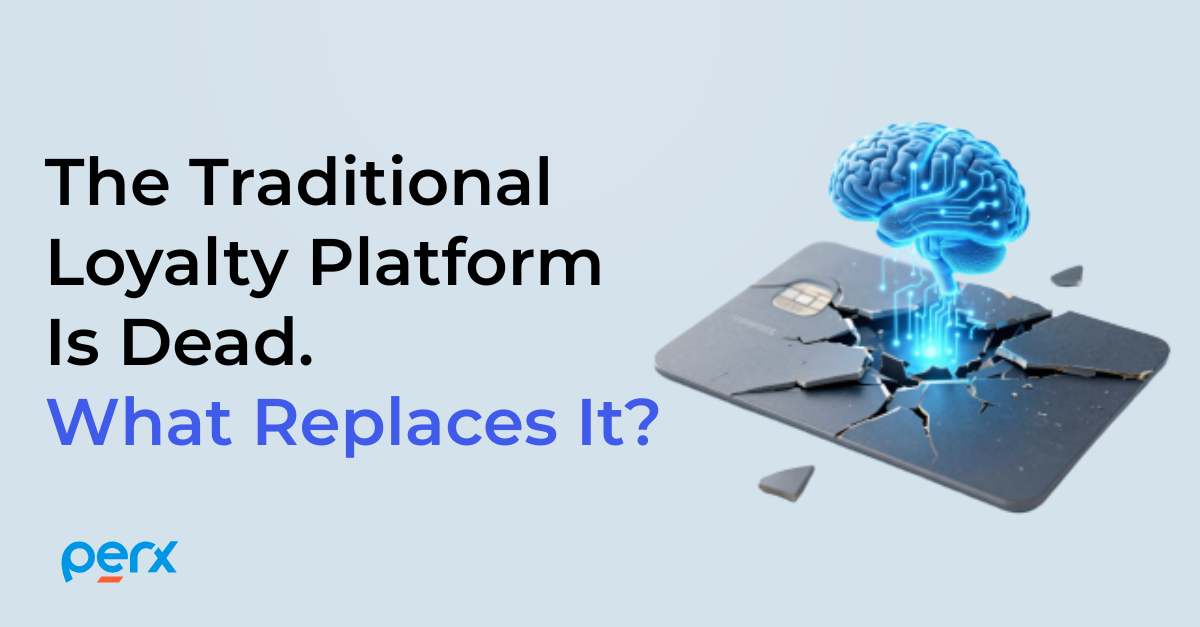
Most BFSI institutions are running a loyalty programme right now. Their customers are enrolled in it. Points are accumulating. Tiers are being maintained. Redemption reports are going out every quarter.
And most of those customers are simultaneously enrolled in a competitor’s programme, doing the exact same thing there.
That is not a loyalty problem. That is an architecture problem. The loyalty platform — as a category, as a concept, as the dominant model for how banks and financial institutions engage their customers — was built to answer a question that the market has quietly stopped asking. And the institutions that recognise this early will define the next decade of BFSI engagement. Those that keep optimising the answer to the wrong question will find the distance between themselves and their customers widening, one unredeemed points balance at a time.
This piece is about what happened, why it matters now, and what the architecture of the next generation actually looks like.
To understand why the loyalty platform model is failing, you have to understand the world it was designed for.
The earn-and-burn model entered financial services from airlines and retail in the late 1990s. The logic was straightforward and, at the time, sound: give customers a tangible incentive to choose your institution over another, track that behaviour through a points ledger, and reward the customers who stayed. It was a rational solution to a real problem — low customer optionality, limited data infrastructure, and a market where the primary differentiators were branch location and interest rates.
The technology built around this model reflected its era. Points engines. Tier structures. Redemption catalogues. Batch data processing. Campaign logic that required weeks of IT involvement to change. The platforms were built to be stable, not agile. They were built to manage a programme, not to understand a customer.
And for a long time, that was enough. In a market where loyalty programmes were novel, the programme itself was the differentiator.
The platforms were built to manage a programme, not to understand a customer.
The problem is not that loyalty platforms stopped working. The problem is that the market moved faster than the model did — and the gap between what customers expect and what earn-and-burn delivers has become structurally unbridgeable.
The differentiation has collapsed. More than 40% of banking consumers report that they cannot meaningfully distinguish between financial brands (UserTesting, Digital Banking Trends 2026). When every bank offers points on card transactions, a rewards catalogue, and a tier structure, those things stop being differentiators. They become baseline expectations — the minimum required to stay in the consideration set, not a reason to choose one institution over another.
The lock-in assumption has broken down. The loyalty platform model was built on a premise of customer exclusivity — the idea that a sufficiently compelling programme would consolidate a customer’s financial behaviour with one institution. That premise is no longer operational. Nearly three-quarters of consumers today bank with more than one provider simultaneously (UserTesting, 2026). Loyalty programmes designed to create lock-in are running inside a market where lock-in has already been abandoned by the customer.
The data problem is structural, not fixable. Most loyalty platforms receive transaction event data: what was purchased, when, and for how much. They do not have access to product holdings across the customer’s relationship with the bank, behavioural signals from digital engagement, propensity indicators, or predictive churn scores. They are making personalisation decisions — decisions that are then marketed as individualised and relevant — with perhaps 30% of the picture. The result is personalisation that feels, to the customer, like anything but.
The metrics problem is costing programmes their budget. Ask the head of loyalty at most BFSI institutions what their programme generated for the P&L last quarter. The answer will involve redemption rates, points issued, campaign engagement, and possibly an NPS movement. It will not involve incremental revenue. It will not involve churn defensibility or cross-sell velocity. These are the metrics that loyalty platforms produce because they are what loyalty platforms are built to measure — and they are precisely the metrics that mean nothing to a CFO trying to evaluate whether the programme is worth its cost.
The velocity gap is a competitive liability. Traditional loyalty platforms require IT involvement for every meaningful change. New earning rules, updated campaign mechanics, segment logic, experience modifications — each requires a ticket, a roadmap slot, and a release cycle. In APAC’s digital banking markets, where customer expectations shift in weeks and competitor features appear monthly, a campaign velocity measured in quarters is not a minor inconvenience. It is a structural disadvantage that compounds over time.
These are not operational failures. They are architectural ones. And they cannot be resolved by adding features to the existing model.
40%+
3 in 4
Before describing where loyalty platforms are heading, consider this question — which most teams find surprisingly difficult to answer with precision:
The conversation in BFSI technology has been dominated, for the past three years, by AI — primarily in risk, fraud detection, underwriting, and back-office operations. The global AI in BFSI market is projected to grow from USD 24.31 billion in 2025 to USD 60.09 billion by 2031 (ResearchAndMarkets, 2025). The majority of that investment is going into the operational layers of the business.
The customer-facing engagement layer has been left behind.
While institutions have invested heavily in modernising their infrastructure — cloud migration, core banking replacement, fraud AI — the system that actually determines whether a customer feels understood, valued, and engaged has largely been left running on architecture from a different decade. The loyalty platform, in most institutions, is the last unreformed layer of the customer experience.
What is replacing it is not a better loyalty platform. It is a different category of system.
The shift is from a campaign execution layer to a customer intelligence and growth layer. The distinction sounds abstract until you map it to the functional requirements: the new model needs to ingest and unify customer data from multiple sources, not just transaction feeds. It needs to build behavioural intelligence on top of that data — understanding not just what a customer did, but what they are likely to do next, and what would need to happen to change that trajectory. It needs to translate that intelligence into growth strategies, simulate the likely outcomes of those strategies before they are deployed, and execute them at the individual level without requiring IT involvement for every iteration. And it needs to report outcomes in the terms that matter to finance leadership — revenue, not redemption.
The loyalty platform asks: how do we reward this transaction? The next-generation model asks: what behaviour do we need to drive, and what does that generate for the P&L?
The transition from loyalty platform to intelligence-led engagement is not theoretical. It is a procurement decision that a growing number of BFSI institutions are working through now and the framing of that decision determines whether they end up with a modernised version of the old model or with something genuinely different.
Three questions cut through the category noise:
1
Not redemption volume. Not campaign open rates. Not points issued. Actual incremental revenue attributable to the programme, in terms the CFO can evaluate. If the answer is no or if the answer requires a data science project to approximate the platform is operating below what the market now requires.
2
3
If the answers to any of these questions are unfavourable, the conversation is not about how to get more from the existing platform. It is about whether the existing platform is the right architecture for the next five years of BFSI engagement.
The institutions that will define BFSI engagement in the next decade are not the ones with the most sophisticated redemption catalogues. They are the ones that move first to connect customer intelligence to revenue outcomes — and build the organisational muscle to run that system at scale.
The advantage compounds. Better data produces better predictions. Better predictions produce more relevant engagement. More relevant engagement produces more customer data and stronger behavioural signals. Institutions that start this cycle early pull further ahead with every iteration. Those that enter it later are not just catching up — they are catching up to a moving target.
53% of financial services firms are already deploying AI agents in production, primarily in risk and fraud applications (ResearchAndMarkets, 2025). The application of the same intelligence infrastructure to customer engagement is the next logical step — and it is happening now, not in a future planning cycle.
The loyalty platform served its purpose. It was the right answer to the right question for the better part of two decades. But the question has changed. And the institutions that are still optimising the old answer — investing in better earn rates, broader redemption catalogues, more sophisticated tier structures — are doing so in a market that has quietly moved on.
The ones that ask the new question first are the ones that will own the answer.
The loyalty platform is not dying because it failed. It is being replaced because the market it was built for no longer exists in the same form — and the gap between what it was designed to do and what BFSI institutions now need from an engagement system has become too wide to bridge with incremental upgrades.
The next-generation model is already taking shape in the institutions that are asking the right questions: not ‘how do we improve our loyalty programme?’ but ‘how do we connect what we know about our customers to the revenue outcomes we need to drive — and how do we do it at a speed that matches the market?’
If you are working through that question for your institution, the Tier 1 Engagement Audit is a practical starting point — a diagnostic framework for understanding where your current engagement stack sits against the standard the market is converging on.
The window to lead this transition is open. It will not stay open for long.

Nikita Shaha is Head of Product & Technology at Perx Technologies. With over 10 years of experience across banking, telecommunications, and software, she focuses on product strategy, AI transformation, and large-scale technical delivery. She writes on how enterprises build intelligent, data-driven customer engagement in a mobile-first economy. Connect with Nikita on LinkedIn.
Thinking Through What This Means for Your Programme?
At Perx, we are building our perspective on autonomous loyalty in public — one piece at a time. If you are a BFSI or telco marketing leader thinking through what this means for your organisation, we would love to hear where you are in that thinking. No pitch. Just a conversation.


Blogs

Blogs
Sustainability

Blogs
Blogs


Perx Technologies Pte Ltd
20A Tanjong Pagar Road
Singapore 088443
An ISO/IEC27001:2013 and ISO 27018:2019 compliant cloud solution

© 2026 Perx Technologies. All rights reserved.
© 2026 Perx Technologies. All rights reserved.
© 2026 Perx Technologies. All rights reserved.
Hey! Shashank