
An ISO/IEC27001:2013 and ISO 27018:2019 certified cloud solution

IN BRIEF
Customer acquisition costs have risen 222% over eight years. Every retained customer is now disproportionately more valuable, yet most enterprise retention platform evaluations still rely on feature checklists that vendors can game in a 45-minute demo.
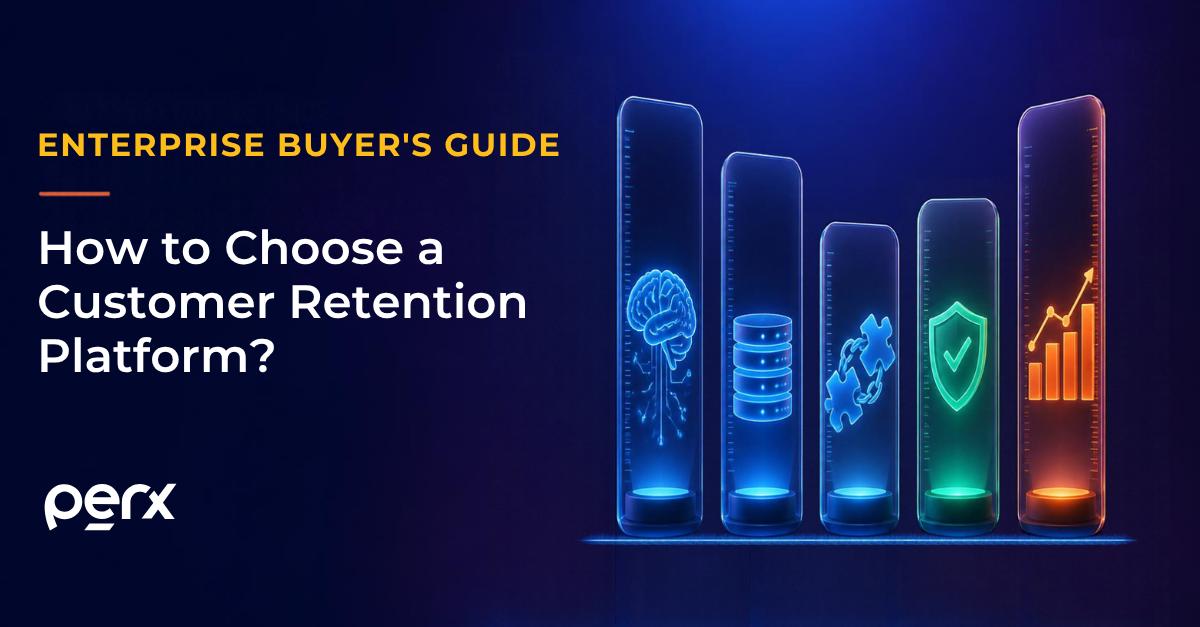
This guide gives marketing and loyalty leaders a structured framework to evaluate platforms on the criteria that actually predict revenue outcomes:
Top-performing programs deliver 7.2x ROI versus the 4.8x industry average. The difference is not budget. It is behavioral depth, data speed, and measurement rigor.
Most enterprise retention platform evaluations follow the same broken script. Marketing sends out an RFP. Vendors respond with feature matrices. Procurement scores the matrices. Someone picks the platform with the most checkboxes ticked.
Then, twelve months after go-live, the program is underperforming. Engagement is shallow. The data is siloed. Finance wants to see ROI and nobody can produce a clean number.
The problem is not the platform. The problem is how it was evaluated.
Feature lists are easy to game. Any vendor with a capable sales team can check every box on a standard RFP. What separates a platform that moves the revenue needle from one that just runs a points ledger is hard to see in a demo. It requires asking fundamentally different questions during evaluation.
This guide is for marketing and loyalty leaders who are past the “do we need a platform” stage and are actively shortlisting vendors. It covers five evaluation dimensions that consistently predict whether a retention investment pays off at enterprise scale: behavioral capability, data architecture, integration fit, governance and compliance, and measurable ROI frameworks.
Key insight: 59% of loyalty professionals now rank improving Customer Lifetime Value as their number one objective in 2026, up from 36% in 2021. Yet 41% of leaders still struggle to quantify overall program impact. The gap between aspiration and measurement is where most platform evaluations go wrong.
Customer acquisition costs have risen 222% over the last eight years. Every retained customer is now disproportionately more valuable than a new one, and a 5% improvement in retention can boost profits by 25 to 95% according to Bain & Company. The business case for investing in a retention platform has never been stronger.
Yet most organizations still use an evaluation process designed for a simpler era. Standard RFPs compare transactional loyalty systems: points engines, tier structures, reward catalogs. They measure feature parity, not behavioral depth.
The average enterprise vendor demo is a 45-minute highlight reel. It shows the platform at its best, configured for a generic use case, with clean data and no integration friction. It answers “can the platform do X?” not “what does the platform actually do for businesses like ours?”
As a result, organizations select platforms based on capability claims rather than deployment evidence. They discover the gaps after signing. Usually this happens during implementation, when the real complexity of connecting to live customer data, existing CRM systems, and downstream analytics becomes apparent.
The platforms that consistently deliver measurable retention lift share four characteristics that standard RFPs rarely probe:
These are the dimensions worth stress-testing during evaluation. The sections below explain how.
This dimension separates retention platforms from loyalty administration tools. A loyalty administration tool manages what already happened. A behavioral retention platform shapes what happens next.
The distinction matters because retention is fundamentally a behavioral problem. Customers churn not because they consciously decide to leave, but because they drift. Engagement frequency drops. A competing offer arrives at the right moment. A friction point goes unresolved. The platform’s job is to detect these signals early and intervene with the right mechanic at the right time.
Ask vendors to walk through a specific scenario: a customer in your highest-value segment has not transacted in 21 days. How does the platform detect this? What trigger fires? What intervention options are available? Who configures the rule, and how long does it take?
The answers reveal more than any feature checklist. Weak platforms describe a manual campaign process. Strong platforms describe an automated trigger that fires based on behavioral deviation from a customer’s personal baseline, not a fixed calendar rule.
The questions worth asking in every vendor session:
| Evaluation Question | What a Strong Answer Looks Like |
|---|---|
| How does the platform detect pre-churn signals? | Real-time behavioral deviation from individual baseline, not segment averages |
| What is the latency between a customer action and a triggered response? | Sub-minute for digital channels; same-session for mobile |
| Can mechanics be personalized at the individual level, not just the segment level? | Yes, with AI-driven reward selection per user |
| How does gamification integrate with behavioral triggers? | Mechanics (challenges, streaks, milestones) fire based on behavioral context |
| What evidence exists from live deployments, not sandbox demos? | Named client outcomes with specific behavioral metrics |
Gamification is a frequently claimed capability that rarely gets implemented well. Most platforms offer badges and points. Fewer offer mechanics genuinely tied to behavioral science: progress mechanics, loss aversion triggers, social proof nudges, and variable reward schedules.
Ask the vendor to show you a live deployment example where a specific gamification mechanic produced a measurable change in a specific customer behavior. If they cannot name the mechanic, the behavior it targeted, and the outcome it produced, the capability is superficial. For a deeper look at what rigorous evaluation of this capability looks like, see Perx’s guide to evaluating loyalty vendors on adaptive rewards and precision targeting.
Behavioral capability is only as good as the data feeding it. This is where many enterprise evaluations underinvest their scrutiny. It is also where the most painful post-implementation surprises originate.
The core question is not “what data can the platform ingest?” It is “how does the platform process and act on that data, and how quickly?”
Most legacy loyalty platforms run on batch processing. Customer data gets ingested nightly or weekly, segments get recalculated, and campaigns get queued. For a points-and-tiers program, this is adequate. For a behavioral retention platform, it is fundamentally incompatible with the use case.
Consider the difference:
The revenue difference between these two scenarios compounds over millions of customer interactions. McKinsey research shows that increasing CLV by just 10% can drive a 25 to 30% increase in profits over time — and real-time personalization is the primary mechanism that drives CLV at scale.
Push vendors on the following during technical discovery:
The last point is easy to overlook. A platform that retains behavioral data exclusively within its own system creates long-term dependency risk. Enterprise-grade platforms should function as a layer on top of your existing data infrastructure, not a replacement for it.
Integration is where vendor promise and operational reality diverge most sharply. A platform that takes 18 months to integrate is not delivering retention value during those 18 months. For enterprise organizations, integration complexity is often the single largest driver of total cost of ownership. It is also the dimension most underweighted during initial evaluation.
Before evaluating any specific integration capability, establish the platform’s architectural philosophy. There are two fundamentally different approaches:
Monolithic platforms operate as closed systems. They manage data, logic, rewards, and customer-facing experiences within a single stack. Integration requires custom connectors, vendor-managed middleware, and long implementation timelines. They offer stability but limited flexibility.
API-first (composable) platforms layer onto existing infrastructure. They expose all core functions via APIs, integrate with your CRM, CDP, and analytics tools natively, and let your team build or extend experiences without touching the vendor’s core system. Industry data shows API-first systems reduce maintenance costs by 30 to 40% while enabling the real-time personalization that drives retention outcomes.
For most enterprises with established technology stacks, API-first architecture is the right choice. The question is whether the vendor’s API-first claims hold up under scrutiny.
| Integration Area | What to Ask |
|---|---|
| CRM / CDP connectivity | What native connectors exist? What is the sync frequency? |
| Mobile app SDK | How long does SDK integration take? What events are captured out of the box? |
| POS / transaction systems | What is the standard integration path for in-store transaction data? |
| Martech stack | Does the platform push events to your existing email, push, and SMS tools, or does it replace them? |
| Analytics / BI tools | Can raw event data be streamed to your data warehouse in real time? |
| Legacy core systems | For BFSI: what is the standard approach for core banking integration? |
Ask every vendor for their median time from contract signature to first live campaign. Not time to full deployment — time to first live campaign. This single number reveals more about integration complexity than any architecture diagram.
Best-in-class platforms can deploy initial campaigns within 90 days. Platforms that require 12 to 18 months of integration work before going live are not retention platforms — they are infrastructure projects with loyalty features attached.
For a comparison of how enterprise loyalty platforms differ on this dimension, the best enterprise loyalty program software guide covers deployment timelines and architecture across the leading vendors.
Fraud prevention. Loyalty programs are a well-documented vector for fraud: account takeovers, points manipulation, fake referrals, and reward arbitrage. Ask vendors specifically how their fraud detection works. Rule-based systems catch known patterns but miss novel exploits. Machine learning-based detection adapts in real time. The distinction matters for programs operating at scale across multiple markets.
Points liability management. Unredeemed points represent a balance sheet liability. Enterprise programs need visibility into projected redemption rates and liability exposure by segment. They also need the ability to configure expiration and caps to keep liability within acceptable bounds. Platforms without robust liability reporting create financial reporting problems that surface during audits.
Role-based access and auditability. Who can modify campaign rules, reward values, and eligibility criteria? And does the platform log every change? For regulated industries, a complete audit trail of program configuration changes is not optional.
Multi-market compliance. For organizations operating across APAC, EMEA, or other multi-jurisdiction environments, the platform must support market-specific data residency, consent frameworks, and promotional rules without requiring separate platform instances.
Before shortlisting any vendor, confirm the following:
These questions are not designed to eliminate vendors — they are designed to surface the conversations that need to happen before contract signature rather than after.
The measurement gap is the most consequential failure mode in enterprise retention programs. According to industry research, 41% of loyalty program leaders struggle to quantify overall program impact. Not because the impact does not exist, but because the platform was never configured to isolate it.
This is partly a measurement design problem and partly a platform capability problem. A platform that only reports aggregate loyalty member activity cannot tell you whether the program caused behavior change. It may have simply attracted customers who would have behaved that way regardless.
Total loyalty member revenue is not a program ROI metric. It is a correlation. Members tend to be higher-value customers from the start. They opted in, they engage more, they have stronger brand affinity. Attributing all of their revenue to the loyalty program overstates impact and misleads investment decisions.
True program ROI requires measuring incrementality: the behavior change that would not have occurred without the program. This means:
Ask vendors whether their analytics layer supports this type of attribution natively. Many platforms can export data to a BI tool for external analysis. However, platforms that support in-platform incrementality measurement reduce the analytical overhead significantly.
Understanding the range of outcomes in the market helps set realistic expectations and identify when a program is underperforming:
| Program Performance Tier | Average ROI | Key Differentiator |
|---|---|---|
| Underperforming | Below 2x | Weak behavioral triggers, high reward cost, low engagement |
| Average | 4.8x | Standard points/tiers, moderate personalization |
| Top-performing | 7.2x | Behavioral triggers, real-time personalization, strong attribution |
The gap between average and top-performing programs is not primarily a budget gap. It is a capability gap — specifically in behavioral depth and measurement rigor. Industry data from the Global Customer Loyalty Report shows that top-performing programs achieve 7.2x ROI, 50% higher than the 4.8x average, through increased transaction frequency, larger basket sizes, and reduced churn.
What does the standard reporting dashboard show, and what requires custom analytics work?
For organizations that have already experienced the measurement gap firsthand, the 5 reasons your loyalty program isn’t yielding results is a useful diagnostic for identifying where the breakdown occurred.
With the five dimensions defined, the practical question is how to sequence the evaluation. Running all five in parallel across six vendors is not efficient. A staged approach narrows the field before you invest in deep technical discovery.
Stage 1: Architectural fit screening (2 weeks). Before any demo, send a short technical questionnaire covering data architecture, integration approach, and deployment timeline. This eliminates vendors whose architecture is incompatible with your stack or whose implementation timelines fall outside your requirements. Expect to cut a longlist of six to eight vendors down to three or four.
Stage 2: Behavioral capability deep-dive (3 weeks). Run structured demo sessions with shortlisted vendors using your own use cases, not their prepared scenarios. Provide a specific customer segment and a specific behavioral challenge (for example, reactivating dormant high-value customers). Ask each vendor to walk through exactly how their platform would address it. Score responses against the evaluation table in Dimension 1.
Stage 3: Reference validation and commercial negotiation (3 weeks). Request references from clients in your industry, operating at comparable scale. Ask references specifically about integration experience, time to first live campaign, and whether the platform’s ROI reporting met their needs. Use reference findings to inform final commercial terms.
Most reference checks are too polite to be useful. Ask these instead:
The last question is the most revealing. A reference who pauses before answering “yes” is telling you something important.
Key takeaway: The goal of the evaluation process is not to find the platform with the most features. It is to find the platform that can demonstrably change customer behavior at your scale, integrate with your existing infrastructure in a reasonable timeframe, and give you clean attribution data to justify continued investment. Those three criteria should drive every evaluation decision.
The strongest signal a vendor can provide is not a feature roadmap or a reference architecture diagram. It is a deployment story: a named client, a specific challenge, a specific mechanic deployed, and a specific outcome measured.
The evidence bar should be high. Vague claims like “we helped a major bank improve engagement” are not evidence. Evidence looks like: a digital-native bank that acquired 300,000 customers in 60 days, delivered 4.3 million interactions, and ran 523 gamified micro-experiences at launch. Or a leading Singapore bank that achieved 25% monthly active user growth by deploying 331 micro-experiences and driving 221,000 additional customer actions.
These are the specifics that tell you whether a platform has been stress-tested at enterprise scale, in your region, in your industry — or whether it has been stress-tested in a demo environment.
After running a full evaluation across the five dimensions, most shortlisted vendors will be competent on the basics. The final decision usually comes down to three differentiating questions:
For organizations evaluating platforms across APAC and looking for a starting point, the Perx Behavioural Loyalty Platform and its customer success stories provide a concrete benchmark for what deployment evidence at enterprise scale looks like.
The organizations that select the wrong retention platform almost always make the same mistake: they let the vendor control the evaluation. They accept the demo agenda, the prepared scenarios, the reference list curated by the sales team, and the feature matrix designed to make every capability sound equivalent.
The framework in this guide is designed to shift that dynamic. When you arrive at a vendor session with specific behavioral scenarios, specific integration questions, and specific ROI attribution requirements, you are no longer evaluating on the vendor’s terms. You are evaluating on yours.
The retention economics make this scrutiny worthwhile. A 5% improvement in customer retention can increase profits by 25 to 95%. The difference between a 4.8x average ROI program and a 7.2x top-performing program is not luck. It is the compounding effect of better behavioral triggers, faster data processing, and cleaner attribution — the capabilities this guide is designed to help you identify and verify before you sign.
Ready to see what behavioral retention looks like at enterprise scale? Request a demo of the Perx Behavioural Loyalty Platform to walk through your specific use cases with the same framework applied to a live deployment.

Praveen Vadla is Senior Digital Marketing Manager at Perx Technologies. With over 10 years of experience in B2B SaaS marketing across the US and Southeast Asia, he focuses on customer loyalty, engagement, and retention strategy. He writes on how brands build lasting customer relationships in a mobile-first economy. Connect with Praveen on LinkedIn.


Blogs

Blogs
Sustainability

Blogs
Blogs


Perx Technologies Pte Ltd
20A Tanjong Pagar Road
Singapore 088443
An ISO/IEC27001:2013 and ISO 27018:2019 compliant cloud solution

© 2026 Perx Technologies. All rights reserved.
© 2026 Perx Technologies. All rights reserved.
© 2026 Perx Technologies. All rights reserved.
Hey! Shashank