
An ISO/IEC27001:2013 and ISO 27018:2019 certified cloud solution

IN BRIEF
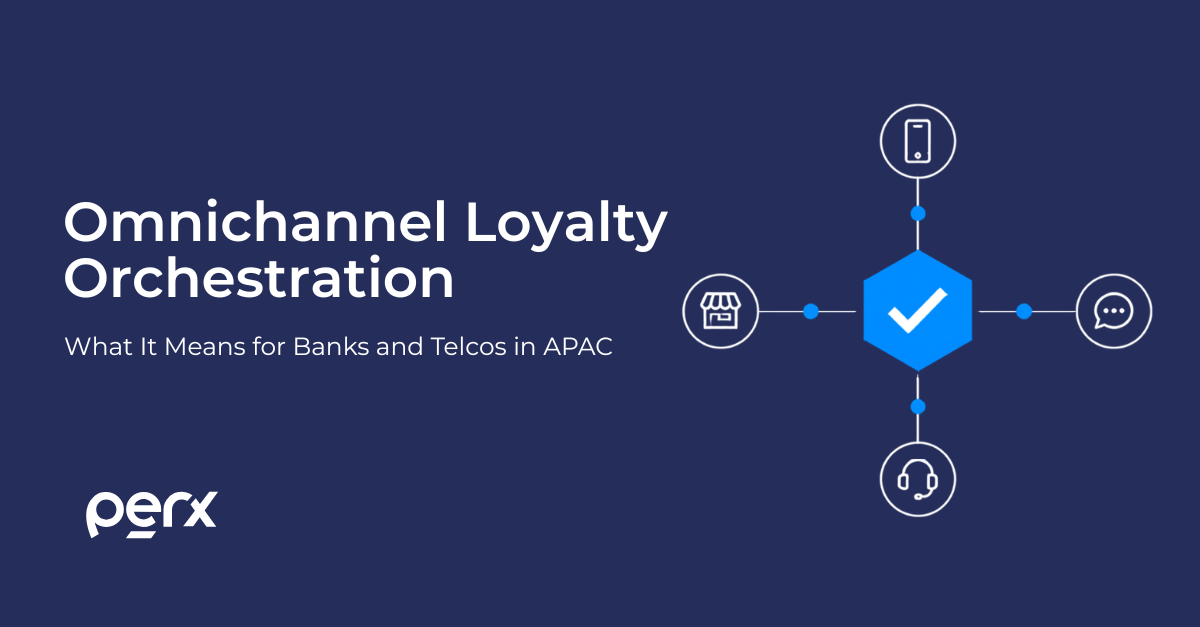
Omnichannel loyalty orchestration means firing the same behaviour-based reward logic across every channel a customer touches, mobile app, SMS, call centre, and branch, so no touchpoint runs its own disconnected program.
For BFSI and telco brands, this replaces fragmented, per-channel loyalty logic with one rules engine that triggers consistently everywhere a customer acts.
Perx’s deployment with Jenius (Bank BTPN, part of SMBC Indonesia) shows what this looks like in production: a single rules-based engine drove US$599 million in card spend and a 32x return on investment, with customer spend running 67% above Indonesia’s national average.
Omnichannel loyalty orchestration is the coordination of reward triggers, messaging, and journey logic across every channel a customer uses, so the experience reads as one continuous program rather than a set of separate promotions run by separate teams.
In most banks and telcos, loyalty logic still lives channel by channel. The mobile app team runs one set of campaigns. The call centre works from a different rulebook. Branch staff apply manual overrides. None of these three teams necessarily know what triggered a reward for the same customer somewhere else. Orchestration removes that fragmentation: one rules engine, one configuration layer, one behavioural record per customer, regardless of which channel the action happened on.
Across APAC, this matters now because customers expect consistent experiences whether they interact via app, web, branch or contact centre, while regulators and risk teams demand transparent, auditable decision-making in financial services.
Traditional loyalty programs are typically built around a static points catalogue configured separately for each channel. Every new channel means a new campaign build, a new IT ticket, and a new opportunity for the customer record to fall out of sync.
The practical difference shows up fastest in speed to launch and in whether a customer’s behaviour across channels is actually visible to the team running the program, rather than trapped in separate silos.
When the same rules engine sits behind every channel, a customer’s action anywhere becomes an immediate, attributable trigger everywhere. A mobile top-up, an SMS response, or a branch visit all map to the same behavioural logic instead of three disconnected reward systems.
In the Jenius deployment, this rules-based approach fired 13.4 million individual spend rule triggers over six months, activating 709,000 users onto the programme and achieving a 55% earn-to-burn ratio, meaning more than half of all rewards issued were actively redeemed rather than sitting unused as a growing liability on the balance sheet.
Perx’s orchestration layer is rules-based and behaviour-driven. Every trigger is tied to a defined customer action and a defined reward outcome, which means every decision the system makes is traceable back to a specific rule, not inferred by a model in ways that are difficult to explain to a risk or compliance team.
For example, a rule might state: “If a customer spends above a defined threshold on eligible card transactions in a month, unlock a tiered reward that is visible and redeemable across app, SMS and branch.” That rule is configured once, version-controlled, and can be formally reviewed and approved before going live.
That distinction matters most in regulated markets. A bank’s risk committee can review, audit and sign off on a rule. That auditability is precisely what the Jenius deployment was built on, and it is why the next phase of the platform is focused on extending this same rules-based foundation with a unified control layer for auditability across every channel and every deployment, not on replacing rules with autonomous decision-making
| Platform | Primary focus & BFSI relevance | Omnichannel / real-time capability & compliance posture |
|---|---|---|
| Perx | BFSI and telco behavioural loyalty, purpose-built for APAC | Rules-based cross-channel orchestration; ISO/IEC 27001:2013 and ISO 27018:2019 certified, with 2026 renewal of ISO/IEC 27001:2022 and ISO 27018:2019 publicly stated. |
| Antavo | Enterprise loyalty for retail, travel and financial services | API-based real-time data ingestion and unified customer profiles; financial-services use cases are publicly described. GDPR and UK GDPR support is documented; specific ISO certifications should be confirmed directly with the vendor. |
| Comarch | Telecom and retail loyalty suites, established enterprise vendor | Strong telco positioning; public materials describe rewards and offers across app, portal, SMS, call centre and in-store channels. Vendor references industry-grade security and certifications, but specific certificate names and scope should be confirmed directly. |
| Capillary Technologies | Retail-first CRM and loyalty engagement, APAC presence | BFSI use cases are publicly discussed, including banking loyalty programs. Native real-time cross-channel orchestration and BFSI-specific security certifications require direct vendor confirmation. |
| Loyalty Juggernaut (GRAVTY) | Enterprise loyalty platform across multiple industries | Explicit financial-services and telecommunications positioning. Publicly lists ISO/IEC 27001, ISO/IEC 27018, SOC 1 Type II, SOC 2 Type II, GDPR and ISO 22301-related credentials. |
| Open Loyalty | Open-source, API-first loyalty engine | Flexible, API-first engine suitable for custom BFSI deployments. ISO 27001 and ISO 9001 certifications are publicly stated, along with GDPR-related capabilities; BFSI-specific compliance configuration and native omnichannel orchestration depend on implementation. |
| Talon.One | Promotion and rules engine used across industries | Explicit financial-services use cases (banking, fintech, insurance) with real-time rules and loyalty transactions. ISO 27001:2022 certified, GDPR compliant and SOC 2 Type II attested. |
Notes:
It is the coordination of reward triggers and journey logic across every channel a customer uses, mobile app, SMS, call centre, and branch, so the program behaves as one system rather than separate, disconnected campaigns.

Praveen Vadla is Senior Digital Marketing Manager at Perx Technologies. With over 10 years of experience in B2B SaaS marketing across the US and Southeast Asia, he focuses on customer loyalty, engagement, and retention strategy. He writes on how brands build lasting customer relationships in a mobile-first economy. Connect with Praveen on LinkedIn.


Blogs

Blogs
Sustainability

Blogs
Blogs


Perx Technologies Pte Ltd
20A Tanjong Pagar Road
Singapore 088443
An ISO/IEC27001:2013 and ISO 27018:2019 compliant cloud solution

© 2026 Perx Technologies. All rights reserved.
© 2026 Perx Technologies. All rights reserved.
© 2026 Perx Technologies. All rights reserved.
Hey! Shashank