// new script 07 sept "

Praveen Vadla

Senior Digital Marketing Manager | September 24, 2026

How AI-Assisted Personalization Improves Loyalty Activation and Retention for Banks and Telcos

IN BRIEF

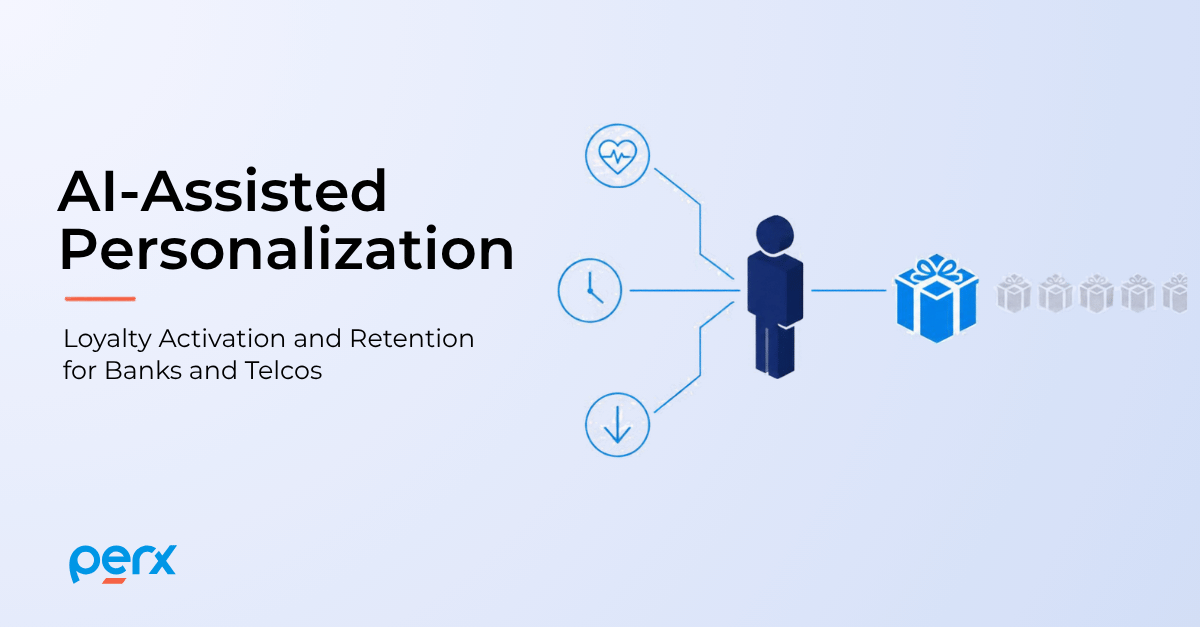
AI-assisted personalization uses predictive analytics to identify which reward, message, or journey step is most likely to move a specific customer’s behaviour, while the actual trigger and payout stay governed by defined, auditable rules.

For BFSI and telco brands, this pairs the speed of automation with the explainability regulators require, insight generation is AI-assisted, execution stays rules-based.

Perx’s Augmented Analytics module generates the propensity and dormancy signals that feed the same rules engine behind the Jenius deployment (US$599M in card spend, 32x ROI, 55% earn-to-burn ratio).

What Does AI-Assisted Personalization Mean in Loyalty Platforms?

AI-assisted personalization means using predictive models to generate a signal, which customer is likely to churn, which reward will move a specific behaviour, which channel a customer responds to, and then acting on that signal through a defined, auditable rule. The AI informs the decision. The rule executes it.

This is a different architecture from agentic AI, where a model makes and executes decisions autonomously. In regulated BFSI environments, that distinction is not academic. A risk committee can review and sign off on a rule. An autonomous model’s real-time decision is harder to explain after the fact, which is why Perx’s execution layer stays rules-based even as the signals feeding it become more sophisticated.

How Does AI-Powered Personalization Improve Customer Activation and Retention?

Propensity-informed targeting means a reward or message reaches a customer at the moment they are statistically most likely to respond, rather than on a fixed campaign schedule applied to every customer equally. Dormancy signals flag at-risk customers before they churn instead of after. Next-best-action modelling suggests which of several possible rewards is likely to convert for a specific customer segment.

In deployments that combine this signal layer with a rules-based execution backbone, banks have seen results such as those in Perx’s Jenius deployment (Bank BTPN, part of SMBC Indonesia): 709,000 activated users and a 55% earn-to-burn ratio over six months, evidence that a well-targeted, well-executed program gets used rather than accumulating unredeemed liability.

What Metrics Show AI-Driven Loyalty Programs Affect Revenue?

  • Activation rate: the share of enrolled customers who take a first qualifying action after signals identify them as a target.
  • Earn-to-burn ratio: the percentage of issued rewards actually redeemed. Perx’s Jenius deployment achieved 55%.
  • Return on investment: measured against program cost and attributed revenue lift. Perx’s Jenius deployment delivered 32x ROI.
  • Customer lifetime value and cost of acquisition: the two metrics a CFO will ask for before any loyalty modernisation budget is approved.

Any AI-driven loyalty metric that cannot be traced to one of these should be treated with scepticism, a model that improves click-through but not activation or ROI has not moved the number that matters.

Ways to Personalize Customer Journeys Using AI in Banking and Telecom

  • Dynamic reward selection: offering different reward types to different customers based on propensity signals, rather than one static catalogue for everyone.
  • Real-time timing optimization: triggering a message or reward at the moment a customer is most likely to act, instead of a fixed send time.
  • Tier progression pacing: adjusting how quickly a customer moves through loyalty tiers based on their individual engagement pattern.
  • Churn-risk intervention: flagging dormant or at-risk customers for a specific re-engagement rule before they lapse.

How Do AI-Powered Loyalty Platforms Personalize Offers Without Data Privacy Concerns?

The practical answer is architectural. Personalization can run on derived signals, propensity scores, dormancy flags, segment membership, rather than requiring raw personal data to leave a bank’s environment. Perx’s platform is built on ISO/IEC 27001:2013 and ISO 27018:2019 certified infrastructure today, and the next phase of the platform is focused on additional deployment modes for banks with strict data residency requirements, so institutions can choose how much data leaves their environment versus how much intelligence is processed on derived signals alone.

FAQs:

How does AI-powered loyalty improve customer activation and retention?
By using propensity and dormancy signals to target the right customer with the right reward at the right moment, then executing that decision through a defined rule. Perx’s Jenius deployment activated 709,000 users with a 55% earn-to-burn ratio using this approach.
Activation rate, earn-to-burn ratio, return on investment, and customer lifetime value against cost of acquisition. Perx’s Jenius deployment delivered a 32x ROI and 55% earn-to-burn ratio.
Dynamic reward selection, real-time timing optimization, tier progression pacing, and churn-risk intervention are the four most common applications in BFSI and telco loyalty programs.
By personalizing on derived signals, propensity scores and dormancy flags, rather than raw personal data, and by running on infrastructure certified to recognised information security and privacy standards.
AI-assisted personalization generates a signal that informs a decision; agentic AI would make and execute that decision autonomously. Perx’s execution layer stays rules-based so every action is auditable, which matters for BFSI risk and compliance review.
Evaluate two things separately: how sophisticated the predictive signal generation is, and whether reward execution stays auditable and rules-based. A platform can be strong on one and weak on the other.

Praveen Vadla

Praveen Vadla is Senior Digital Marketing Manager at Perx Technologies. With over 10 years of experience in B2B SaaS marketing across the US and Southeast Asia, he focuses on customer loyalty, engagement, and retention strategy. He writes on how brands build lasting customer relationships in a mobile-first economy. Connect with Praveen on LinkedIn.

Recommended for you

Loyalty Engagement Platform Built for the Mobile-first Economy
Privacy Overview

This website uses cookies so that we can provide you with the best user experience possible. Cookie information is stored in your browser and performs functions such as recognising you when you return to our website and helping our team to understand which sections of the website you find most interesting and useful.