
An ISO/IEC27001:2013 and ISO 27018:2019 certified cloud solution

IN BRIEF
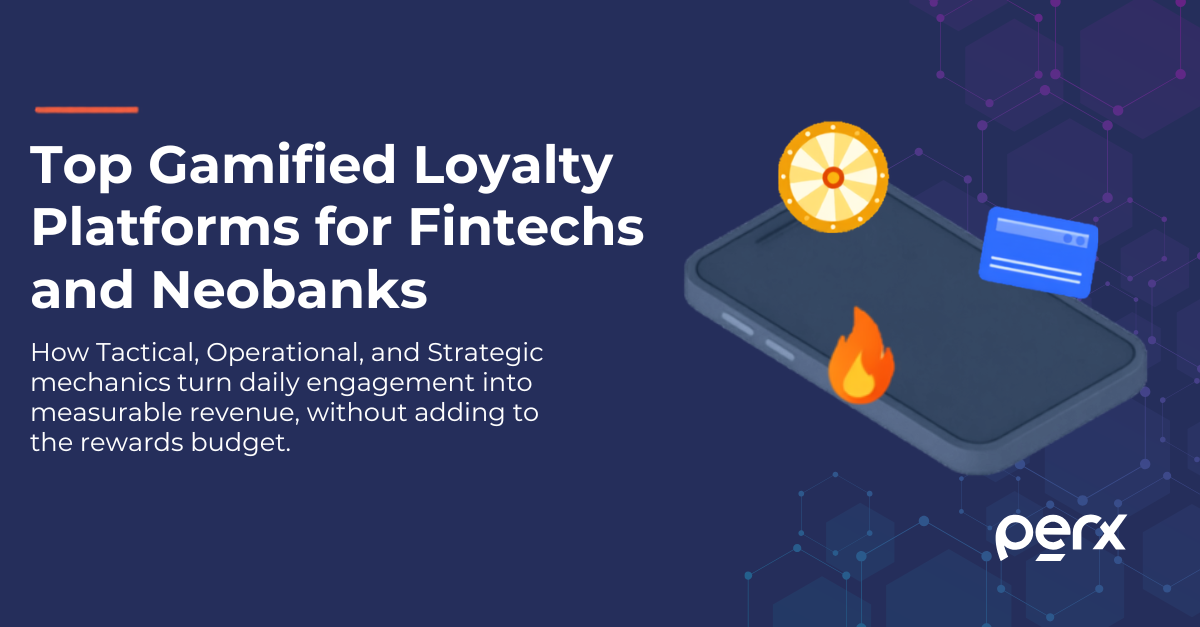
Cashback and promo cycles are the default retention tool for most digital-native financial brands, and they work, until the promotion ends. Every promo cycle costs money, and every quiet week between cycles shows up directly in the DAU number. For payments and wallet apps operating on tight margins, this is a cost structure problem, not a marketing inefficiency. Fintechs and neobanks that rely solely on cashback are effectively buying engagement rather than building it, and finance teams have started asking pointed questions about reward spend that does not translate into habit. The alternative is not a bigger discount. It is a mechanic that creates a reason to return that has nothing to do with a lower price: a streak that would be a shame to break, a quest that is one step from completion, or a spin that only costs something when a customer actually wins.
This dynamic shows up clearly in customer acquisition cost. One Singapore-based digital bank, which had already brought its customer acquisition cost down to $52 against a regional industry benchmark of $303, went further by shifting from a straightforward reward per referral to a hybrid stamp-and-raffle mechanic: customers earned a stamp, and a chance to win a single high-value prize such as a trip, for every successful referral and qualifying transaction. Because the mechanic pays out one large prize to a small number of winners rather than a fixed reward to every referrer, the bank’s cost per acquired customer fell to $9, a 33x reduction against the industry benchmark and a further 5x reduction against its own prior acquisition cost, while still generating 25,200 referrals and 32,000 new customers within 60 days. This is the core economic argument for chance-based mechanics over flat cashback: the anticipation of winning a single large reward can motivate the same referral behaviour as a guaranteed payout, at a fraction of the average cost per customer.
Not every gamification vendor is built for regulated financial services, and not every vendor covers all three mechanic types in one connected system. When evaluating a platform, the behaviour mechanics angle matters more than the size of the mechanic catalogue:
For a closer look at how each mechanic performs and when to use which, see Perx’s gamification ebook.
One APAC BNPL provider needed a way to bring dormant users back to the app without adding to the promo budget. Spin-the-Wheel is a Tactical mechanic built for exactly this: the anticipation of a spin creates a daily reason to open the app at a low marginal cost, since only some spins pay out. Once introduced, weekly active users rose 51%, with customers returning regularly to play and redeem. Because Tactical mechanics target immediate transaction frequency rather than long-term identity, they tend to be the fastest way for a fintech to show engagement ROI within one or two quarters.
| Fintech Use Case | Mechanic Layer | Example Mechanic | Business Outcome Targeted |
|---|---|---|---|
| BNPL app with dormant users | Tactical | Spin-the-Wheel, Cashback | Reactivate dormant users, lift weekly transaction frequency |
| Neobank onboarding and KYC | Operational | Quests, Progress Bars | Reduce sign-up-to-activation drop-off |
| Wallet or superapp competing on daily usage | Strategic | Streaks, Leaderboards, Status Tiers | Grow DAU/MAU ratio, build habitual daily opens |
| Cross-border payments or remittance | Tactical | Digital Stamp Cards | Build a repeat cross-border transaction habit |
| Digital lending or BNPL cross-sell | Operational | Quizzes, Milestone Quests | Drive product education ahead of a cross-sell conversation |
| Card or account activation campaigns | Tactical | Instant Win (Plinko, Bubble Pop) | Convert a first-time user into a repeat transactor quickly |
Most fintechs start with Tactical mechanics because they are the fastest to deploy against and the easiest to prove ROI on within a quarter. Neobanks with an onboarding drop-off problem tend to see more value starting with Operational mechanics, since KYC and profile completion are usually the single biggest point of customer loss. Strategic mechanics compound the value of the other two but take longer to show results, since identity and habit formation is a slower behavioural shift than a single transaction.
We cover this evaluation process in more depth in our guide, How to Choose a Loyalty Platform: An Enterprise Guide.
Every mechanic across all three layers generates a data trail: which customer responded, to which mechanic, how quickly, and what transaction resulted. On their own, these mechanics prove engagement. Connected across a customer base, that same data starts to answer a different question: which specific behaviours actually predict revenue, dormancy, or churn at an individual customer level, rather than at a campaign-wide average. This is the direction fintech engagement platforms are heading in as a category: linking behavioural data to revenue outcomes rather than reporting engagement in isolation. It is a natural fit for the next phase of the platform for any vendor already running Tactical, Operational, and Strategic mechanics at scale, since those mechanics are already generating the behavioural data that a more connected revenue view would depend on.

Praveen Vadla is Senior Digital Marketing Manager at Perx Technologies. With over 10 years of experience in B2B SaaS marketing across the US and Southeast Asia, he focuses on customer loyalty, engagement, and retention strategy. He writes on how brands build lasting customer relationships in a mobile-first economy. Connect with Praveen on LinkedIn.


Blogs

Blogs
Sustainability

Blogs
Blogs


Perx Technologies Pte Ltd
20A Tanjong Pagar Road
Singapore 088443
An ISO/IEC27001:2013 and ISO 27018:2019 compliant cloud solution

© 2026 Perx Technologies. All rights reserved.
© 2026 Perx Technologies. All rights reserved.
© 2026 Perx Technologies. All rights reserved.
Hey! Shashank