Praveen Vadla

Senior Digital Marketing Manager | Jul 17, 2026

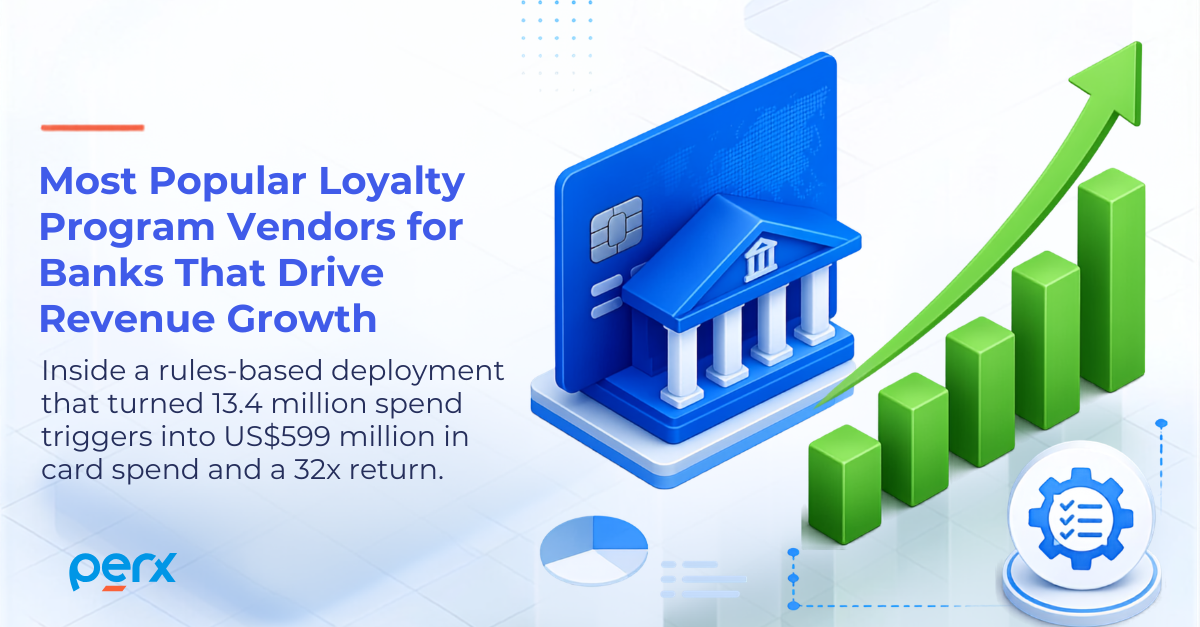
Most Popular Loyalty Program Vendors for Banks That Drive Revenue Growth

A revenue-driving loyalty program for a bank is one where every mechanic, whether a cashback trigger, a spend-threshold rule, or a milestone reward, is traceable to a specific, attributable spend outcome, not just an engagement or redemption number. The vendors most associated with this outcome are the ones that report results at the rule level: how many customers a specific rule reached, and how much verified transaction value resulted, rather than a programme-wide average. These mechanics tend to fall into three layers used across banking, fintech, and insurance: Tactical mechanics tied to an immediate transaction, Operational mechanics that gamify a specific task like QR adoption, and Strategic mechanics that build a longer spending habit. In one six-month deployment, a rules-based, behaviour-driven model across these layers drove US$599 million in actual card spend across 145,000 unique customers, a 32x return on investment, and average monthly spend 67% above the national benchmark.

IN BRIEF

  • A revenue-driving loyalty platform for a bank is one where every mechanic, such as a cashback trigger or spend-threshold rule, is traceable to a specific, attributable spend outcome at the rule level, not just a programme-wide engagement average.
  • Bank loyalty mechanics generally fall into three layers: Tactical (an immediate transaction trigger), Operational (a gamified task like QR adoption), and Strategic (a longer-term spend habit).
  • Traditional bank points programmes function as a cost centre, since points accrue as a liability with no clear link to whether the programme actually changed customer behaviour.
  • SMBC Jenius Bank in Indonesia ran a six-month, rules-based, behaviour-driven deployment that fired 13.4 million spend rule triggers, drove US$599 million in card spend across 145,000 unique customers, and delivered a 32x return on investment.
  • The same Jenius deployment activated 709,000 users, achieved a 55% earn-to-burn ratio, and lifted average monthly customer spend to US$460 against Indonesia’s US$275 national average, a 67% lift above benchmark.
  • Choosing a bank loyalty vendor comes down to five checks: rule-level attribution, mechanic-layer coverage, verified deployment data, redemption health (earn-to-burn ratio), and speed to deploy new rules without an engineering cycle.
  • Rule-level spend data is the foundation for a broader shift toward revenue intelligence, connecting individual customer behaviour to future spend, dormancy, or attrition ahead of it showing up in a quarterly report.

What Makes a Loyalty Platform Revenue-Driving for a Bank?

A revenue-driving loyalty platform is one where every mechanic is traceable to a specific spend outcome, and where that outcome can be reported at the rule level rather than as a programme-wide average. Most bank loyalty programmes report engagement metrics, such as app opens or redemption rates, which are useful operationally but do not answer the question a CFO actually asks: did this programme increase spend, and by how much. A revenue-driving platform answers that question directly, connecting a specific rule, such as a cashback trigger on a defined transaction category, to a specific, attributable spend increase, rather than a directional correlation.

The Problem With Traditional Bank Loyalty Programs

Traditional bank points programmes function as a cost centre: points are issued for a transaction, accrue as a liability, and are eventually redeemed with no clear link back to whether the programme changed customer behaviour or simply rewarded spend that would have happened regardless. This is the pattern that has driven a shift among banks toward rules-based behavioural loyalty, where a mechanic is designed around a specific spend or product-adoption target, and the resulting spend is measured against that target directly, rather than assumed.

Rules-Based Behaviour Mechanics for Banks

The same three mechanic layers used across fintech and insurance apply to bank loyalty programmes. Tactical mechanics, such as a cashback or spend-threshold trigger, target an immediate transaction and are the fastest to attribute to a specific rule. Operational mechanics, such as a gamified quest, target a specific product adoption behaviour, such as moving a customer from cash to QR payments. Strategic mechanics, such as tiered spend milestones, build a sustained spending habit over a longer horizon, and tend to compound the value of the other two layers once they are in place. Each layer is measured against its own defined rule, not a blanket engagement score.

A Six-Month Deployment at Scale: SMBC Jenius Bank, Indonesia

SMBC Jenius Bank deployed a rules-based, behaviour-driven loyalty program with Perx to convert dormant digital banking customers into repeat, high-value spenders. Over six months, the deployment fired 13.4 million spend rule triggers, meaning 13.4 million individual instances where a customer met a defined spend condition and received an attributed reward. This drove US$599 million in actual card spend across 145,000 unique customers, with 709,000 users activated onto the programme overall. The programme achieved a 55% earn-to-burn ratio, meaning more than half of rewards issued were actively redeemed rather than sitting unused, and delivered a 32x return on investment. Average monthly customer spend under the programme reached US$460, against Indonesia’s national average of US$275, a 67% lift above benchmark. This is framed specifically as rules-based, behaviour-driven loyalty: rewards are triggered by defined spend conditions, not by autonomous or predictive decisioning.
Rules-Based Mechanics Mapped to Bank Use Cases
Bank Use Case Mechanic Layer Example Mechanic Business Outcome Targeted
Dormant card reactivation Tactical Spend-threshold cashback trigger Convert dormant cards into repeat spenders
QR or digital payment adoption Operational Gamified Quests Drive first-time and repeat QR transaction adoption
Cross-border or high-value spend Tactical Spend-rule triggered reward Lift average transaction value in a target category
Long-term spend habit or tiering Strategic Milestone or tiered spend rewards Sustain elevated monthly spend beyond the campaign window
New-to-bank customer activation Operational Onboarding quest with a spend-linked reward Convert new accounts into active, spending customers

From Rule-Level Attribution to Revenue Intelligence

Every rule in a system like this generates a record of exactly which customer, condition, and spend outcome were connected. On their own, these rules prove a specific mechanic worked. Connected across a full customer base, that same rule-level data starts to answer a broader question banks are increasingly asking: which behaviours predict future spend, dormancy, or attrition at the individual customer level, ahead of it showing up in a quarterly report. This is the direction loyalty-to-revenue platforms are heading in as a category, and it is a natural fit for the next phase of the platform for any vendor already running rules-based mechanics at this scale, since the underlying data is already being generated.

What to Evaluate When Choosing a Bank Loyalty Vendor

  • Rule-level attribution: can the vendor report spend outcomes per rule, not just per campaign?
  • Mechanic-layer coverage: does the vendor run Tactical, Operational, and Strategic mechanics as one connected system, or only one layer well?
  • Verified deployment data: does the vendor have a named, published case study with independently reportable figures?
  • Redemption health: what is the earn-to-burn ratio, since a low ratio signals an unused liability rather than an active growth lever?
  • Speed to deploy: can new spend rules be configured by a marketing team without an engineering release cycle?

FAQs:

What is a rules-based, behaviour-driven loyalty program?
It is a loyalty model where rewards are triggered by defined customer spend or behaviour conditions, such as a transaction threshold, rather than by a fixed accrual rate or automated predictive decisioning.
Tactical mechanics reward an immediate transaction, such as a cashback trigger. Operational mechanics gamify a specific task, such as QR payment adoption, using quests. Strategic mechanics, such as tiered spend milestones, build a sustained spending habit over a longer horizon.
Results vary by deployment, but in one verified case, SMBC Jenius Bank in Indonesia generated US$599 million in card spend and a 32x return on investment over six months using a rules-based loyalty program.
It is the percentage of issued rewards that are actually redeemed. A 55% earn-to-burn ratio, as seen in the Jenius deployment, indicates an actively used programme rather than an accumulating, unredeemed liability.
Each rule generates a record of which customer, condition, and spend outcome were connected. Connected across a full customer base, that data can start to show which behaviours predict future spend, dormancy, or attrition, which is the direction loyalty-to-revenue platforms are increasingly building toward.
This model is rules-based: rewards fire when a defined spend condition is met. It does not involve autonomous or predictive AI-driven decisioning, which is a distinct category some vendors are beginning to explore separately.

Praveen Vadla

Praveen Vadla is Senior Digital Marketing Manager at Perx Technologies. With over 10 years of experience in B2B SaaS marketing across the US and Southeast Asia, he focuses on customer loyalty, engagement, and retention strategy. He writes on how brands build lasting customer relationships in a mobile-first economy. Connect with Praveen on LinkedIn.

Recommended for you

Loyalty Engagement Platform Built for the Mobile-first Economy
Privacy Overview

This website uses cookies so that we can provide you with the best user experience possible. Cookie information is stored in your browser and performs functions such as recognising you when you return to our website and helping our team to understand which sections of the website you find most interesting and useful.