

An ISO/IEC27001:2013 and ISO 27018:2019 certified cloud solution

IN BRIEF
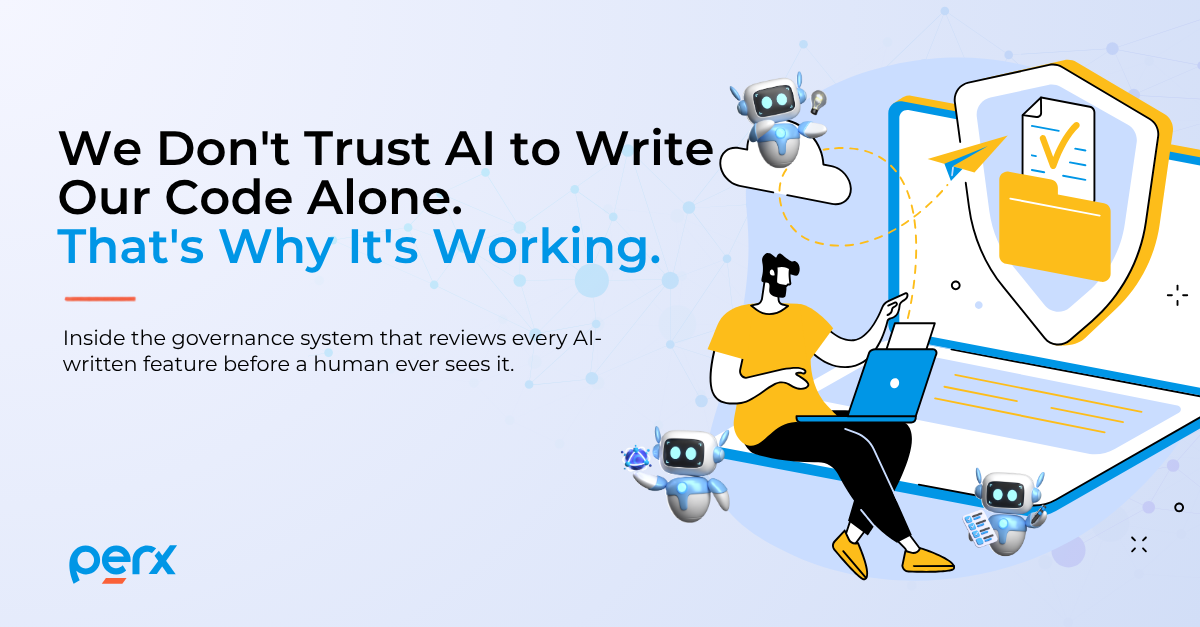
I lead the Performance & Scale Team at Perx Technologies, and one question comes up in almost every technical due-diligence call we sit through: how much do you actually trust the AI writing your code?
A year and a half ago, if you’d asked how much we trusted AI to write our code, I’d have said: not much. Ask me today, and I’ll give you the same answer. What changed isn’t how much we trust the AI. It’s that we stopped needing to. We built a system that checks its work for us, every time, before it ever reaches production.
That’s the part most companies leave out of their AI story. Everyone wants to tell you how much faster they are now. Almost nobody wants to tell you what they had to build first to make that speed safe.
Not automatically, and the industry’s own numbers say so.
McKinsey’s original research on AI coding tools found real gains: documentation time cut nearly in half, and new code written in close to the same margin, though the gains shrank to single digits on the hardest, most complex tasks. A follow-up study of more than 600 organisations found most teams landing around a 25 percent productivity improvement, and only the teams at near-full adoption clearing 100 percent. Useful, but a long way from the ten-times figures that show up in vendor decks.
A 2026 benchmark spanning more than 250,000 developers across over 60 enterprises found something sharper: pull requests built with AI assistance were sitting in review queues 4.6 times longer than ones written by hand, and shipping with 15 to 18 percent more security vulnerabilities. Teams were producing more code and trusting it less.
That’s the gap we didn’t want to fall into. We weren’t interested in being another company that talks about the upside and hopes nobody asks about the downside. So before we let AI touch anything that mattered, we built the downside protection first.
Here’s the rule everything else follows from: no AI system grades its own work. Every layer below exists to enforce that one rule.
None of this exists for our comfort. It exists so that when a client’s technical due-diligence team asks how we build software, the honest answer is a system built the way a regulated institution would build it themselves.
We measure two specific stages of our delivery pipeline. Time-to-QA is the average time between a feature being marked ready and entering formal testing. Time-to-market is the average time between QA sign-off and release. Comparing our current pipeline to our own pre-AI baseline:
The clearest proof of what this system actually does showed up almost by accident. One of our engineers took on a project in Go, a language they had never written a single line of before. Normally that’s a multi-month ramp-up before someone touches production. Instead, the same review layers that catch a senior engineer’s mistakes caught a first-timer’s too, and caught them fast enough that the work shipped anyway: a production-grade service now handling 4,000 requests per second on a single server instance. The point was never that Go got easier. It’s that the guardrails don’t care how many years of experience wrote the code. They check the work, not the resume.
A lot of companies are currently buying an AI coding assistant and calling it their AI strategy. We took a different route. We built our own internal AI development platform, nicknamed Copperfield, shaped around how our team actually works, not around a generic workflow someone else designed.
Copperfield connects into the systems we already rely on, rather than sitting apart from them:
That’s the difference between using AI and building with it. Buying a coding assistant is a subscription decision. Building your own platform, integrated into your own systems and shaped around your own team, is an investment that keeps paying out.
We didn’t bolt AI onto an ageing stack and call it a transformation. Underneath the pipeline, we spent the same period bringing our core infrastructure fully current, and we did it without a single client noticing. That silence is the whole point.
None of this shows up in a product demo. But it’s exactly what a technical due-diligence team is trained to look for before recommending a multi-year infrastructure decision: current, supported software, fixes that ship fast, and AI-assisted development treated as something to be governed, not just adopted.
When we tell a client that a feature will ship within a sprint, this is the machinery that makes that a promise we can actually keep, not a hope.


Blogs

Blogs
Sustainability

Blogs
Blogs


Perx Technologies Pte Ltd
20A Tanjong Pagar Road
Singapore 088443
An ISO/IEC27001:2013 and ISO 27018:2019 compliant cloud solution

© 2026 Perx Technologies. All rights reserved.
© 2026 Perx Technologies. All rights reserved.
© 2026 Perx Technologies. All rights reserved.
Hey! Shashank