Praveen Vadla

Senior Digital Marketing Manager | August 03, 2026

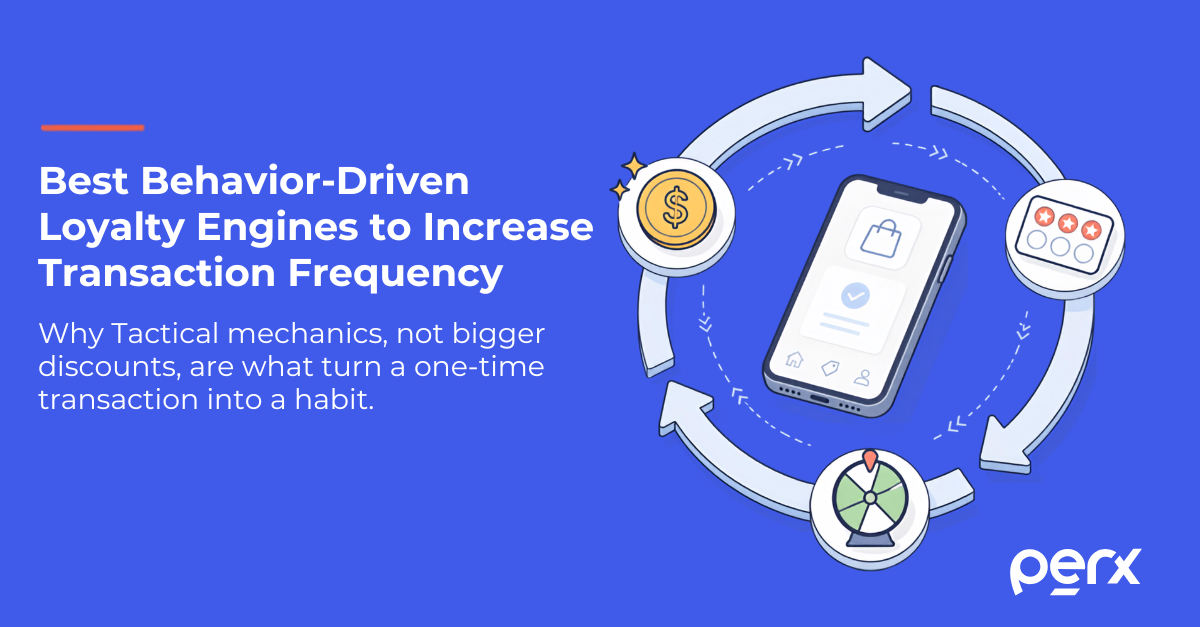
Best Behavior-Driven Loyalty Engines to Increase Transaction Frequency

A behavior-driven loyalty engine is a system that triggers rewards based on a specific customer action or spend condition, built around a target behaviour, such as increased transaction frequency, rather than simply rewarding whatever a customer happens to do.

These reward mechanics are generally categorised into three – Tactical, operational, and strategic. For increasing transaction frequency specifically, the strongest engines lean on Tactical mechanics, meaning mechanics that reward a customer at the moment the wallet opens, rather than mechanics designed for long-term identity or status.

Cashback, digital stamp cards, spin-the-wheel rewards, and instant-win mechanics all fall into this category, and each maps to a specific psychological driver, such as instant gratification or variable reward anticipation, that determines how quickly it can move a frequency metric.
Cashback, digital stamp cards, spin-the-wheel rewards, and instant-win mechanics all fall into this category, and each maps to a specific psychological driver, such as instant gratification or variable reward anticipation, that determines how quickly it can move a frequency metric. In one deployment, a leading Singapore telco used daily Spin-the-Wheel mechanics to grow its monthly active users by 190% and sustain a 70% average active user rate, with 85% of its 1.12 million players returning repeatedly across six months. Separately, a Singapore digital bank used Tactical stamp card mechanics to generate $1.5 million in attributable forex transactions..

IN BRIEF

  • A behavior-driven loyalty engine triggers rewards based on a specific customer action or spend condition, built around a target behaviour like transaction frequency, rather than simply rewarding whatever a customer happens to do.
  • Reward mechanics split into three types, Tactical, Operational, and Strategic, with Tactical mechanics doing most of the work when frequency is the specific target.
  • Transaction frequency is a stronger leading indicator of lifetime value than a single large transaction, since it compounds into cross-sell opportunities, product stickiness, and reduced churn risk.
  • Five Tactical mechanics drive frequency: Cashback, Digital Stamp Cards, Spin-the-Wheel, Instant Win, and Raffles, each mapped to a specific psychological driver such as instant gratification or variable reward anticipation.
  • A leading Singapore telco’s daily Spin-the-Wheel mechanic grew monthly active users by 190% with 85% repeat engagement across 1.12 million players, and a Singapore digital bank’s Stamp Card mechanic generated $1.5 million in attributable forex transactions.
  • A Southeast Asian microfinance network with more than 3,500 branches used Tactical raffle campaigns to mobilise ₱27.9 billion in net deposits and generate S$10.3 million in net lending profits at a 32x return.
  • Frequency-level mechanic data is the foundation for revenue intelligence, showing which mechanics and customer segments produce a durable habit versus a short-lived response to a promotion.

What Is a Behavior-Driven Loyalty Engine?

The distinction from a traditional loyalty programme is the direction of design: a traditional programme rewards what already happened; a behavior-driven engine is built around a target behaviour first, such as a second transaction within a set period, and the reward mechanic is engineered specifically to produce that outcome. These engines generally work across three mechanic types: Tactical mechanics for immediate transactions, Operational mechanics for gamifying a specific task, and Strategic mechanics for longer-term habit, with Tactical mechanics doing most of the work when frequency is the specific target.

Why Transaction Frequency Is the Metric That Matters

Transaction frequency is a leading indicator of lifetime value in a way that a single large transaction is not. A customer who transacts once a month is worth more over time than one who transacts once a quarter, even at similar per-transaction spend, because frequency compounds into cross-sell opportunities, product stickiness, and reduced churn risk. This is why banks and fintechs increasingly measure loyalty programme success against a frequency target specifically, rather than a general engagement or satisfaction score.

Tactical Mechanics That Drive Frequency

  • Cashback: real-time value returned on a specific transaction type, removing price sensitivity at the moment of sale.
  • Digital Stamp Cards: turns a single transaction into a committed, multi-visit mission, using the Endowed Progress Effect to increase completion likelihood.
  • Spin-the-Wheel: a variable-reward mechanic that gives customers a daily reason to open the app, at a low marginal reward cost since not every spin pays out.
  • Instant Win (Plinko, Bubble Pop, and similar mechanics): a low-cost, high-frequency re-engagement mechanic, particularly effective for reactivating dormant users.

How to Evaluate a Behavior-Driven Loyalty Engine, Through a Behaviour Mechanics Lens

  • Does the engine map each mechanic to a specific behavioural principle, or is it a generic points multiplier?
  • Does it cover Tactical mechanics for immediate frequency, with a path into Operational and Strategic mechanics once frequency improves?
  • Can the vendor report frequency lift attributable to a specific mechanic, not just overall engagement?
  • Does the deployment have a verified, named case study behind the reported numbers?
  • Is the mechanic deployable on a marketing team’s own timeline, so frequency-driving campaigns are not gated by an engineering release cycle?

Tactical Mechanics at Scale: QR Adoption and Cross-Border Spend Habits

One Southeast Asian microfinance network, with more than 3,500 branches and 20 million customers, used Tactical raffle campaigns to turn single-product branch visits into repeat, multi-revenue engagements. Across nine campaigns run over the course of a year, the network issued 47 million raffle tickets, targeted 709,000 spending users, and mobilised ₱27.9B in net deposits, generating S$10.3 million in net lending profits against a S$324,000 subscription cost, a 32x return achieved across just 20% of the year’s calendar days.

Because a raffle pays out one prize to a small number of winners rather than a reward to every participant, the mechanic drove this frequency and deposit lift at a reward cost held below 0.02% of deposits across most campaigns. Separately, a Singapore-based digital bank used Tactical Stamp Card mechanics to build a cross-border spending habit, generating $1.5 million in forex transactions directly attributable to the mechanic, with the spending pattern persisting beyond the campaign window, the signal that the behaviour became a habit rather than a short-term response to a promotion.

Behaviour Mechanics Mapped to Frequency Use Cases

Frequency Goal Mechanic Layer Example Mechanic Business Outcome Targeted
Reactivate a dormant wallet or account Tactical Spin-the-Wheel, Instant Win Bring a dormant customer back to a first new transaction
Drive QR or digital payment adoption Operational Gamified Quests Shift customers from cash or card to digital rails
Build a cross-border or overseas spend habit Tactical Digital Stamp Cards Turn a single overseas transaction into a repeat habit
Increase everyday transaction frequency Tactical Cashback triggers Lift weekly or monthly transaction count
Sustain frequency beyond the campaign window Strategic Streaks, tiered milestones Convert a short-term lift into a lasting habit

From Frequency Signals to Revenue Intelligence

Every Tactical mechanic generates a record of which customer transacted, how often, and in response to which trigger. On their own, these records prove a frequency lift. Connected across a full customer base, that same data starts to answer a broader question: which specific mechanics and customer segments are the earliest indicators of a durable spending habit versus a short-lived response to a promotion. This is the direction behavior-driven engagement platforms are heading in as a category, and it is a natural fit for the next phase of the platform for any vendor already running Tactical mechanics at scale, since the frequency data is already being generated.

FAQs:

What is a behavior-driven loyalty engine?
It is a system that triggers rewards based on specific customer actions or spend conditions, designed around a target behaviour, such as increased transaction frequency, rather than simply rewarding whatever a customer happens to do.
Tactical mechanics such as Cashback, Digital Stamp Cards, Spin-the-Wheel, and Instant Win games are designed specifically to reward the moment a customer transacts, making them the fastest mechanics for moving a frequency metric.
At SMBC Jenius Bank, Operational mechanics drove 81,600 QR payment adoption actions within a deployment that generated US$599 million in transaction value over six months. A Singapore digital bank generated $1.5 million in attributable forex transactions using Stamp Card mechanics.

Tactical mechanics typically show measurable frequency lift within weeks of deployment, since they are designed to influence the next transaction rather than build long-term identity or status, which takes longer to materialize.

Each mechanic generates a record of which customer transacted, how often, and in response to which trigger. Connected across a customer base, that data can begin to show which mechanics and segments produce a durable habit versus a short-lived response, which is the direction engagement platforms are increasingly building toward.

Praveen Vadla

Praveen Vadla is Senior Digital Marketing Manager at Perx Technologies. With over 10 years of experience in B2B SaaS marketing across the US and Southeast Asia, he focuses on customer loyalty, engagement, and retention strategy. He writes on how brands build lasting customer relationships in a mobile-first economy. Connect with Praveen on LinkedIn.

Recommended for you

Loyalty Engagement Platform Built for the Mobile-first Economy
Privacy Overview

This website uses cookies so that we can provide you with the best user experience possible. Cookie information is stored in your browser and performs functions such as recognising you when you return to our website and helping our team to understand which sections of the website you find most interesting and useful.